

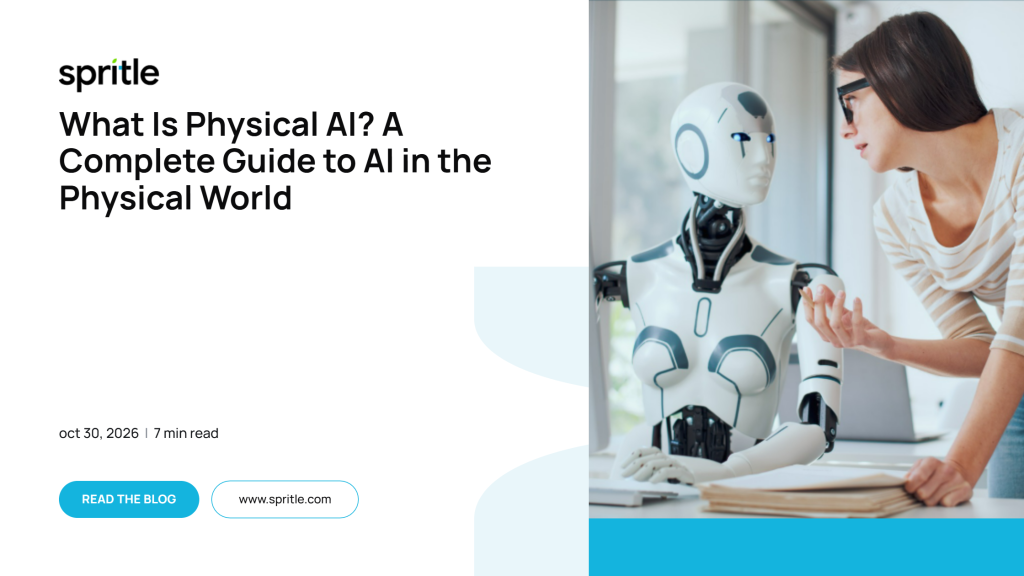
AI has become very good at working with information.
It can write text, analyze documents, generate images, answer questions and help software make decisions.
But the physical world is different.
A warehouse doesn’t exist as a spreadsheet. A machine doesn’t exist as a database record. A delivery vehicle has to navigate an actual road. A robot has to understand where objects are, react to unexpected movement and perform an action without breaking something.
This creates a different challenge for artificial intelligence:
How do you build AI that can perceive, understand and act in the physical world?
That is where Physical AI comes in.
Physical AI connects AI models with sensors, machines, robotics, edge computing and real-world environments so intelligent systems can perceive their surroundings, make decisions and take physical actions.
What Is Physical AI?
Physical AI is the use of artificial intelligence in systems that can perceive, reason about and interact with the physical world.
Unlike software-only AI, a Physical AI system receives information from its physical environment and can respond through some form of physical or operational action.
A simple model is:
Sense → Understand → Decide → Act → Learn
For example:
Camera + Sensors
↓
AI perceives the environment
↓
AI understands what is happening
↓
AI decides what should happen next
↓
Robot / Machine / Vehicle acts
↓
Feedback is collected
↓
The system adapts or improves
This is why Physical AI is closely associated with robotics, autonomous systems, industrial automation, smart machines and embodied AI.
How Is Physical AI Different From Digital AI?
The biggest difference is the environment in which the AI operates.
Digital AI primarily works with digital information.
Physical AI works with information coming from the physical world and can influence that physical environment.
For example:
A generative AI system can create a maintenance report.
A Physical AI system can potentially:
Detect machine vibration → identify an abnormal condition → decide that inspection is required → trigger an operational response.
| Digital AI | Physical AI |
| Works primarily with digital information | Interacts with physical environments |
| Text, images, documents and software | Sensors, cameras, machines and physical surroundings |
| Produces digital outputs | Can produce physical or operational actions |
| Usually operates in software | Operates across software and hardware |
| Examples: LLMs, recommendation systems | Examples: robots, autonomous systems, intelligent machines |
| Environment is relatively predictable | Environment can be dynamic and unpredictable |
The distinction is not absolute.
Physical AI systems often contain digital AI components.
The difference is that Physical AI connects intelligence to real-world perception and action.
Is Physical AI the Same as Robotics?
Not exactly.
Robotics is the engineering discipline concerned with designing, building and operating robots.
Physical AI focuses on the intelligence that allows systems to perceive environments, make decisions and act within them.
A robot can operate using predefined rules without sophisticated AI.
Likewise, Physical AI doesn’t have to mean a humanoid robot.
It can exist in:
- Industrial machines
- Autonomous vehicles
- Drones
- Warehouse systems
- Smart manufacturing equipment
- Inspection systems
- Agricultural machines
- Intelligent mobile platforms
A useful way to think about the relationship is:
Robotics provides the physical system. Physical AI provides intelligence that helps the system understand and respond to its environment.
Physical AI vs Embodied AI
The terms Physical AI and Embodied AI are also closely related.
Embodied AI generally refers to intelligence that exists within an embodied agent capable of perceiving and interacting with its environment.
Physical AI is often used more broadly to describe AI systems operating in physical environments.
In practice, there is substantial overlap.
You can think of:
Embodied AI → intelligence situated in an agent
Physical AI → AI applied to perception, decision-making and interaction in physical environments
Both concepts move AI beyond simply processing digital information.
What Makes a Physical AI System?
A production-ready Physical AI system typically combines several layers.
1. Sensors
The system needs information about the environment.
Examples include:
- Cameras
- LiDAR
- Radar
- Microphones
- Temperature sensors
- Pressure sensors
- Proximity sensors
- Motion sensors
↓
2. Perception
AI processes sensor information to understand what is happening.
For example:
Camera → Object detected
LiDAR → Obstacle identified
Temperature sensor → Abnormal temperature
↓
3. AI Models
Models interpret the information and support decisions.
These may include:
- Computer vision models
- Machine learning models
- Multimodal AI
- Language models
- Predictive models
↓
4. Decision Layer
The system determines what should happen next.
Continue → Stop → Move → Inspect → Alert → Re-route
↓
5. Actuation
The decision becomes an action.
Examples:
Motor → Robotic arm → Vehicle → Machine → Control system
↓
6. Feedback
The system observes the result.
Action → New sensor data → Updated understanding → Next decision
This feedback loop is fundamental to Physical AI systems.
How Does Physical AI Work?
Imagine an autonomous warehouse vehicle moving through a facility.
The vehicle needs to understand:
- Where it is
- Where obstacles are
- Where people are
- Where other vehicles are
- Where it needs to go
- What route is safe
A simplified workflow could look like:
STEP 1 — Sense
Cameras, LiDAR and other sensors collect environmental information.
↓
STEP 2 — Perceive
AI identifies:
People → Shelves → Vehicles → Obstacles → Pathways
↓
STEP 3 — Understand
The system builds an understanding of the current environment.
↓
STEP 4 — Plan
The AI determines an appropriate action or route.
↓
STEP 5 — Act
The vehicle moves.
↓
STEP 6 — Reassess
Sensors continuously provide new information.
If an obstacle appears:
New information → New decision → New action
This makes Physical AI fundamentally different from a static software workflow.
The environment can change while the system is operating.
The Core Technologies Behind Physical AI
Physical AI isn’t powered by a single technology.
It is an ecosystem.
Computer Vision
Computer vision allows systems to interpret visual information.
It can support:
- Object detection
- Image classification
- Scene understanding
- Visual inspection
- Tracking
Sensors
Sensors provide information that cameras alone may not capture.
Examples include:
LiDAR → Distance and spatial information
Radar → Object detection and movement
Temperature → Thermal conditions
Pressure → Physical state
Motion sensors → Movement
The combination of multiple sensor types is often called sensor fusion.
AI Models
AI models transform sensor information into useful predictions or decisions.
Depending on the application, systems may use:
- Deep learning
- Reinforcement learning
- Computer vision models
- Multimodal models
- Predictive models
- Large language models
Edge Computing
Many Physical AI applications cannot depend entirely on remote cloud processing.
A machine may need to react within milliseconds.
Sensor → Edge device → AI inference → Action
This can reduce latency and support environments where network connectivity is limited.
Robotics and Actuation
The physical system needs a mechanism to execute decisions.
Examples:
Robotic arms
Autonomous vehicles
Drones
Industrial machines
Mobile robots
The intelligence becomes useful only when it can connect to an action.
Physical AI vs Generative AI
Generative AI has transformed how machines work with information.
It can generate:
- Text
- Images
- Code
- Audio
- Video
Physical AI adds another dimension:
Interaction with the physical environment.
| Generative AI | Physical AI |
| Generates digital content | Interacts with physical environments |
| Primarily software-based | Software + hardware |
| Works with digital inputs | Uses physical-world sensor inputs |
| Output is usually digital | Output can involve physical action |
| Example: text generation | Example: autonomous navigation |
| Environment may be static | Environment can change continuously |
However, they can work together.
For example, a Physical AI system could use a multimodal or generative AI model to interpret instructions while another model handles real-time perception and control.
This creates a powerful combination:
Generative Intelligence + Physical Interaction
Where Is Physical AI Used?
The potential applications of Physical AI systems extend across many industries.
Manufacturing
Physical AI can support:
- Intelligent robots
- Automated inspection
- Predictive maintenance
- Machine monitoring
- Adaptive production
- Worker safety
For example:
Machine sensors → AI detects abnormal behavior → Maintenance workflow triggered
Warehousing and Logistics
Applications can include:
- Autonomous mobile robots
- Intelligent picking
- Navigation
- Package handling
- Warehouse optimization
A system can combine:
Computer Vision + Sensors + Navigation + AI Decision-Making
to operate in dynamic warehouse environments.
Automotive
Physical AI plays a major role in intelligent vehicles.
Systems may use:
Cameras + Radar + LiDAR + AI Models + Navigation
to perceive surroundings and support driving decisions.
Healthcare
Physical AI can support areas such as:
- Robotic assistance
- Hospital logistics
- Intelligent equipment
- Automated inspection
- Rehabilitation systems
Healthcare applications require appropriate safety, validation and regulatory controls.
Agriculture
AI-powered machines can potentially support:
- Crop monitoring
- Precision agriculture
- Automated harvesting
- Weed detection
- Equipment navigation
The combination of sensors, vision and AI allows machines to respond to changing field conditions.
Construction
Potential applications include:
- Site monitoring
- Equipment tracking
- Safety monitoring
- Autonomous machinery
- Progress analysis
A Real-World Example: Physical AI in Manufacturing
Consider a manufacturing facility where a robotic system needs to move components between workstations.
A traditional automation system might follow a predefined sequence:
Move → Stop → Pick → Move → Place
This works when the environment remains predictable.
But what happens when:
- A component is misplaced?
- A person enters the area?
- An obstacle blocks the route?
- Lighting conditions change?
- A machine behaves unexpectedly?
A Physical AI system can introduce perception and adaptive decision-making.
The workflow becomes:
Sensors
↓
Environment Perception
↓
Object + Obstacle Detection
↓
Situation Understanding
↓
Path / Action Planning
↓
Robot Action
↓
Feedback
↓
Reassessment
The machine is no longer simply executing a fixed sequence.
It is responding to its environment.
What Are the Benefits of Physical AI?
The value of Physical AI goes beyond automation.
Greater Operational Autonomy
Systems can perform tasks with less continuous human intervention.
Real-Time Decision-Making
AI can process sensor information and respond to changing conditions.
Improved Productivity
Machines can operate continuously and support repetitive physical workflows.
Better Safety
Physical AI can monitor environments and identify potentially dangerous situations.
Adaptive Operations
AI systems can respond to changing physical conditions rather than relying entirely on fixed rules.
Scalable Automation
Organizations can potentially deploy intelligent systems across multiple operational environments.
Data-Driven Physical Operations
Sensor data can provide new visibility into machines, processes and environments.
But these benefits depend on the quality of the AI models, sensors, infrastructure, integration and safety mechanisms supporting the system.
What Are the Challenges of Physical AI?
Physical AI is significantly harder than deploying a software-only AI application.
Why?
Because mistakes happen in the real world.
1. Safety
A software error might produce an incorrect answer.
A physical-system error could damage equipment or injure someone.
Safety therefore needs to be designed into the system.
2. Real-World Variability
Physical environments are unpredictable.
Lighting changes.
Objects move.
People behave unexpectedly.
Weather changes.
Machines wear down.
AI must operate despite this variability.
3. Sensor Reliability
Sensors can produce:
- Noise
- Missing data
- Incorrect measurements
- Occlusion
- Hardware failures
Physical AI systems need mechanisms to handle these conditions.
4. Latency
Some decisions cannot wait for a round trip to a remote cloud.
This makes edge computing important for many applications.
5. Model Reliability
AI models can make incorrect predictions.
Physical AI therefore needs:
Validation → Monitoring → Fail-safes → Human oversight
6. Hardware Integration
AI software must interact with real hardware.
That introduces engineering challenges involving:
Robotics → Embedded systems → Sensors → Actuators → Networks → Control systems
7. Cost
Physical AI often requires investment in:
- Hardware
- Sensors
- Edge infrastructure
- AI development
- Integration
- Maintenance
A successful implementation needs a clear business case.
Why Edge Computing Matters for Physical AI
Imagine a robotic machine that needs to stop immediately when an obstacle is detected.
Sending every sensor signal to a remote cloud, waiting for a response and then stopping the machine may introduce unacceptable latency.
An edge architecture can look like:
Sensor
↓
Edge Device
↓
AI Inference
↓
Decision
↓
Machine Action
Meanwhile, higher-level information can be sent to cloud systems for:
Analytics → Model management → Reporting → Optimization
This creates a hybrid architecture:
Edge = Fast operational decisions
Cloud = Centralized intelligence and management
Physical AI Does Not Mean “Put an LLM Inside a Robot”
This is an important distinction.
An LLM can be useful for:
- Understanding natural-language instructions
- Reasoning over contextual information
- Generating plans
- Communicating with users
But real-time physical control often requires specialized models and systems.
A practical Physical AI architecture may combine:
Vision Models
for perception
Sensor Fusion
for environmental understanding
Planning Models
for decision-making
Control Systems
for precise physical actions
Edge Computing
for low-latency inference
Language Models
for higher-level interaction where appropriate
This layered approach is usually more practical than expecting one model to handle everything.
How Should Enterprises Start With Physical AI?
Physical AI projects should start with the business and operational problem, not the hardware.
Step 1 — Identify the Physical Task
Ask:
What repetitive, difficult or safety-sensitive physical activity could benefit from intelligence?
↓
Step 2 — Define the Environment
Understand:
People → Machines → Objects → Movement → Lighting → Connectivity
↓
Step 3 — Identify Required Sensors
Determine what information the system needs.
Camera? LiDAR? Radar? Temperature? Motion?
↓
Step 4 — Select the AI Approach
Choose the appropriate models for:
Perception → Prediction → Planning → Decision
↓
Step 5 — Build a Controlled Pilot
Test the system in a limited environment.
↓
Step 6 — Add Safety and Governance
Define:
Fail-safes → Human override → Monitoring → Access control
↓
Step 7 — Scale
Move from:
Pilot → Production → Multi-site deployment
A controlled approach reduces operational risk while allowing the organization to measure actual value.
What Is the Future of Physical AI?
AI is moving through an important transition.
First, AI learned to work with:
Data
Then it became capable of working with:
Language
Then:
Images + Audio + Video
The next step is increasingly:
Physical environments
That means AI systems may increasingly be able to:
Perceive → Reason → Plan → Act → Learn
The most interesting future may not be humanoid robots everywhere.
It may be much more practical:
Factories that adapt to changing conditions.
Warehouses that dynamically optimize movement.
Machines that understand their physical state.
Vehicles that perceive and respond to their surroundings.
Industrial systems that detect problems before failures occur.
This is where Physical AI systems can become part of everyday enterprise operations.
Frequently Asked Questions
What is Physical AI?
Physical AI is artificial intelligence designed to perceive, reason about and interact with the physical world using technologies such as sensors, AI models, robotics and edge computing.
What is the difference between Physical AI and Generative AI?
Generative AI primarily creates or processes digital content, while Physical AI connects AI intelligence to physical environments, sensors and actions. The two can also work together.
Is Physical AI the same as robotics?
No. Robotics focuses on physical machines and robots, while Physical AI focuses on the intelligence that enables systems to perceive and respond to their environment. Physical AI can be used in robots as well as vehicles, industrial machines and other physical systems.
What is Embodied AI?
Embodied AI refers to AI systems whose intelligence is situated within an agent capable of perceiving and interacting with its environment. It is closely related to Physical AI.
What sensors are used in Physical AI?
Depending on the application, Physical AI systems can use cameras, LiDAR, radar, microphones, temperature sensors, pressure sensors, proximity sensors and motion sensors.
Why is edge computing important for Physical AI?
Edge computing allows AI inference to happen close to where sensor data is generated. This can reduce latency and support real-time decisions.
Where is Physical AI used?
Physical AI can be applied to manufacturing, robotics, logistics, automotive systems, agriculture, healthcare, construction and other environments where AI needs to interact with physical operations.
What are the main challenges of Physical AI?
Key challenges include safety, environmental variability, sensor reliability, latency, model reliability, hardware integration, governance and cost.
How can an enterprise start a Physical AI project?
Start with a clearly defined physical-world problem, evaluate the environment and required sensors, select appropriate AI technologies, build a controlled pilot and establish safety and monitoring mechanisms before scaling.
The Bigger Picture
Physical AI changes one fundamental assumption about artificial intelligence.
AI doesn’t have to remain inside a screen.
It can see a machine, understand its condition, navigate a warehouse, inspect a product, monitor an environment or control a physical process.
The basic loop is:
Sense → Understand → Decide → Act → Learn
But building this loop reliably requires more than an AI model.
It requires the right combination of:
AI Models + Sensors + Edge Computing + Software + Hardware + Integration + Safety + Governance
That is what turns an AI experiment into a production-ready Physical AI System.
The future of AI isn’t only about making software more intelligent.
It is about making intelligence capable of operating in the real world.
Ready to explore Physical AI for your enterprise?
Explore Physical AI Systems → Talk to our AI experts


