

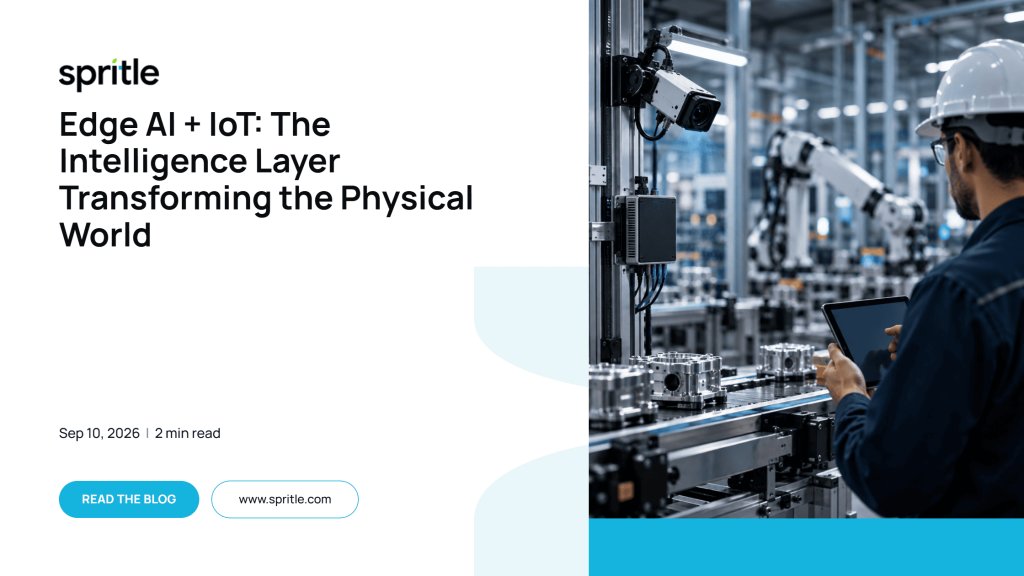
From connected devices to intelligent decisions – how businesses can turn real-world data into real-time action.
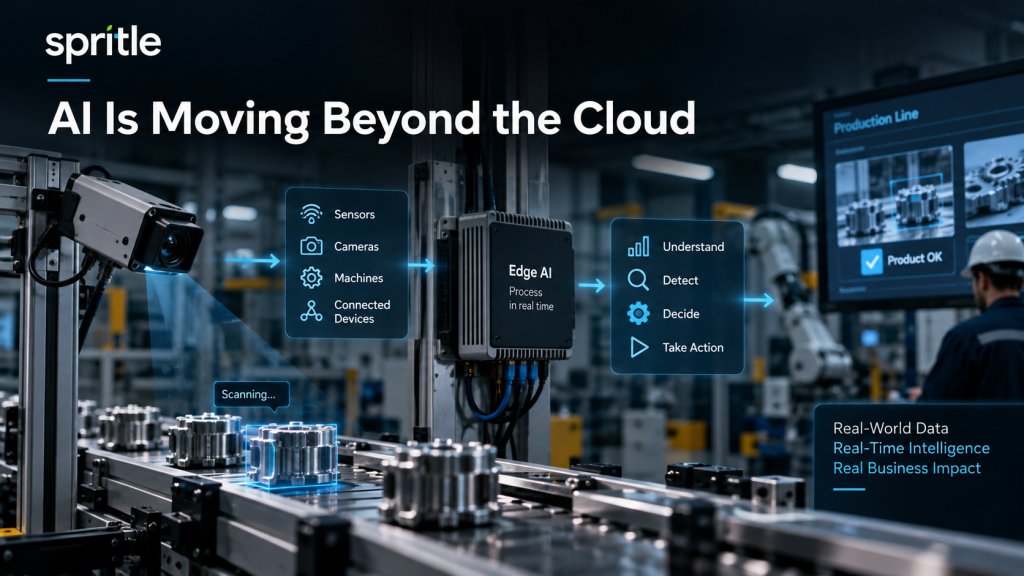
AI Is Moving Beyond the Cloud
Artificial Intelligence has become an important part of how businesses operate. Organizations are using AI to analyze information, automate processes, improve customer experiences, and support better decision-making.
But the next evolution of AI is taking place beyond traditional software applications.
AI is moving closer to the physical world.
Factories, warehouses, vehicles, retail stores, hospitals, offices, and other environments are generating enormous amounts of data through cameras, sensors, machines, and connected devices.
The challenge is no longer simply collecting this data.
The bigger opportunity is to understand what is happening in real time and take action at the right moment.
This is where Edge AI and IoT come together.
From Connected Devices to Intelligent Decisions
IoT has already changed the way businesses interact with the physical world.
Sensors can monitor temperature, vibration, pressure, movement, location, energy consumption, and many other conditions.
Cameras can continuously capture visual information.
Machines can generate operational data every second.
But collecting information alone doesn’t create intelligence.
Consider a manufacturing machine.
An IoT sensor might tell us:
“The vibration level has increased.”
That is useful information.
But an intelligent system can go further:
“The vibration pattern is abnormal and may indicate an equipment issue.”
And an integrated system could take the next step:
“Create an alert, notify the maintenance team, and recommend an inspection.”
This is the evolution from data collection to intelligent action.
When Intelligence Needs to Happen in Real Time
Traditional AI architectures often send information to centralized cloud infrastructure for processing.
That approach works extremely well for many applications.
However, some business decisions need to happen closer to where the data is generated.
Imagine a camera inspecting products on a manufacturing line.
Instead of:
Camera → Network → Cloud → AI → Response
an Edge AI solution can process the information closer to the production environment:
Camera → Edge AI → Detection → Decision → Action
A defective product can be identified immediately.
A safety violation can trigger an alert.
An abnormal machine condition can be detected before it becomes a larger operational problem.
The value of Edge AI is therefore not simply technical performance.
It is about bringing intelligence closer to the moment when a business decision matters.
Edge and Cloud: Better Together
Edge AI should not be viewed as a replacement for cloud computing.
The bigger opportunity is Edge + Cloud.
Edge computing can handle:
- Real-time AI inference
- Local decision-making
- Immediate responses
- Data filtering
- Time-sensitive operations
Cloud platforms can provide:
- Centralized analytics
- Historical data
- Model management
- Reporting
- Enterprise integration
- Device management
This creates a hybrid architecture where intelligence exists at multiple levels.
Sensors & Cameras → Edge AI → Real-Time Action → Cloud Analytics → Business Intelligence
The objective is simple:
Put intelligence where it creates the most value.
Where Edge AI + IoT Can Create Business Value
The potential applications extend across industries.
Manufacturing
AI-powered quality inspection can identify defects automatically. Edge AI can also support worker safety, machine monitoring, and predictive maintenance.
Logistics
IoT can provide visibility into assets and vehicles, while Edge AI can add intelligence to warehouses, cameras, and operational environments.
Healthcare
Connected devices and intelligent monitoring can support equipment management, environmental monitoring, and real-time alerts.
Retail
Edge AI can support customer analytics, queue monitoring, shelf intelligence, and store optimization.
Smart Buildings
Connected sensors combined with AI can help organizations understand occupancy, energy consumption, equipment usage, and environmental conditions.
Technology is important, but the business problem must always come first.
The Real Challenge
Building an AI model is only one part of the journey.
Enterprise Edge AI solutions require:
AI + IoT + Edge Computing + Software Engineering + Security + Integration
Organizations also need to consider device management, monitoring, model updates, scalability, deployment, and long-term support.
The real challenge isn’t building a technology demonstration.
It is turning that demonstration into a secure, scalable, and commercially valuable solution.
From Innovation to Business Impact
Every Edge AI + IoT initiative should begin with a business problem.
The journey should look like:
Business Problem → Use Case → Proof of Concept → Business Validation → Production → Scale
The questions that matter are:
- What problem are we solving?
- What does that problem cost today?
- Can real-time intelligence improve the outcome?
- How will we measure the impact?
- Can the solution scale across locations or customers?
When technology is connected to these questions, Edge AI and IoT move beyond experimentation and become a genuine business transformation opportunity.
Our Perspective
We believe the next generation of intelligent applications will increasingly connect the digital world with the physical world.
Our focus is on identifying real business challenges where Edge AI + IoT can create measurable value and developing solutions that can scale across industries.
The future isn’t simply about putting AI everywhere.
It’s about putting intelligence where it creates the most value.
Where could intelligence closer to the source create a meaningful advantage for your business?


