
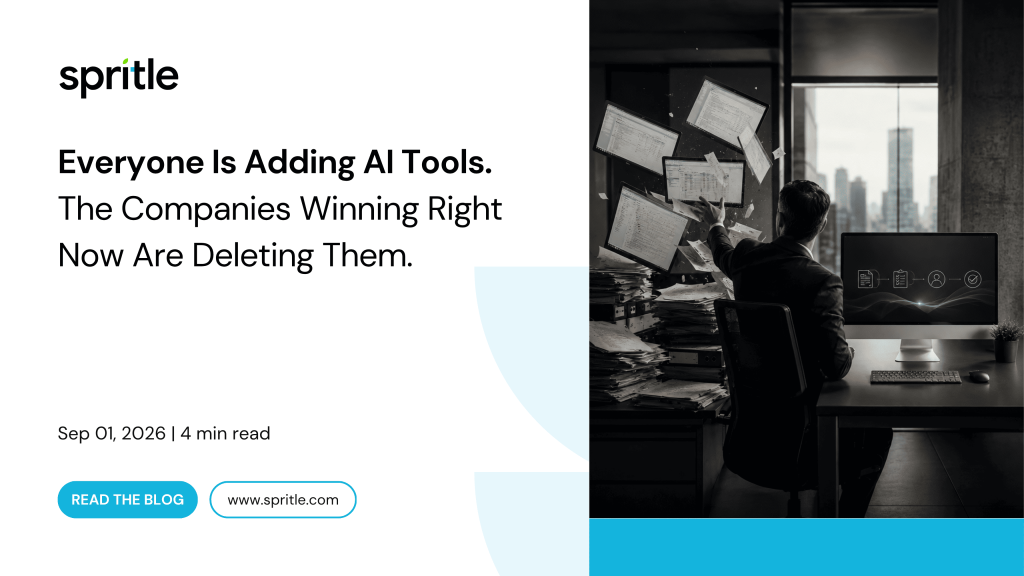
Walk into almost any leadership meeting this year and you will hear the same question. What AI tool should we add next. It is the wrong question, and the companies that figure this out first are the ones quietly pulling ahead of everyone else asking it.
The right question is harder. What can we remove now that this exists.
The Problem Nobody Names Out Loud
Most companies do not have an AI adoption problem. They have a tool sprawl problem, and they have been trying to solve it by adding one more layer on top.
We saw this clearly with a client running their tender process and vendor onboarding through five separate systems. One tool handled the RFPs. Another stored vendor documentation. A third ran compliance checks. A fourth managed approvals. A fifth was the actual portal vendors logged into to submit anything at all.
Every new vendor relationship meant weeks of back and forth across systems that did not talk to each other. Someone on the internal team was manually bridging the gap between five logins, because that was the job the tools left behind for a human to do.
This is not a rare setup. It is the default state of most mid sized companies right now. Nobody designed it this way on purpose. It accumulated, one reasonable software purchase at a time, until the accumulation itself became the actual bottleneck.

What Changed
We rebuilt this entire process as a single Claude based workflow, with one interface shared by the internal team and the vendors themselves.
A vendor submits their information once. Claude checks it against compliance requirements and the company’s own tender history, flags anything genuinely unusual, and routes only the real exceptions to a human for review. Everything routine clears without anyone touching five different tools to make it happen.
Five systems became one. A process that took weeks now takes days. Not because the AI is clever in the abstract, but because the entire chain of handoffs that used to require a human bridge no longer needs one.
Why This Is Not Really About the Tools
It is tempting to read this as a story about software consolidation. It is really a story about a different kind of discipline.
Adding a new AI tool to an already crowded stack is easy. It requires no hard conversations, no one has to admit the old process was broken, and it feels like progress because something new got purchased. Deleting four systems that people have built habits and workarounds around is a much harder decision, and it requires someone willing to ask an uncomfortable question. Does this entire approval chain need to exist in its current form at all.
The companies with the largest AI budgets are frequently the ones failing to ask that question. They bolt a chatbot onto every existing tool they already own, and end up with the same sprawl, now narrated by AI instead of solved by it.
The companies actually winning right now are the ones treating every new AI capability as a trigger to revisit their entire process, not as one more layer to stack on top of what already exists.
The Question Worth Sitting With
Bigger budget does not buy you the discipline to delete something that is already working, even if it is working badly. It usually just buys you more tools you will eventually have to tear out.
So the useful exercise this week is not a vendor evaluation for a new AI product. It is an honest look at your own stack. What is the one process in your company still running through five separate tools that could be running through one.
That question is uncomfortable precisely because the answer usually points at something your team has been quietly working around for years. Answering it honestly is what separates companies that are adding AI from companies that are actually being changed by it.


