

This healthcare LLM cost comparison originated from a practical challenge we encountered while evaluating AI architecture for a healthcare organization. The requirement was simple: healthcare professionals should be able to use AI freely without worrying about how many credits or tokens they consume.
The obvious solution appeared to be self-hosting an open-weight language model. However, once we started evaluating the workload, infrastructure requirements and actual inference economics, the answer became considerably more interesting.
This healthcare LLM cost comparison examines proprietary, open-weight and medical-specialized models across five healthcare workflows. Using an illustrative workload of 4,500 monthly patient visits, we explore inference pricing, GPU hosting economics, clinical quality and the factors that influence deployment decisions.
What is the most cost-effective LLM for healthcare?
There is no universally cost-effective healthcare LLM. The right choice depends on clinical accuracy, workload volume, infrastructure utilization, response-time requirements and operational overhead.
Our analysis suggests that:
- Managed AI APIs are a strong starting point for organizations with moderate or unpredictable workloads.
- Managed open-weight inference can offer lower consumption costs without dedicated GPU infrastructure.
- Self-hosted models become attractive when utilization, customization or data-control requirements justify the investment.
- Medical-specialized models can outperform larger general-purpose models on narrowly defined tasks.
- Human review, transcription and integration costs can exceed LLM inference expenses.
We explore these trade-offs using an illustrative healthcare deployment processing 4,500 patient visits per month.
Table of contents
- The real cost of healthcare AI
- Healthcare LLM comparison
- Medical-specialized models
- Cost per healthcare AI task
- Monthly deployment costs
- API vs. self-hosting break-even
- Batch inference and cost optimization
- Clinical quality and hidden costs
- Recommended healthcare AI architecture
- Model selection framework
- Frequently asked questions
1. Why the real cost of healthcare AI is not just token pricing
Healthcare organizations increasingly want to introduce AI across clinical documentation, patient records, insurance workflows, medical coding and clinical decision support.
However, consumption-based pricing raises an understandable concern: what happens when AI adoption increases across the organization?
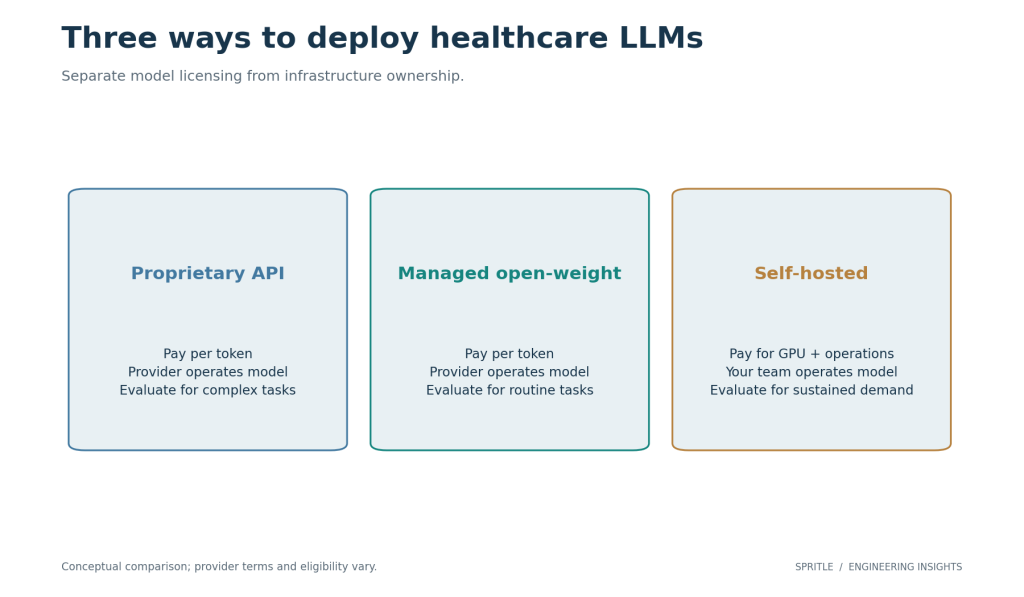
During our architecture evaluation, we considered three deployment approaches.
| Deployment approach | Pricing mechanism | Infrastructure responsibility |
|---|---|---|
| Managed proprietary LLM | Consumption-based | Model provider |
| Managed open-weight LLM | Consumption-based | Cloud provider |
| Self-hosted open-weight LLM | GPU runtime and operating costs | Healthcare organization or technology partner |
The distinction is important. Open-weight models do not necessarily require self-hosting, and eliminating per-token licensing charges does not eliminate the cost of inference.
Research by Burns et al. (2025), published in npj Digital Medicine, examines similar economic and computational challenges in healthcare revenue-cycle operations.
Read the study: Generative AI costs in large healthcare systems, an example in revenue cycle.
2. Healthcare LLM Cost Comparison: Models to Evaluate in 2026
We recommend evaluating models by their suitability for specific workflows rather than selecting a single model for every healthcare application.
| Model | Category | Potential healthcare applications |
|---|---|---|
| GPT-6.2 Astra Healthcare | Frontier proprietary | Complex medical reasoning and research |
| GPT-6.2 Sol Healthcare | Proprietary | Clinical assistance and documentation |
| Claude Sonnet 5.5 | Proprietary | Documentation, summarization and complex administrative workflows |
| Claude Haiku 5.5 | Efficient proprietary | Classification, extraction and routine summaries |
| Gemini 3.8 Flash | Efficient multimodal | Document processing and summarization |
| gpt-oss-20b | Open-weight | Classification and structured extraction |
| gpt-oss-120b | Open-weight | Reasoning and complex workflows |
| Qwen3.6-35B-A3B | Open-weight | Customized enterprise workflows |
| MedGemma 1.5 4B | Medical-specialized | Medical document and image understanding |
| MedGemma 27B | Medical-specialized | Medical text and multimodal tasks, depending on variant |
| BioMistral | Medical-specialized | Domain-adapted medical text processing |
| LingSante-3.1-Flash | Medical-specialized | Advanced medical reasoning and tool-assisted workflows |
These are candidate model-to-workflow mappings, not independently validated performance rankings.
Older models such as BioMistral remain relevant when specialized training produces acceptable results for narrow workloads. Conversely, newer frontier models should not automatically be selected for every task.
Official model references: OpenAI models, Claude models, Gemini, MedGemma.
3. Are medical-specialized LLMs better than general-purpose models?
Medical-specialized LLMs are particularly interesting when a healthcare workflow has a clearly defined domain and measurable output.
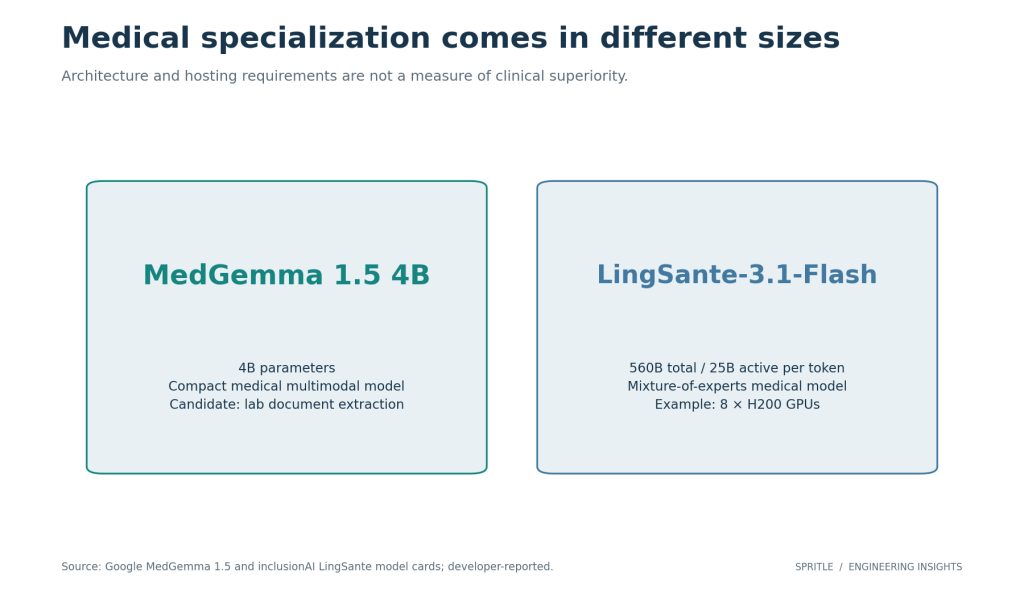
Two models illustrate very different approaches.
MedGemma: Compact medical specialization
Google’s MedGemma family is designed for medical text and image comprehension.
MedGemma 1.5 4B is particularly interesting for laboratory document extraction, medical image understanding and structured information processing.
Google’s evaluation reports that the newer 4B model outperforms its older 27B counterpart on selected laboratory report extraction datasets.
This suggests that specialization and training quality can sometimes matter more than parameter count.
Source: Google MedGemma 1.5 model card, developer-reported results.
LingSante-3.1-Flash: Medical reasoning at a much larger scale
LingSante-3.1-Flash, developed by inclusionAI, takes a different approach.
| Specification | LingSante-3.1-Flash |
|---|---|
| Architecture | Mixture of experts |
| Total parameters | 560 billion |
| Active parameters per token | 25 billion |
| Context window | 1 million tokens |
| Example serving configuration | 8 × NVIDIA H200 GPUs |
Its developer reports second place in medical professional-behavior evaluations and fifth place among 23 evaluated configurations on the InclusionMed benchmark.
However, strong benchmark performance does not automatically establish clinical readiness or economical self-hosting.
The distinction between 560 billion total parameters and 25 billion active parameters is particularly important. Lower computation per generated token does not imply that the entire model can fit within the memory requirements of a conventional 25B model.
We consider LingSante an interesting candidate for further evaluation, but we have not independently benchmarked it.
Source: inclusionAI LingSante-3.1-Flash model card, 2026.
4. Healthcare LLM Cost Comparison by Clinical Workflow
Rather than comparing models only by their price per million tokens, we estimate the cost of completing a specific healthcare task.
Methodology and assumptions
Our illustrative workload includes five healthcare AI workflows:
- Clinical note generation
- Medical coding
- Claims and prior authorization
- Clinical question answering
- Laboratory report extraction
We calculate text inference cost using the following formula:
Cost per task = ((Input tokens × input rate) + (Output tokens × output rate)) / 1,000,000
The input includes instructions and retrieved patient or policy context. Output includes all billable generated tokens, including reasoning tokens where applicable.
Model pricing comparison
All prices are in USD per million tokens, reviewed November 26, 2026.
| Model | Input | Output |
|---|---|---|
| Claude Haiku 5.5 | $0.10 | $0.50 |
| gpt-oss-20b | $0.0721 | $0.3090 |
| gpt-oss-120b | $0.1545 | $0.6180 |
| Gemini 3.8 Flash | $0.75 | $3.75 |
| Claude Sonnet 5.5 | $2.00 | $10.00 |
| GPT-6.2 Sol Healthcare | $2.00 | $10.00 |
| GPT-6.2 Astra Healthcare | $8.00 | $40.00 |
The gpt-oss prices are Amazon Bedrock standard-tier rates for Sydney. Haiku pricing is the starting rate for shorter prompts. Google and OpenAI healthcare rates shown include time-limited promotional pricing. Actual healthcare deployments require region-specific pricing and contractual eligibility verification.
Sources: Anthropic pricing, OpenAI pricing, Google Cloud pricing, Amazon Bedrock pricing.
Healthcare AI cost per task
| Workflow | Input / output tokens | Haiku 5.5 | gpt-oss-120b | Sonnet 5.5 | Astra Healthcare |
|---|---|---|---|---|---|
| Clinical note | 6,000 / 1,000 | $0.00110 | $0.00155 | $0.022 | $0.088 |
| Medical coding | 3,000 / 500 | $0.00055 | $0.00077 | $0.011 | $0.044 |
| Claims processing | 5,000 / 800 | $0.00090 | $0.00127 | $0.018 | $0.072 |
| Clinical Q&A | 8,000 / 1,500 | $0.00155 | $0.00216 | $0.031 | $0.124 |
| Lab extraction | 2,000 / 300 | $0.00035 | $0.00049 | $0.007 | $0.028 |
These are calculated text inference estimates, not measured production costs. They exclude audio, image processing, external tools, retries and human review.
More importantly, the models have not been established as clinically equivalent.
Clinical documentation and ambient scribing
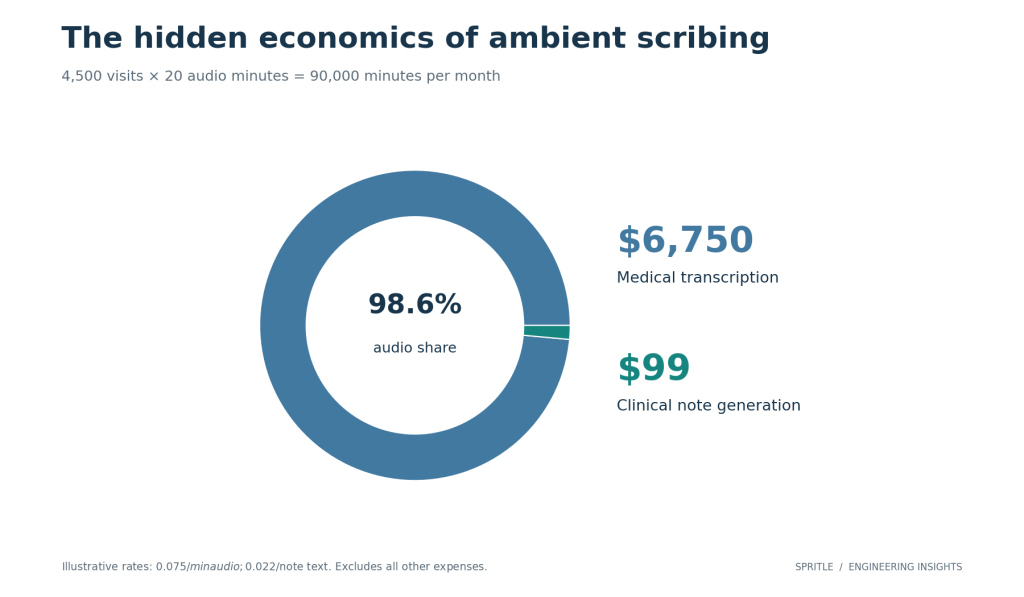
Assuming 4,500 visits per month and 20 minutes of audio per visit, an ambient scribing system would process 90,000 audio minutes.
At an illustrative medical transcription rate of $0.075 per minute, monthly transcription costs would reach $6,750.
By comparison, drafting 4,500 clinical notes using Claude Sonnet 5.5 under our token assumptions would cost approximately $99.
This demonstrates why optimizing transcription may generate more savings than changing the text-generation model.
A 2025 randomized trial by Lukac et al. found that one ambient AI scribe reduced time spent documenting by 9.5%, while another did not produce a significant improvement.
We would therefore measure medication-name accuracy, critical omissions, speaker identification and clinician correction time before selecting a scribing pipeline.
Source: Ambient AI Scribes in Clinical Practice: A Randomized Trial, NEJM AI.
Medical coding and billing
Medical coding is a promising use case for smaller, specialized models combined with deterministic validation.
Rather than relying on unconstrained LLM generation, we would retrieve relevant ICD-10 and licensed CPT references, generate candidate codes and validate those suggestions against applicable rules.
Dai et al. (2026) describe a clinically grounded, HL7-aligned ICD-10-CM coding pipeline deployed in a real-world healthcare environment.
Source: Evaluating real-world deployment of an HL7-CDA-aligned LLM for ICD-10-CM coding, npj Digital Medicine.
Insurance claims and prior authorization
The economics of claims processing depend on accuracy as much as inference cost.
A 2026 JMIR study evaluating six LLMs for anticancer drug reimbursement eligibility reported accuracy between 77.9% and 88.7%, with estimated inference costs of $0.002–$0.10 per case.
However, performance deteriorated when insufficient information was available to determine eligibility.
Our recommendation is to use smaller models for extraction and classification, validated policy references for eligibility checks, and stronger reasoning models or qualified reviewers for exceptions.
Source: Assessing Eligibility for Anticancer Drug Health Insurance Reimbursement Using Large Language Models, JMIR, 2026.
Clinical decision support
Clinical decision support requires substantially more caution.
A randomized clinical trial by Goh et al. (2024) found that giving physicians access to an LLM did not significantly improve diagnostic reasoning compared with conventional resources.
Model intelligence alone is insufficient. Clinical integration, evidence retrieval, uncertainty handling and human oversight remain important.
Source: Large Language Model Influence on Diagnostic Reasoning: A Randomized Clinical Trial, JAMA Network Open.
Laboratory report extraction
For scanned or unstructured laboratory reports, a compact medical multimodal model such as MedGemma is worth evaluating.
However, if structured data is already available through the laboratory information system, HL7 or FHIR interfaces, deterministic integration should be the first option.
Not every healthcare workflow requires generative AI.
5. Healthcare LLM Cost Comparison at 4,500 Monthly Visits
Assume each visit triggers the five illustrative workflows once.
This produces a modeled workload of:
| Monthly workload | Volume |
|---|---|
| Patient visits | 4,500 |
| AI tasks | 22,500 |
| Input tokens | 108 million |
| Output tokens | 18.45 million |
Applying the previously listed prices produces the following estimates.
| Model | Monthly text inference | With 30% usage buffer |
|---|---|---|
| gpt-oss-20b | $13.49 | $17.53 |
| Claude Haiku 5.5 | $20.03 | $26.03 |
| gpt-oss-120b | $28.09 | $36.51 |
| Gemini 3.8 Flash | $150.19 | $195.24 |
| Claude Sonnet 5.5 | $400.50 | $520.65 |
| GPT-6.2 Astra Healthcare | $1,602.00 | $2,082.60 |
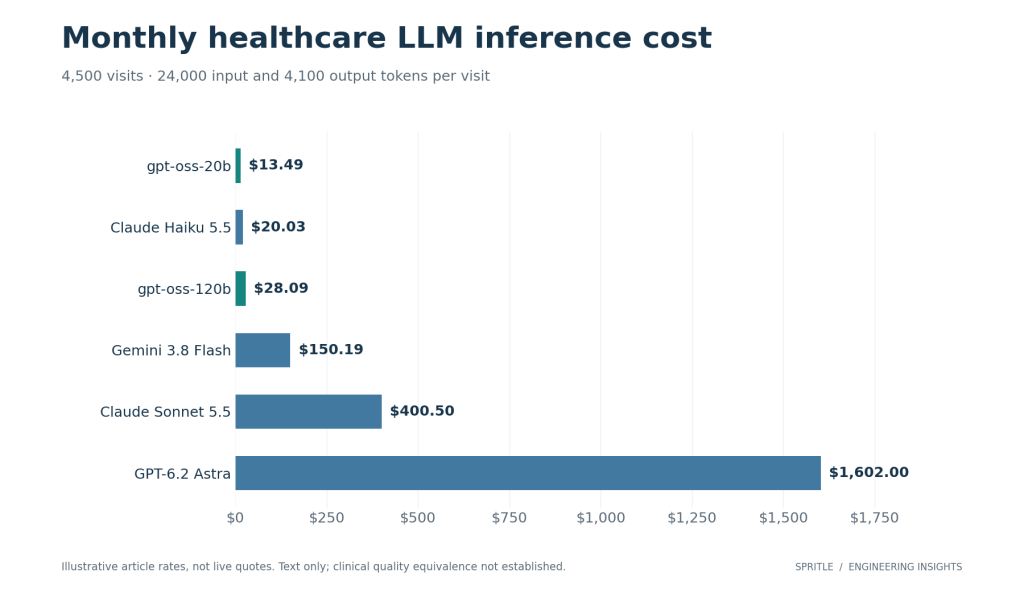
The difference is substantial. Nevertheless, the cheapest model is not necessarily capable of completing every workflow reliably.
A workload-aware architecture could use Sonnet or another sufficiently capable model for complex documentation and smaller validated models for extraction and routine classification.
This approach balances quality and consumption costs rather than forcing the entire organization onto one LLM.
6. Healthcare LLM Cost Comparison: Cloud API vs. Self-Hosting
Self-hosted inference costs are determined by model size, GPU memory, throughput, concurrency, operating hours and engineering overhead.
Consider an illustrative GPU configuration costing $1.861 per hour.
| GPU operating strategy | Monthly hours | GPU compute cost |
|---|---|---|
| Scheduled batch inference | 60 | $111.66 |
| Clinic-hours inference | 264 | $491.30 |
| Always-on inference | 730 | $1,358.53 |
This GPU configuration represents a candidate for compatible smaller models, not a universal hosting configuration.
For example, OpenAI documents that gpt-oss-120b fits within an 80 GB GPU, while gpt-oss-20b can run within 16 GB of memory.
Source: OpenAI, Introducing gpt-oss, 2025.
Calculating the break-even point
Our Sonnet-based illustrative workload costs $0.089 per patient visit.
If GPU compute costs $491.30 per month, the theoretical compute-only break-even occurs at approximately 5,521 monthly visits.
Against the lower-priced managed gpt-oss-120b example, the equivalent threshold exceeds 78,000 visits.
Neither threshold establishes that one GPU can actually handle that volume.
We must validate throughput, memory consumption, peak concurrency, latency and comparable clinical quality.
Break-even volume = Fixed self-hosting cost / (Managed cost per task − Self-hosted variable cost per task)
When additional GPUs become necessary, infrastructure costs increase in steps, changing the break-even calculation.
![API VS GPU HOSTING BREAK-EVEN ANALYSIS]](https://www.spritle.com/blog/wp-content/uploads/2026/11/x06-break-even-1024x597.png.pagespeed.ic.De1DAmillY.png)
[INTERACTIVE COMPONENT 01 — HEALTHCARE AI COST CALCULATOR]
7. Can scheduled GPU inference reduce healthcare AI costs?
Not every healthcare AI workflow requires real-time processing.
| Workflow | Suggested execution strategy |
|---|---|
| Interactive clinical assistance | Real-time |
| Ambient transcription | Streaming or deferred |
| Pre-visit summaries | Scheduled batch |
| Historical medical record processing | Scheduled batch |
| Documentation audit | Scheduled batch |
| Claims preparation | Scheduled batch or on-demand |
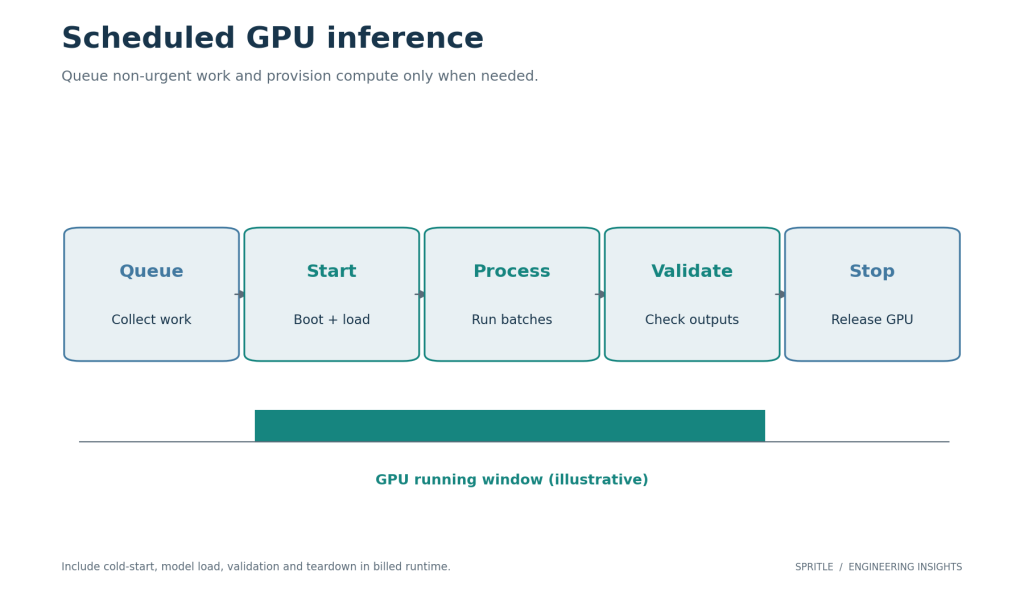
For non-urgent tasks, we can queue requests, start GPU infrastructure, process the workload and shut down the instances afterward.
However, the infrastructure must finish processing within the scheduled window.
For our 4,500-visit scenario, completing the full text workload in 60 GPU hours would require average aggregate processing rates of approximately 500 input tokens per second and 85 output tokens per second, before startup time, retries and operational overhead.
These are capacity requirements, not measured GPU performance.
Managed batch inference is another alternative. Amazon Bedrock offers eligible models at approximately 50% below standard on-demand rates.
Source: Amazon Bedrock batch pricing.
We would benchmark managed batch inference before committing to scheduled self-hosting.
8. How should healthcare organizations measure AI cost-effectiveness?
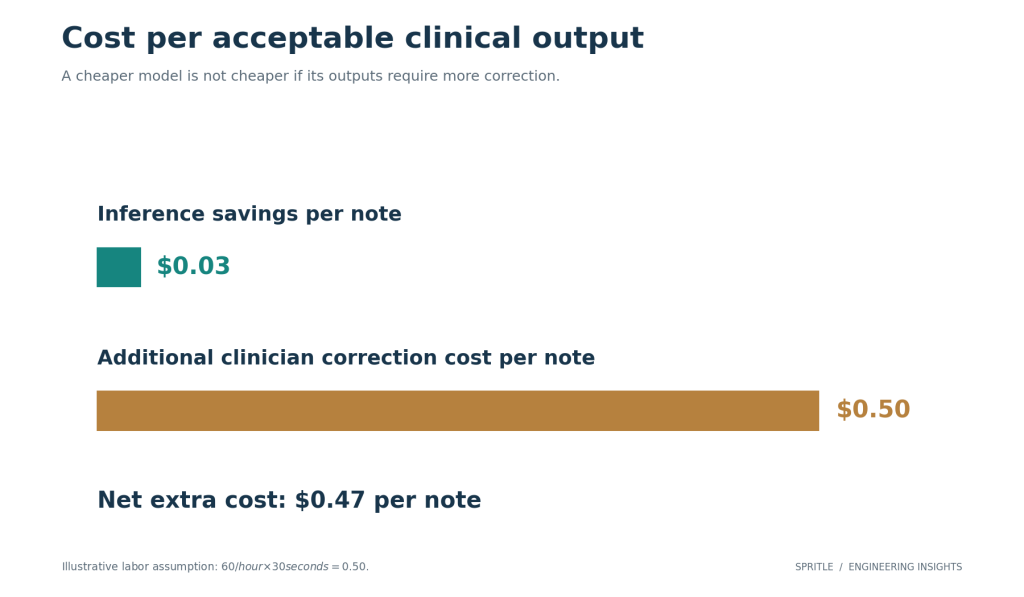
Cost per million tokens tells us how much computation costs. It does not tell us how much a clinically usable outcome costs.
We propose a more useful metric:
Cost per acceptable output = Total inference, infrastructure, review and correction costs / Number of outputs meeting predefined quality requirements
Consider two clinical documentation models.
If a cheaper model saves $0.03 per note but requires an additional 30 seconds of clinician correction, at an illustrative labor cost of $60 per hour, that correction costs $0.50.
The inference saving is outweighed by the additional work.
Healthcare model evaluations should therefore include:
| Metric | What it measures |
|---|---|
| Task acceptance rate | Usability of generated outputs |
| Critical error rate | Potential patient-safety issues |
| Hallucination and omission rate | Factual reliability |
| Human correction time | Actual operational efficiency |
| P95 latency | Response time under representative demand |
| GPU throughput | Infrastructure utilization |
| Cost per acceptable output | Overall economic effectiveness |
Benchmarks such as HealthBench Professional, introduced by Hicks et al. in 2026, provide useful workflow-oriented evaluation frameworks.
However, benchmark performance must be supplemented with validation using representative clinical data and qualified reviewers.
9. Hidden costs and healthcare compliance
A realistic healthcare AI budget must also account for:
- Electronic health record and laboratory system integration
- Security, encryption and access control
- Protected health information handling
- Model evaluation and clinical validation
- Human oversight and error correction
- Infrastructure monitoring and incident response
- Model upgrades, licensing and regulatory requirements
For US healthcare deployments, applicable HIPAA requirements must be addressed, including Business Associate Agreements where required.
Using a private cloud environment or a HIPAA-eligible infrastructure service does not automatically make the complete application HIPAA-compliant.
Source: US Department of Health and Human Services — Guidance on HIPAA and Cloud Computing.
10. What healthcare AI architecture do we recommend?
Our preferred approach is a workload-aware, multi-model architecture.
A centralized model-routing layer can select an approved model based on task complexity, clinical risk, latency requirements, quality thresholds and cost.
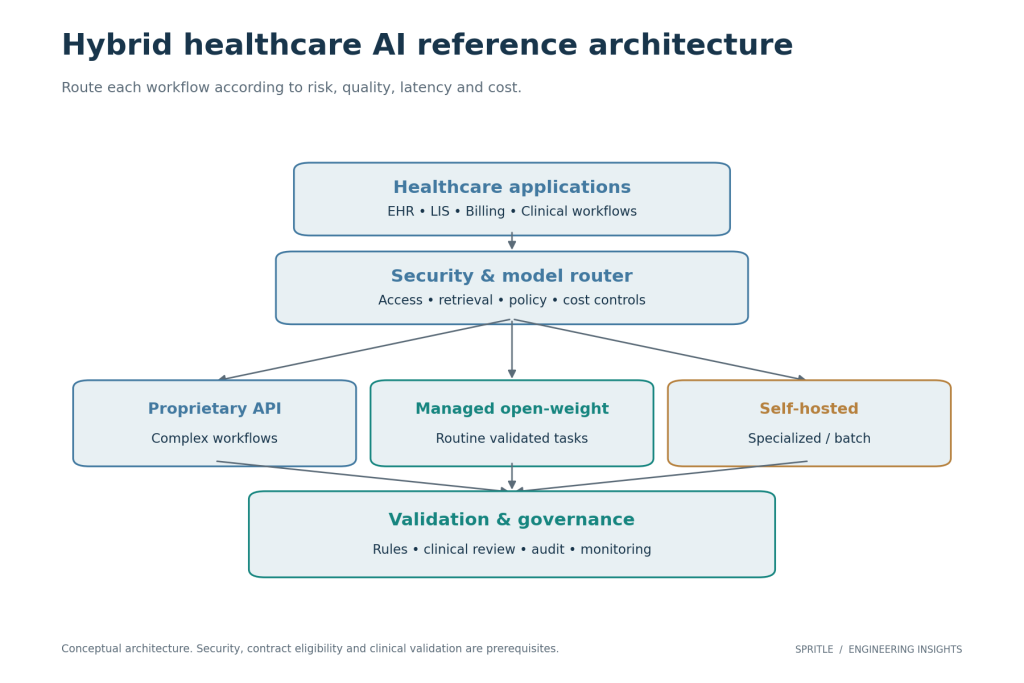
This architecture should also manage consumption at the application level through:
- Per-workflow token budgets
- Rate limits and retry limits
- Duplicate request detection
- Approved prompt caching
- Scheduled processing
- Cost tracking by department and workflow
- Exception handling and controlled escalation
This addresses the original requirement: healthcare professionals should be able to use approved AI workflows without constantly thinking about credits.
The platform, rather than the employee, manages the economics.
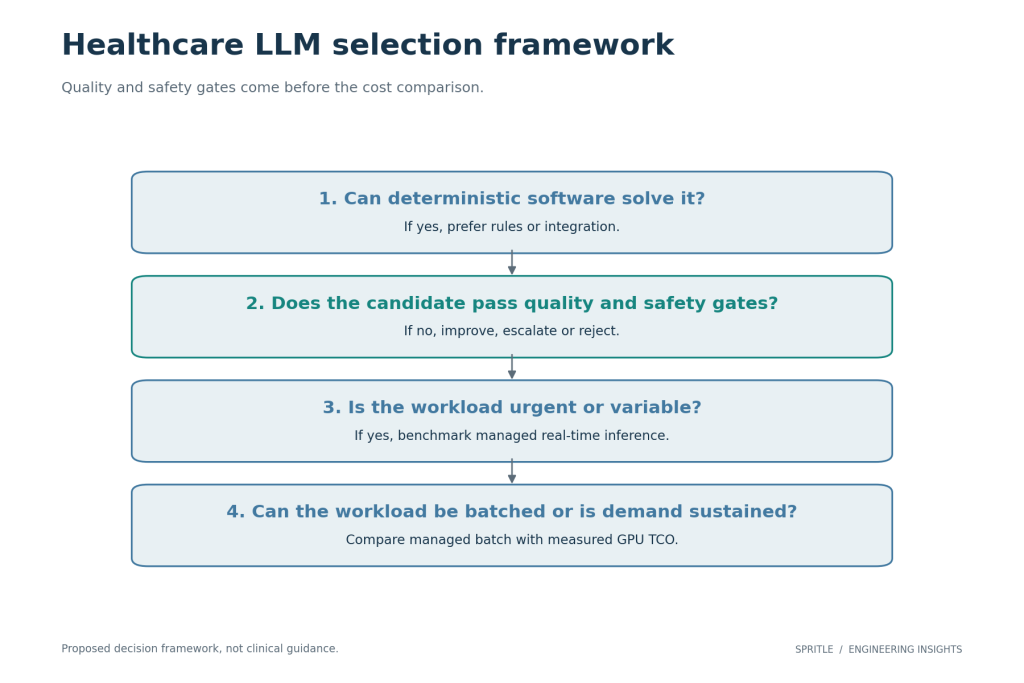
11. Healthcare LLM decision framework
We recommend the following decision process.
| Requirement | Approach to evaluate first |
|---|---|
| Structured data already available | Deterministic software or integration |
| Narrow, repetitive task | Smaller validated model |
| Medical document or image processing | Medical-specialized multimodal model |
| Complex clinical reasoning | Validated frontier or medical reasoning model with clinical oversight |
| Moderate or unpredictable workload | Managed inference |
| Non-urgent processing | Managed batch or scheduled GPU inference |
| High, sustained utilization | Benchmark self-hosted infrastructure |
| Strict data-control requirements | Approved private or self-managed deployment |
Start with the smallest model that meets the quality requirement. Escalate complexity only where there is a measurable benefit.
Frequently asked questions
What is the cheapest LLM for healthcare applications?
There is no universal cheapest model. Smaller proprietary and managed open-weight models offer low inference costs, but the most economical model is the one that meets task-specific accuracy and safety requirements with minimal correction and operational overhead.
Is self-hosting an open-source healthcare LLM cheaper than using a cloud API?
Not necessarily. Self-hosting becomes attractive when GPU utilization, throughput, operating costs and customization requirements justify the infrastructure investment. Managed inference is often a better starting point for moderate or variable workloads.
Is MedGemma better than Claude or GPT for healthcare?
MedGemma is a medical-specialized model family that deserves evaluation for medical text and image workflows. Claude and GPT are broader model families with different capabilities. Their suitability depends on the specific task and independently validated results.
Is LingSante the best medical LLM?
LingSante-3.1-Flash reports competitive performance on developer-reported medical benchmarks. However, it is not established as the best model across every healthcare task, and its deployment requirements must be considered.
Can healthcare organizations use Amazon Bedrock for patient data?
Potentially, when the selected service, model, configuration and region are covered by the appropriate contractual and regulatory arrangements. The entire application must also implement required security, privacy and governance controls.
Can healthcare AI expenditure be controlled without limiting employee adoption?
Yes. Organizations can manage expenditure at the application level through approved model routing, consumption budgets, rate limiting, scheduling, caching and usage monitoring without exposing token-based pricing to every employee.
Conclusion
The healthcare AI industry often focuses on which model has the highest benchmark score or the lowest token price.
Neither metric is sufficient in isolation.
For the 4,500-visit workload we modeled, managed inference is a strong economic starting point. However, scheduled GPU processing, medical-specialized models and hybrid architectures deserve consideration as workloads evolve.
The most sustainable healthcare AI architecture is one that delivers acceptable clinical quality, predictable expenditure and operational reliability without forcing healthcare professionals to manage the complexity of the underlying technology.
We should optimize for the cost of delivering a reliable healthcare outcome, not merely the cost of generating tokens.
About this analysis
This article is based on healthcare AI architecture evaluation, publicly available research, official model pricing and illustrative workload projections.
The 4,500 monthly visits represent an anonymized modeling scenario, not disclosed customer production statistics. Pricing was reviewed on November 26, 2026. No original head-to-head clinical benchmark is claimed.
This is a technical and economic analysis, not medical advice.
Selected research and references
- Burns et al. (2025). Generative AI costs in large healthcare systems, an example in revenue cycle. npj Digital Medicine.
- Lukac et al. (2025). Ambient AI Scribes in Clinical Practice: A Randomized Trial. NEJM AI.
- Dai et al. (2026). Evaluating real-world deployment of an HL7-CDA-aligned LLM for ICD-10-CM coding. npj Digital Medicine.
- Assessing Eligibility for Anticancer Drug Health Insurance Reimbursement Using Large Language Models. JMIR, 2026.
- Goh et al. (2024). Large Language Model Influence on Diagnostic Reasoning: A Randomized Clinical Trial. JAMA Network Open.
- Hicks et al. (2026). HealthBench Professional. arXiv preprint.
- Google. MedGemma 1.5 model card. Developer-reported evaluation.
- inclusionAI (2026). LingSante-3.1-Flash. Developer model card.
- OpenAI (2025). Introducing gpt-oss.
- Official pricing: OpenAI, Anthropic, Google Cloud, Amazon Bedrock.
- US Department of Health and Human Services. Guidance on HIPAA and Cloud Computing.


