
How Spritle deployed a Digital Twin of an Organization, powered by Claude, that cuts impact analysis from days to under half a day.
The Problem
Organizations spend an estimated $3.4 trillion a year on digital transformation. Seventy percent of those efforts fail to deliver on their objectives (McKinsey). In the AI era, the numbers are just as stark: 95% of enterprise generative-AI initiatives deliver no measurable return. The root cause in both cases is the same. Organizations do not have a clear, connected picture of how they actually operate.
Process knowledge is scattered across documents that go stale, spreadsheets that contradict each other, and most critically, in the heads of the people who do the work. BCG’s research puts it plainly with their 10-20-70 rule: just 10% of AI success comes from algorithms, 20% from technology and data, and a full 70% is people and process. The technology is the easy part. Capturing the organizational knowledge is the real work.
When a leadership team asks “what happens if we retire this system?” or “which processes are ready for AI automation?”, the answer usually involves days of manual cross-referencing across multiple tools and conversations with several stakeholders. That is the gap Insight Twin set out to close.
The Client
Insight Twin was founded by Michael Schank, who spent 25 years leading transformation and process work at some of the world’s largest institutions, including Accenture, Bank of America, EY, and Citi, and wrote the book on it: Digital Transformation Success (Apress). What struck him across every program was that the failures never came down to budget or talent. The best-funded, smartest teams hit the same wall. Michael had a clear methodology for building a Digital Twin of an Organization: one that could describe how an organization actually operates, prescribe where it should go, act by producing tangible deliverables, and monitor performance against the model.
Turning that methodology into software meant solving a specific problem: an AI layer that could reason over an organization’s real, connected operating model, and stay grounded in it, rather than answering from general knowledge or drifting from what the model actually said. That is what Michael needed a technology partner to build. That is where Spritle came in.
What We Deployed
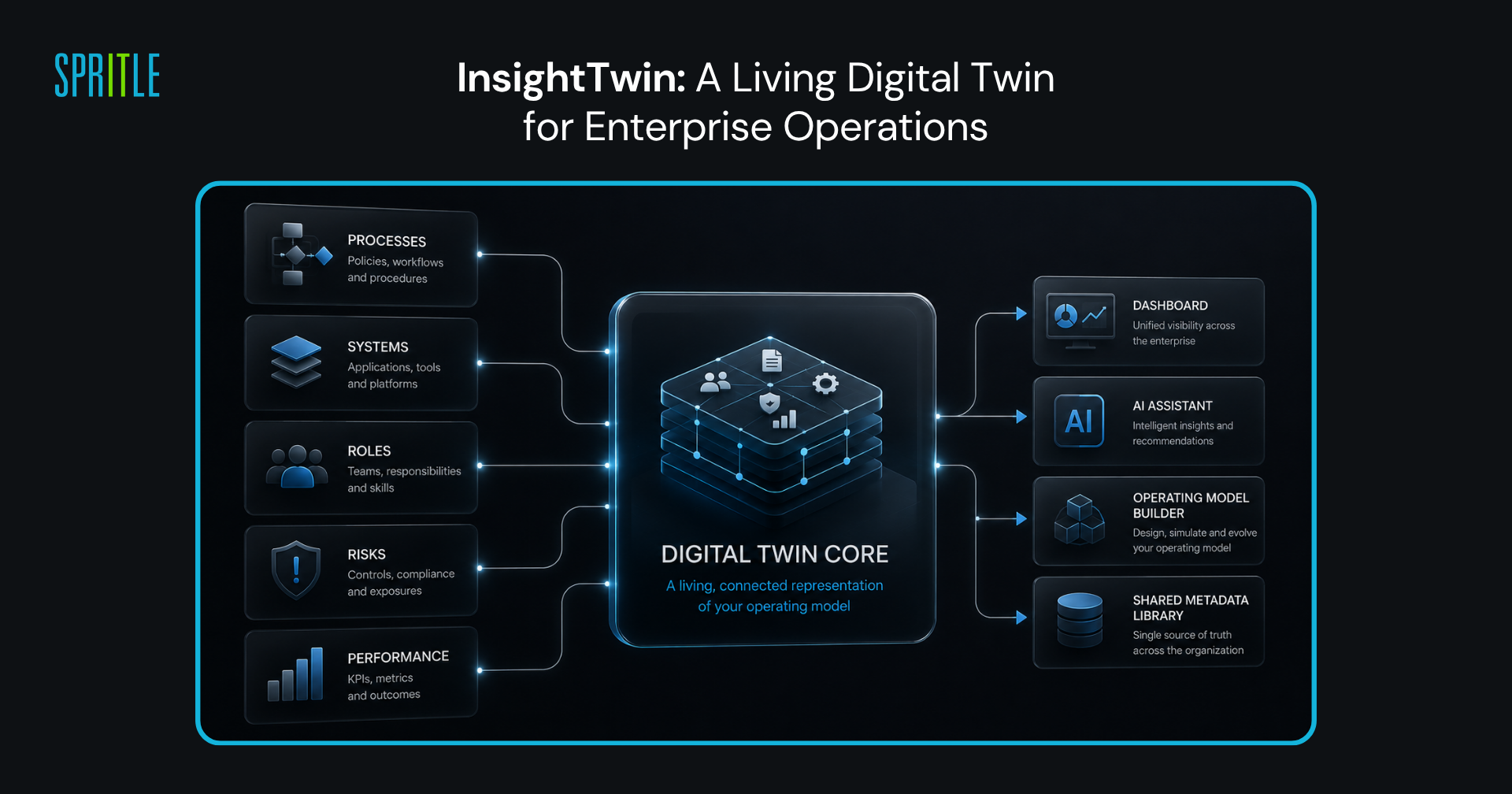
Gartner now recognizes Digital Twin of an Organization as a formal market category, publishing its first Magic Quadrant for DTO Platforms in July 2026. InsightTwin is built squarely in this space. The platform is now live at insighttwin.com, a Digital Twin of an Organization that ingests operational data from across a business (HR systems, technology repositories, risk databases, performance platforms) and combines it with institutional knowledge gathered directly from employees. The result is a connected model of everything the organization does: every process, every system, every role, every risk, linked together rather than siloed in separate tools.
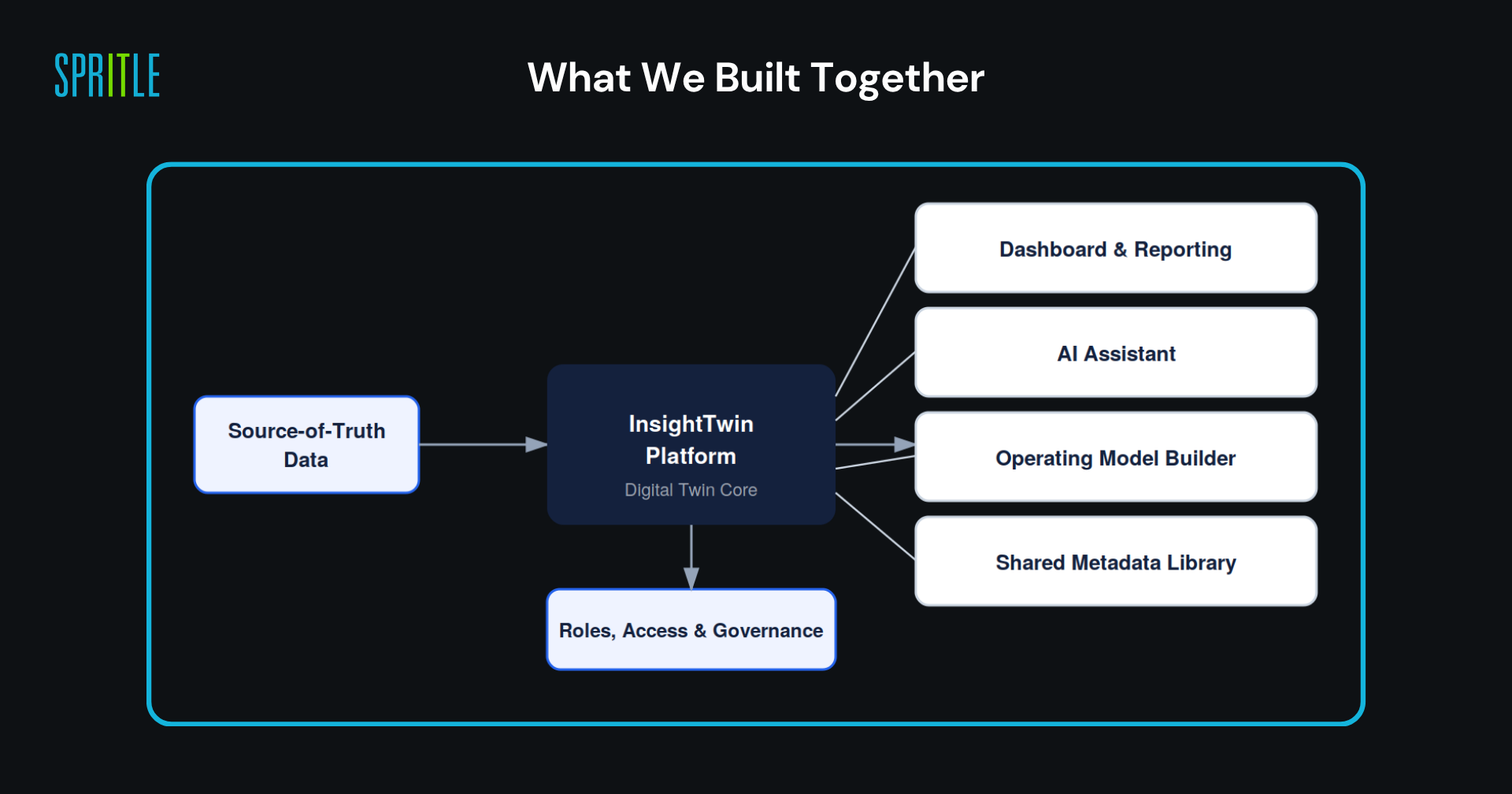
The platform includes four core modules working together: a dashboard giving users an at-a-glance view of their organization’s data; an AI assistant, built on Claude Platform, that reasons over the entire connected model; an operating model builder where teams map process inventories, value streams, and business capabilities as one connected structure; and a shared metadata library that keeps every entity described consistently across the platform.
The InsightTwin platform: source data flows through the Digital Twin core to the modules users work with day to day.
Where Claude Makes the Difference
The real value of a Digital Twin of an Organization is not just having the data connected. It is what you can do with it. This is where Claude changes things.
The Claude-powered AI assistant does not answer from general knowledge. It reasons over the organization’s own verified operating model, every process, system, risk, dependency, and owner, all linked together. That means users can ask questions that would otherwise require days of manual analysis:
Impact analysis:
“What happens if we remove this process?” The assistant traces every dependency, identifies affected systems, flags risks, and names the owners, in minutes. What used to take 2–3 days of manual cross-referencing now takes under half a day end-to-end, including human review of the AI’s findings before anything is acted on.
Risk visibility:
“What risks are associated with this process?” draws from the connected risk and compliance data across the entire model, not a single spreadsheet.
AI readiness:
“Which processes are best suited for automation?” grounded in actual operational data, because the model captures every process, every system, every activity, and every person.
Future-state planning:
The AI assistant does not just reason over how things work today. It can also query staging data, planned changes that have not gone live yet, with the same depth as production data. That means teams can ask “if we make these proposed changes, what gets impacted?” or “what new risks does this future-state introduce?” before anything actually changes in production.
What sets this apart:
Most process modeling tools only describe how an organization operates today. InsightTwin’s AI assistant reasons over staging data, proposed changes that have not gone live, with the same depth as production data, so teams can ask “what happens if we make this change?” before anything actually changes. No existing process modeling tool offers this.
Enterprise-Grade from Day One
The platform was built to handle real enterprise requirements from the start, not bolted on later:
Role-based access control across administrators, editors, approvers, and viewers, with single sign-on support and email-based approval flows.
A structured promotion workflow where content moves through three stages (draft, review, and live) with automated validation, human QA review, and a full audit trail at every gate.
Multi-tenancy built into the data layer, with each organization’s data fully isolated and AI usage tracked with configurable cost pass-through.
Content moves from draft to live through review gates, never edited in place.
| Challenge | How Claude Helped | Result |
| Impact analysis for removing or changing a process/system took 2–3 days of manual cross-referencing across teams and tools | Claude Platform-powered AI assistant surfaces dependencies, affected systems, risks, and owners in minutes; team validates and finalizes with human review |
Full analysis turnaround cut from 2–3 days to under half a day
|
| Teams could only assess impact against what was already live, with no way to safely test proposed changes before they happened | AI assistant reasons over staging data (planned, not-yet-live changes) with the same depth as production data |
Teams can pressure-test future-state changes before anything goes live, a capability no existing process modeling tool offers
|
What Our Client Has to Say
“Spritle understood what we were building. A Digital Twin of an Organization has to describe how an organization actually operates, prescribe where it should go, act by producing tangible deliverables, and monitor performance against the model. Spritle took that methodology and made it working software, including an AI assistant that reasons over the connected model itself. They have handled that complexity, and we view them as a long-term partner.”
Michael Schank
Founder, Insight Twin
Learn more about InsightTwin at insighttwin.com.


