


Introduction: The Illusion of Simplicity in AI Agents
Many teams today believe that AI agents are plug-and-play tools — install them, type a prompt, and watch them magically transform workflows. It sounds like the dream of automation finally realized. But here’s the truth: it doesn’t work that way.
While AI agents are incredibly powerful, their real value comes not from isolated responses but from deep integration — with your systems, workflows, and business context. Without that, they risk becoming just another shiny technology producing outputs that no one acts on.
The future of enterprise AI isn’t about better prompts. It’s about connected agents that can access your data, execute real actions, and evolve with your organization.
The Myth of “Prompt + Agent = Solution”
Generative AI introduced the world to prompting — the art of asking questions creatively to extract better results. Then came AI agents, promising to take it a step further: not just respond, but act.
And yet, this shift led to a dangerous oversimplification: the belief that prompts plus agents equal transformation.
Here’s why that formula fails:
- Agents without access to tools can’t execute beyond chat-based responses.
- Agents without context lose memory and repeat mistakes endlessly.
- Agents without governance risk automating bad decisions at scale.
👉 In essence, a disconnected AI agent is just a fancier chatbot with no operational depth.
What Integration Really Means
True AI agents aren’t standalone apps — they are intelligent process participants. Integration allows agents to move beyond isolated conversations and perform real, measurable actions.
1. Data Access
Agents must tap into internal systems like CRMs, ERPs, or data warehouses to make data-driven decisions. Without access, they’re guessing.
2. API Connectivity
AI agents need to talk to your existing ecosystem — updating tasks, logging tickets, sending emails, or triggering automated workflows.
3. Persistent Memory
Context is key. Agents must remember user preferences, past actions, and previous outputs to deliver continuity instead of repetition.
4. Governance and Guardrails
Trust is non-negotiable. Integrated agents must operate under well-defined rules with human-in-the-loop validation, ensuring safety and compliance.
When all four layers connect, your AI agents evolve from convenience tools into workflow engines that amplify productivity and accuracy.
Why Plug-and-Play Doesn’t Work
Businesses often want AI that’s “ready to go.” But AI agents aren’t apps — they’re ecosystems that require infrastructure, data, and strategy.
Here’s why the plug-and-play mindset fails:
❌ Lack of Contextual Awareness
A pre-trained agent doesn’t understand your company’s internal jargon, workflows, or objectives. Without integration, its responses stay generic.
❌ One-Size-Fits-All Limitations
Each business has unique processes. Agents must adapt — not expect your team to change how it works.
❌ No Feedback Loop
Without integration, there’s no data flow back to the agent. It can’t learn, improve, or provide insights over time.
❌ Security and Compliance Risks
Disconnected tools often lack proper oversight, increasing risks related to data leakage and non-compliance with standards like GDPR, HIPAA, or SOC 2.

Real-World Example: Spritle’s Integrated AI Agent Ecosystem
At Spritle Software, we saw this challenge firsthand with a fintech client who wanted to “add AI agents for compliance.” Their vision was simple — prompts that automate reporting. But compliance isn’t a single task; it’s a complex workflow.
Their team needed to:
- Monitor transactions in real time
- Flag anomalies or suspicious behavior
- Draft and file compliance reports
- Notify regulators promptly
A prompt-based AI agent could summarize data but couldn’t complete the process. So, we built an integrated AI agent system tailored to their needs.
🧠 The Agent Ecosystem Included:
- Monitoring Agent – Pulled live transaction data from the core banking system.
- Analysis Agent – Scanned data for fraud indicators and rule violations.
- Compliance Agent – Drafted structured reports and validated regulatory clauses.
- Notification Agent – Sent alerts via secure communication channels.
Human reviewers still approved reports, ensuring trust and accountability.
🚀 The Results:
- Reporting time dropped from days to hours.
- Compliance errors fell drastically.
- Regulators praised the transparency of audit-ready documentation.
- Analysts spent more time on risk prevention, not paperwork.
The transformation wasn’t about better prompting — it was about seamless integration and orchestration between systems and AI agents.
Lessons for Business Leaders
Before implementing AI agents, leaders should ask these critical questions:
- Are your agents connected to real data sources?
Without access to your systems, they’re operating blind. - Can they interact with APIs and business tools?
Integration is essential for action-taking, not just text generation. - Do your agents retain context across sessions?
Memory builds continuity and improves decision-making. - Are guardrails and governance mechanisms in place?
Compliance and human oversight ensure trust and accountability.
When these conditions are met, AI agents become partners in execution, not just assistants for conversation.
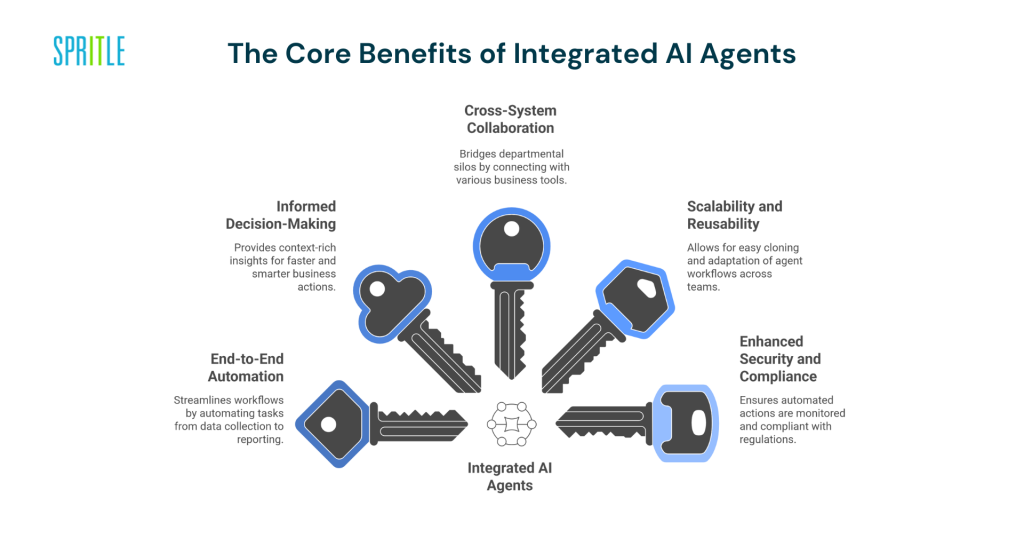
The Core Benefits of Integrated AI Agents
Let’s break down what organizations gain when AI agents are integrated properly.
1. End-to-End Automation
Integrated AI agents execute multi-step workflows — from data collection to reporting — reducing manual dependencies.
2. Informed Decision-Making
Agents access historical and real-time data, offering context-rich insights for faster, smarter business actions.
3. Cross-System Collaboration
By connecting with tools like Salesforce, Jira, Slack, and ERPs, agents bridge departmental silos, improving communication and efficiency.
4. Scalability and Reusability
Once an agent workflow is integrated, it can be cloned, adapted, and scaled across multiple teams or regions.
5. Enhanced Security and Compliance
Centralized governance ensures every automated action is monitored, logged, and compliant with industry regulations.
Common Mistakes When Deploying AI Agents
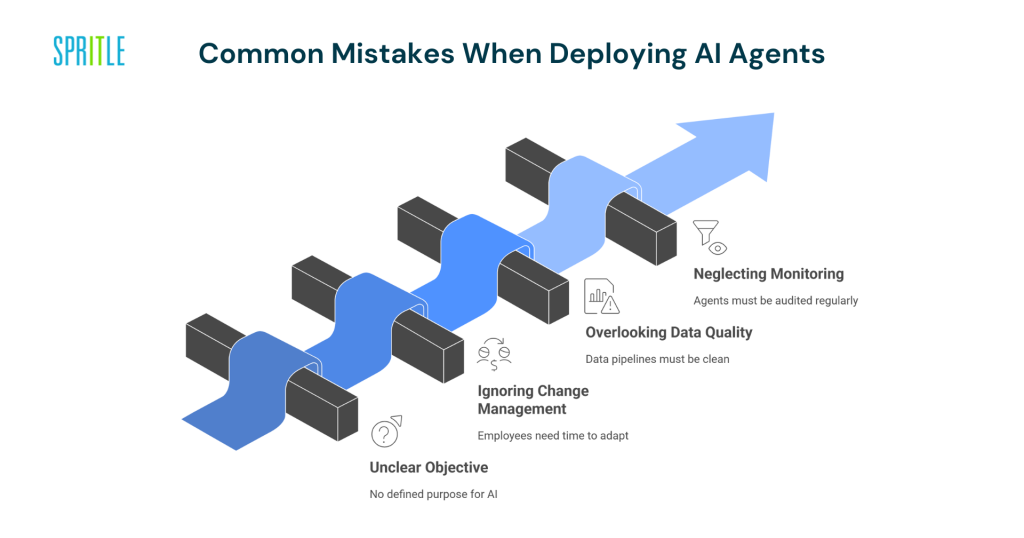
Even with the best intentions, teams often stumble during implementation. Here’s what to avoid:
❌ Deploying Without a Clear Objective
“Let’s use AI” isn’t a strategy. Define what the AI agent should accomplish — automate, analyze, or assist.
❌ Ignoring Change Management
Employees need time and training to adapt to AI-driven workflows. Human buy-in determines success.
❌ Overlooking Data Quality
Garbage in, garbage out. Ensure your data pipelines are clean, accurate, and continuously updated.
❌ Neglecting Monitoring & Evaluation
Agents must be audited regularly for accuracy, bias, and performance to prevent workflow drift.
Integration Framework: Building Successful AI Agent Systems
To help you get started, here’s a simplified roadmap for AI agent integration:
Step 1: Identify Use Cases
Start with repetitive, data-heavy workflows where AI can deliver measurable impact — compliance, reporting, or customer service.
Step 2: Map Data Sources
List every database, dashboard, and API your agents need to access.
Step 3: Build Modular Agents
Design agents for specific functions (data extraction, analysis, communication) that can later collaborate in a shared ecosystem.
Step 4: Add Human Oversight
Ensure every agent’s output passes through review checkpoints to maintain accuracy and compliance.
Step 5: Measure & Iterate
Track KPIs like time saved, accuracy improved, and cost reduced — then continuously refine your AI agent network.
The Future of AI Agents: From Assistants to Ecosystem Orchestrators
We’re entering an era where AI agents won’t just assist—they’ll orchestrate entire business processes.
Imagine this:
- Your sales agent analyzes leads, updates CRM entries, and generates personalized follow-ups.
- Your HR agent screens resumes, schedules interviews, and sends offer letters.
- Your operations agent monitors supply chain data, predicts bottlenecks, and triggers restock orders automatically.
This level of automation only happens through integration, not isolated prompting. The future isn’t about having dozens of disconnected agents — it’s about having a cohesive AI ecosystem working seamlessly together.
The Security and Ethics Layer
As organizations scale their AI usage, responsible integration becomes critical. Integrated AI agents must:
- Encrypt sensitive data during access and transmission.
- Maintain transparent audit trails.
- Operate under ethical frameworks that prevent misuse or bias.
- Include manual approval steps for critical decisions.
Balancing autonomy and oversight ensures that AI acts as an augmentation of human intelligence, not a replacement.
Conclusion: Integration Is the True Superpower
The dream of plug-and-play AI is appealing but unrealistic. The real magic of AI agents lies not in clever prompts but in deep integration with your data, workflows, and governance systems.
The winners of tomorrow won’t just experiment with AI — they’ll embed it into the core of their business operations.
At Spritle Software, we help organizations move beyond the “prompt illusion” by designing integrated AI agent ecosystems that deliver measurable, scalable outcomes.
📩 Ready to see what connected AI agents can do for your business? Let’s build the future — together.


