

When I started learning about revenue cycle management, one fact surprised me! A hospital treats a patient and sends the bill to the insurer, but about 15% of claims are denied the first time1. With claim denials, some of that money comes back months later. Some never come back!
The work was done. The care was given. The money still didn’t arrive.
That’s the problem this post is about.
One claim, two endings
Meet Sarah. She books a physical therapy visit and gives her insurance details over the phone. One digit of her member ID is wrong.
| Step | The usual way | With agents and your team |
|---|---|---|
| Booking | ID typed in with the wrong digit. Nobody notices | Intake agent reads her insurance card and the coverage agent checks it. The agent flags the mismatch to the front desk in seconds |
| Visit | Sarah gets her treatment | Front desk confirms the corrected ID while she checks in |
| Claim | Sent with the wrong ID | Claim agent checks it against payer rules and the billing team reviews anything it flags. It goes out clean |
| A month later | Denied: member not found | Paid |
| After that | A biller finds the error, fixes it, resubmits, and waits another 45 to 60 days. Sarah may get a confusing bill in the meantime | Nothing. The claim is done |
Same patient, same visit, same payer. One claim costs a do-over and months of waiting. The other just gets paid. (Illustrative example.)
The real cost of claim denials
That 15% is the average across the industry2. In 2025, 41% of providers said at least one in ten of their claims was denied, up every year since 20223. Fighting a denial costs about $57 per claim, and providers spent $25.7 billion on it in 2023 alone.
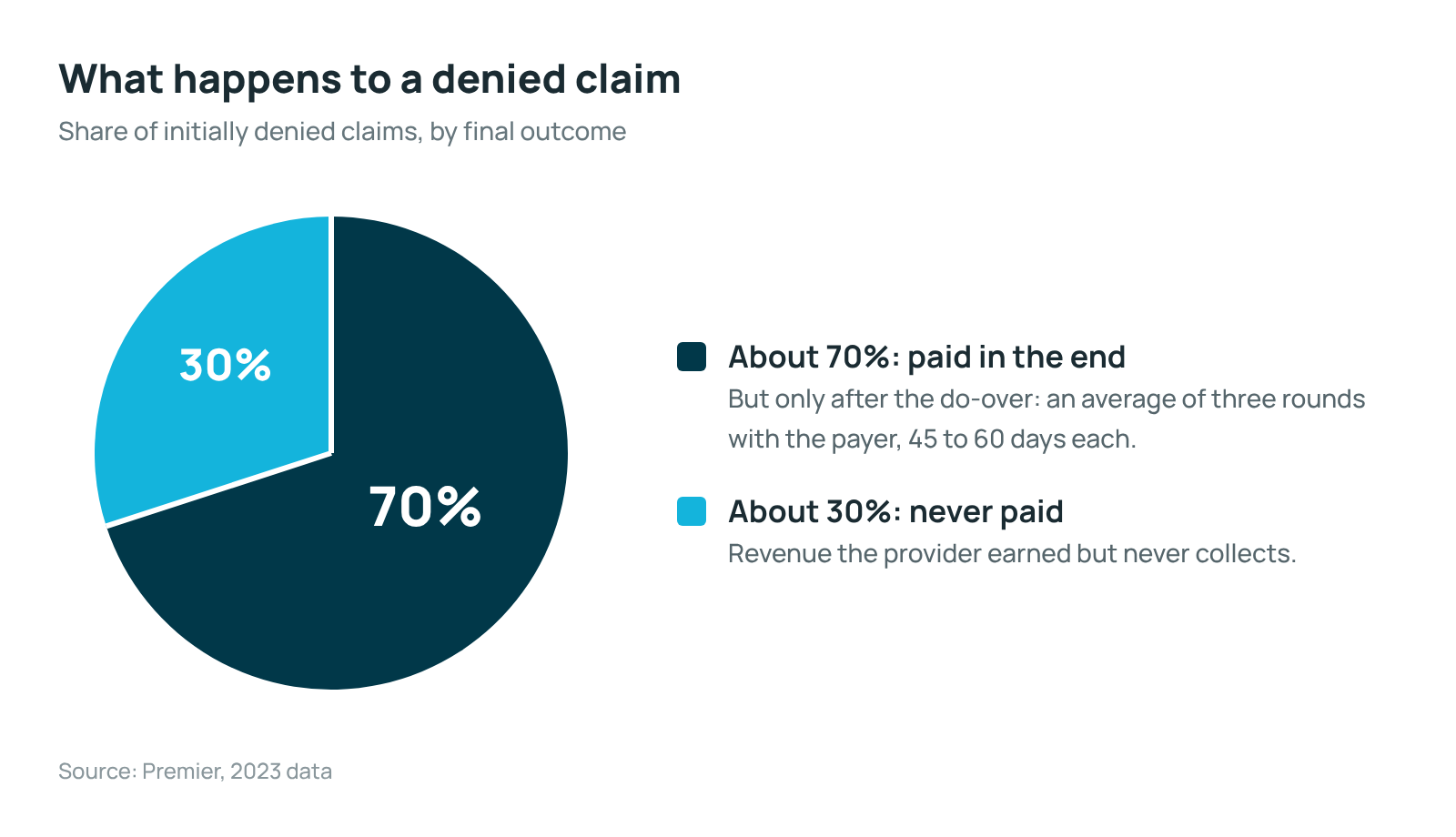
Most claim denials aren’t a final “no”. Payers eventually pay about 70% of denied claims. But getting there takes an average of three rounds with the payer, each lasting 45 to 60 days4.
So the real cost isn’t just lost revenue. It’s:
- Cash stuck in limbo for months.
- Staff time spent fixing claims that should have been right the first time.
- Money that never comes back: providers never recover about one in four denials5.
Healthcare doesn’t have a payment problem. It has a do-over problem.
Where claim denials really start
Claim denials show up in the billing office, so billing gets the blame. But most of them start much earlier.
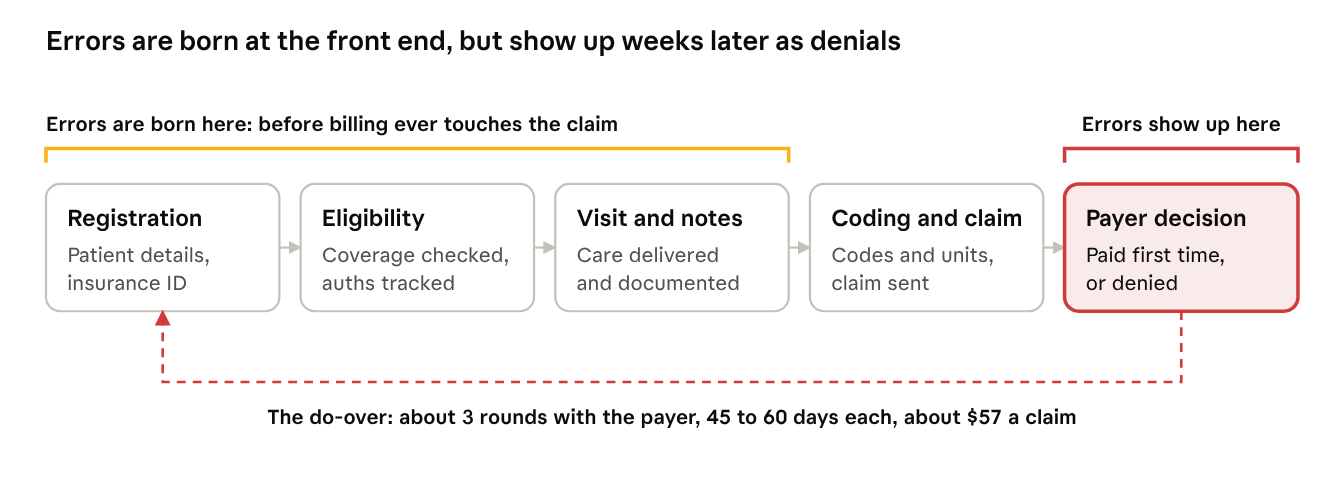
Most claim mistakes happen in the first three steps, but nobody finds out until the payer says no.
- About half of denials trace back to the front end: registration, eligibility and authorizations6.
- Registration and eligibility alone cause roughly one in four claim denials, the single largest cause.
- Providers name missing or inaccurate data (50%), authorizations (35%) and registration errors (32%) as top causes7.
The good news is in the same data: about 86% of claim denials are potentially avoidable8. A typo at check-in shouldn’t become a 60-day dispute.
Who pays the price
| Who | What they feel |
|---|---|
| Practice owner | Unpredictable cash, thin margins, and a business that’s hard to grow |
| Billing team | An endless queue of rework. 43% of providers say they’re understaffed9 |
| Clinicians | Notes sent back weeks after the visit, when the details are long forgotten |
| Patients | Surprise bills, confusing statements, and less trust in their provider |
Why the usual fixes don’t stick
Most organizations respond in one of three ways: hire more billers, move billing offshore, or buy a better appeals tool. Each one makes the do-over cheaper or faster. None of them stops the do-over.
It’s like mopping faster while the tap is still running. The floor never gets dry.
The opportunity is clear: 67% of providers believe AI can improve claims, but only 14% use it today. Of those that do, 69% say it has already cut denials or improved resubmissions10.
Where AI agents fit in, and where they don’t
AI agents aren’t the answer to every denial. Some causes need people and process: front-desk habits, staff training on each payer’s rules, contracts that need renegotiating, or a clinical workflow that has to change. No software fixes those on its own. What agents do well is the repetitive, rule-based checking in between, the steps that get skipped on a busy day. Used together with better processes and a strong billing team, they stop many do-overs before they start.
The goal is simple: bill once, get paid once. Alongside better processes and your own team, give each step of the revenue cycle an AI agent that does the routine work, catches mistakes at the moment they happen, and hands the hard cases to a person.
Meet the agent team
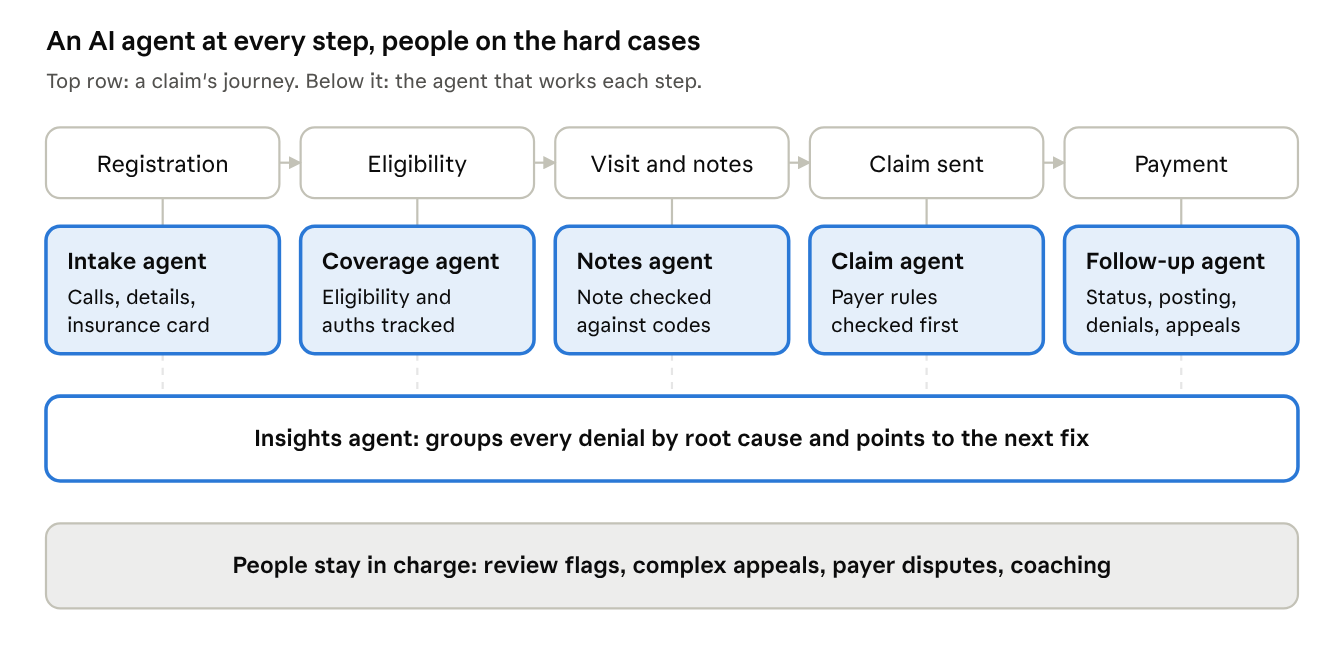
Each step gets an agent, the insights agent learns from all of them, and people take the cases that need judgement.
| Agent | What it does | Outcome you see |
|---|---|---|
| Intake agent | Answers booking calls and messages, collects patient and insurance details, reads the insurance card | Clean registration from the first contact |
| Coverage agent | Checks eligibility at booking and again before the visit, tracks authorizations and visits left | No surprise “not covered” or “no auth” denials |
| Notes agent | Compares the clinical note with the codes being billed and asks the clinician one clear question if they don’t match | Fewer notes sent back weeks later |
| Claim agent | Reviews every claim against payer rules before it goes out | More claims paid on the first try |
| Follow-up agent | Checks claim status, posts payments, sorts denials and drafts appeals | Cash moves without anyone chasing it |
| Insights agent | Groups every denial and fix by root cause and reports the top repeat mistakes each month | You know exactly what to fix next |
People stay in charge. Agents do repetitive work around the clock. Experienced staff review what agents flag, handle complex appeals and payer disputes, and coach the front desk. Your EMR and practice software stay as they are; the agents work alongside them.
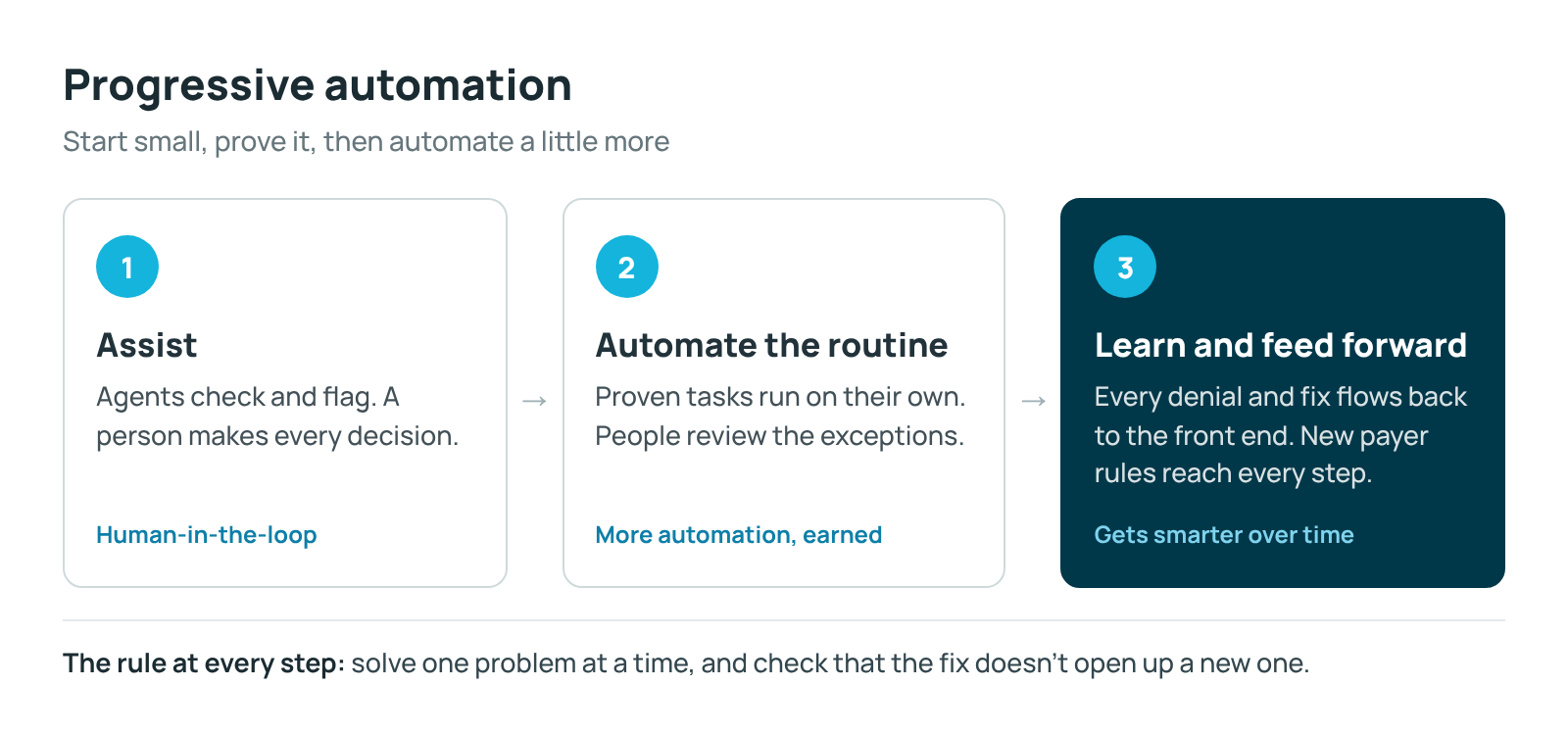
Progressive automation: start small, get smarter
Healthcare keeps changing. Payers update their rules, codes change every year, and authorization requirements shift. A system that only automates today’s process will be out of date in a few months. So the goal isn’t to automate everything on day one. It’s to build something that keeps learning.
- Assist. Agents check and flag; a person makes every decision. Human-in-the-loop from day one.
- Automate the routine. Once an agent has proven itself on a task, it handles the routine cases, and people review only the exceptions.
- Learn and feed forward. Every denial and every fix flows back to the front end, so the same mistake isn’t made twice. When a payer changes a rule, intake and claim checks learn it too, not just the billing team.
Solve one problem at a time, and check that the fix doesn’t open up a new one somewhere else. Prove it works, then take on the next.
Can you trust AI with claims?
It’s the right question, and the answer depends on how the agents are set up. Three non-negotiables:
- Patient data stays protected. Agents work inside the provider’s systems under HIPAA safeguards, and patient data never trains someone else’s model.
- A person approves anything risky. Agents handle routine, rule-based work. Appeals, write-offs and anything unusual go to a person to approve.
- Every action is on record. The system logs what the agent did, when and why, so you can trace and audit any claim.
Agents don’t replace your billing team’s judgement. They take away the repetitive work that buries it.
What it’s worth
Here’s a simple illustration for a mid-sized clinic, using the industry averages above:
| Today | With denials cut in half | |
|---|---|---|
| Claims sent per month | 1,000 | 1,000 |
| Denied the first time (15%) | 150 | 75 |
| Cost to rework each denial | about $57 | about $57 |
| Monthly rework cost | about $8,600 | about $4,300 |
That’s roughly $50,000 a year saved on rework alone. On top of that, cash arrives months sooner, and fewer claims end up among the one in four denials that are never recovered.
Illustration only: your volume, denial rate and payer mix will change the numbers.
The scorecard that matters
Forget vanity metrics. These six numbers tell you whether the agents are working:
| Metric | What it tells you | Direction you want |
|---|---|---|
| Clean claim rate | Share of claims paid on the first try | Up |
| Initial denial rate | Share of claims denied the first time | Down |
| Days in AR (accounts receivable) | How long it takes to get paid | Down |
| Rework hours per 100 claims | Time spent fixing instead of filing | Down |
| Cost to collect | What you spend to collect each dollar | Down |
| Revenue per visit | What each visit actually turns into | Up |
When the first four move the right way, the last two follow.
Start with one problem
- Pull last month’s claim denials and sort them by where they started, not by the payer’s reason code.
- Pick the top three causes. They usually cover a big share of the rework.
- Put an agent on the first one. Registration and coverage are usually the fastest win, starting with an intake agent on your booking calls.
- Measure again in 30 days. Keep what works, then automate a little more.
The organizations that get paid fastest aren’t working harder at billing. They’re getting it right before billing ever starts.
Bill once. Get paid once.
Spritle builds AI agents for healthcare operations, from intake voice agents to claim checks and revenue dashboards. Want to see where your do-overs come from? Let’s talk.
Sources
- Premier: Claims adjudication costs providers $25.7 billion
- Premier: Claims adjudication costs providers $25.7 billion (24 Feb 2025; 2023 data)
- Experian Health: 2025 State of Claims survey (22 Sep 2025)
- Premier: Claims adjudication costs providers $25.7 billion
- Becker’s: 86% of denials are potentially avoidable (Change Healthcare 2020 Denials Index)
- Becker’s: 86% of denials are potentially avoidable
- Experian Health: 2025 State of Claims survey
- Becker’s: 86% of denials are potentially avoidable
- Experian Health: 2025 State of Claims survey
- Experian Health: 2025 State of Claims survey


