

A company can have access to the latest AI models, dozens of AI tools, and a growing list of automation ideas and still make very little progress.
The problem is usually not the technology.
It is knowing where AI should be applied, what needs to change around it, and how to move from promising experiments to systems that actually work inside the business.
That is where AI Transformation Consulting comes in.
What Is AI Transformation Consulting?
AI Transformation Consulting is the strategic and technical process of helping an organization identify where AI can create business value, prepare its data and technology environment, design an AI roadmap, implement high-value use cases, and establish the governance and operating capabilities required to scale AI across the enterprise.
Unlike a standalone AI project, AI Transformation Consulting looks at the wider organization: processes, people, data, technology, workflows, security, governance, and business objectives.
In practice, AI Transformation Consulting Services connect business strategy with AI implementation so organizations can make informed decisions about what to build, what to integrate, and what not to pursue.
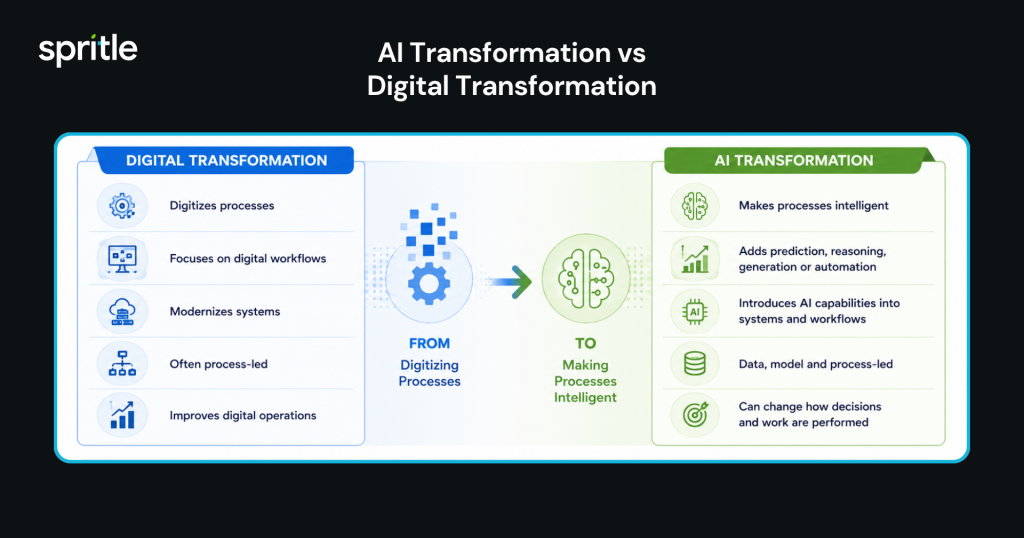
AI Transformation vs Digital Transformation
Digital transformation typically focuses on modernizing how a business operates through digital technologies.
AI transformation goes a step further by introducing systems that can interpret information, generate content, predict outcomes, automate decisions, or interact with users and business processes.
| Digital Transformation | AI Transformation |
| Digitizes processes | Makes processes intelligent |
| Focuses on digital workflows | Adds prediction, reasoning, generation or automation |
| Modernizes systems | Introduces AI capabilities into systems and workflows |
| Often process-led | Data, model and process-led |
| Improves digital operations | Can change how decisions and work are performed |
This distinction matters because simply adding an AI tool to an existing process does not necessarily create an Enterprise AI Transformation.
What Does an AI Transformation Consultant Actually Do?
An AI transformation consultant is not simply someone who recommends an AI model.
Their role is to connect business objectives, technology decisions and implementation priorities.
Depending on the organization, AI Transformation Consulting Services may involve:
- Assessing AI readiness across data, infrastructure, processes and teams
- Identifying high-value AI opportunities
- Building an AI strategy and transformation roadmap
- Prioritizing use cases based on business value and feasibility
- Designing AI and data architectures
- Selecting appropriate models and technologies
- Planning pilots and production implementations
- Establishing AI governance and security controls
- Supporting integration with existing enterprise systems
- Defining measurement and ROI frameworks
- Creating a path for enterprise-wide scaling
The important part is the connection between these activities.
A technically impressive AI solution can still fail if it solves a low-value problem, depends on inaccessible data, cannot integrate with existing systems, or has no clear owner after deployment.
Why Do Enterprises Need AI Transformation Consulting?
Most enterprises do not have an AI problem.
They have a prioritization problem.
A large organization may have hundreds of potential AI opportunities across customer service, finance, supply chain, engineering, operations, HR, sales and IT. The difficult question is not whether AI can be used.
It is:
Which AI initiatives should we actually invest in first?
That is one of the central roles of AI Transformation Consulting.
A structured consulting approach helps enterprises evaluate opportunities against factors such as:
- Business impact
- Technical feasibility
- Data availability
- Implementation complexity
- Security and compliance
- Adoption requirements
- Expected ROI
- Scalability
This prevents the transformation roadmap from becoming a collection of disconnected AI experiments.
The Key Components of AI Transformation Consulting
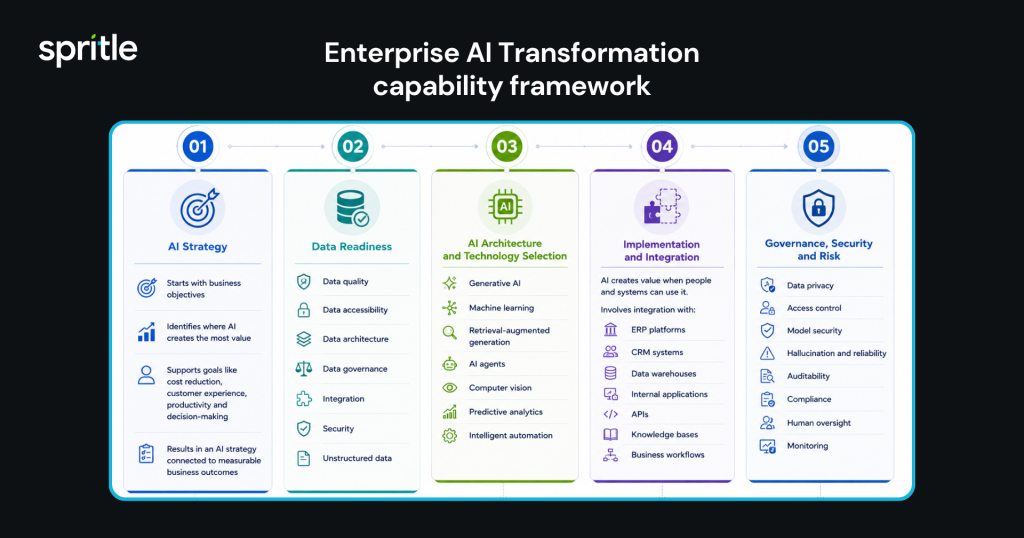
A successful Enterprise AI Transformation typically requires several capabilities to work together.
1. AI Strategy
The transformation begins with business objectives rather than technology selection.
Consultants identify where AI can support goals such as reducing operational costs, improving customer experience, accelerating product development, increasing productivity or improving decision-making.
The result is an AI strategy connected to measurable business outcomes.
2. Data Readiness
AI is only as useful as the information surrounding it.
An assessment should examine:
- Data quality
- Data accessibility
- Data architecture
- Data governance
- Integration
- Security
- Unstructured data
Poor data foundations can turn an apparently simple AI initiative into a much larger engineering project.
3. AI Architecture and Technology Selection
Enterprises may need to choose between different approaches, including:
- Generative AI
- Machine learning
- Retrieval-augmented generation
- AI agents
- Computer vision
- Predictive analytics
- Intelligent automation
The right choice depends on the problem.
A good AI Transformation Consulting engagement does not begin with “Which model should we use?” It begins with “What outcome are we trying to achieve?”
4. Implementation and Integration
An AI system creates business value only when people and existing systems can actually use it.
That can involve integration with:
- ERP platforms
- CRM systems
- Data warehouses
- Internal applications
- APIs
- Knowledge bases
- Business workflows
This is where AI Transformation Services move beyond strategy into engineering and operational execution.
5. Governance, Security and Risk
Enterprise AI introduces questions around:
- Data privacy
- Access control
- Model security
- Hallucination and reliability
- Auditability
- Compliance
- Human oversight
- Monitoring
Governance cannot be added as an afterthought.
It should be considered while the AI architecture and implementation approach are being designed.
The AI Transformation Process: From Assessment to Scale
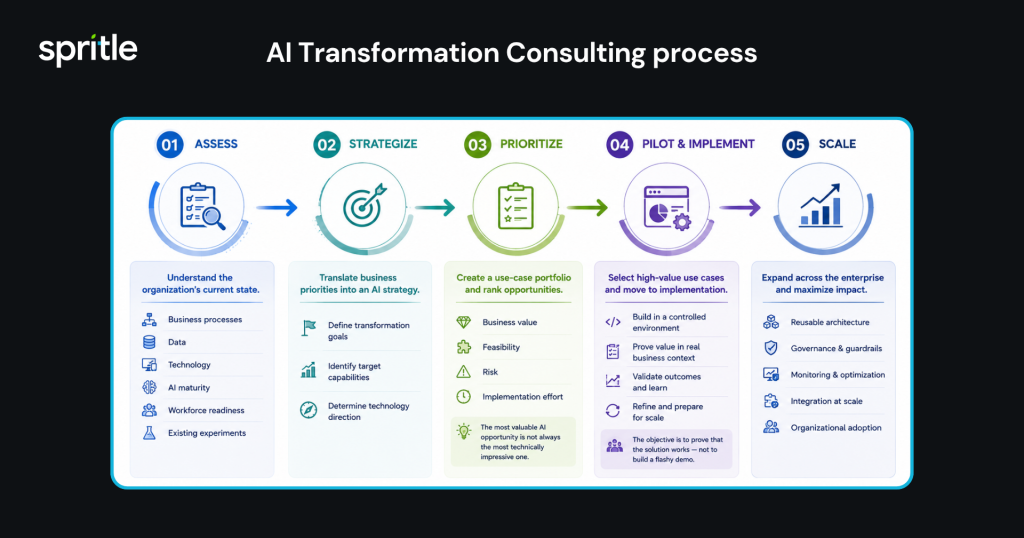
There is no universal transformation roadmap, but a practical AI Transformation Services journey can be organized into five stages.
Stage 1: Assess
Understand the organization’s current state.
Evaluate business processes, data, technology, AI maturity, workforce readiness and existing experiments.
Stage 2: Strategize
Translate business priorities into an AI strategy.
Define transformation goals, target capabilities and the technology direction.
Stage 3: Prioritize
Create a use-case portfolio and rank opportunities according to value, feasibility, risk and implementation effort.
This is often where organizations discover that their most valuable AI opportunity is not the most technically impressive one.
Stage 4: Pilot and Implement
Select high-value use cases and move them into controlled implementation.
The objective should not be to build a flashy demonstration.
It should be to prove that the solution works within the organization’s actual environment.
Stage 5: Scale
Once a solution demonstrates value, expand it across relevant teams, processes and business units.
Scaling requires reusable architecture, governance, monitoring, integration and organizational adoption.
This is what separates an isolated AI project from Enterprise AI Transformation.
Enterprise AI Transformation Use Cases
The right use cases vary by industry and business model, but common opportunities include:
Customer operations: AI assistants, intelligent ticket routing, knowledge retrieval and personalized interactions.
Finance: Document processing, forecasting, anomaly detection and financial analysis.
Manufacturing: Predictive maintenance, visual inspection, production optimization and operational intelligence.
Software engineering: Code assistance, automated testing, documentation and developer productivity.
Supply chain: Demand forecasting, inventory optimization and exception management.
Enterprise knowledge: Internal search, document intelligence and AI-powered knowledge assistants.
The goal is not to deploy AI everywhere.
It is to identify the areas where AI can create measurable and sustainable value.
What Are the Benefits of AI Transformation Consulting?
A structured consulting approach can help organizations:
- Align AI investments with business priorities
- Avoid low-value AI experiments
- Identify practical transformation opportunities
- Build a scalable AI roadmap
- Improve data and technology readiness
- Reduce implementation risks
- Establish governance earlier
- Create repeatable AI capabilities
- Move promising pilots toward production
- Measure business outcomes more effectively
The real benefit is not simply “using more AI.”
It is building an organization that knows where AI belongs and how to operationalize it.
Common AI Transformation Challenges
AI transformation rarely fails because a model cannot be trained.
The harder challenges are often organizational and architectural.
Starting With Technology Instead of the Business Problem
Choosing an AI technology first can lead to solutions searching for problems.
Treating the Pilot as the Destination
A successful proof of concept does not automatically become a production system.
Ignoring Legacy Architecture
Enterprise AI often needs to work with systems that were never designed for AI-driven workflows.
Underestimating Data Readiness
Incomplete, fragmented or inaccessible data can delay implementation.
Forgetting Adoption
Employees need to understand how AI changes their workflows and where human judgment remains necessary.
Scaling Without Governance
A solution that works for one team can create security, compliance and operational problems when rolled out across the enterprise.
How to Choose an AI Transformation Consulting Company
Choosing a consulting partner should go beyond looking at a list of AI technologies.
Ask:
- Can they connect AI strategy to measurable business outcomes?
- Do they understand enterprise data and legacy environments?
- Can they move from strategy and pilots into production?
- Do they address security and governance from the beginning?
- Can they integrate AI with existing business systems?
- Do they understand change management and adoption?
- Can they explain how success will be measured?
The strongest Enterprise AI Transformation Consulting Services combine strategic thinking with technical execution.
You should be able to see a clear path from business problem → AI opportunity → architecture → implementation → measurement → scale.
AI Transformation Consulting vs AI Development
These services are related, but they solve different problems.
AI development focuses primarily on building an AI solution.
AI Transformation Consulting determines where AI should be used, how it should fit into the organization, what capabilities are required, and how multiple AI initiatives can be prioritized and scaled.
In other words, development can build the solution.
Consulting helps determine which solution is worth building and how it fits into the larger transformation.
What Does AI Transformation Cost?
There is no universal price for AI Transformation Consulting Services.
Cost depends on factors such as:
- Number and complexity of use cases
- Data maturity
- Existing technology infrastructure
- Integration requirements
- Governance requirements
- Industry regulations
- Pilot scope
- Enterprise rollout requirements
A practical approach is to start with a focused assessment and prioritize initiatives before committing to a large transformation program.
How Should an Enterprise Get Started?
The first step does not need to be a large AI deployment.
Start by answering four questions:
- Where does the business lose the most time, money or information?
- Which processes involve large amounts of repetitive or knowledge-intensive work?
- What data is already available to support AI?
- Which opportunity could demonstrate measurable value without creating disproportionate risk?
These answers provide the foundation for an actionable AI Transformation Services roadmap.
The objective is not to predict every AI initiative the company will need over the next five years.
It is to identify the right next move and build the capability to make the next decision intelligently.
Final Takeaway
AI Transformation Consulting is not about adding AI to an organization. It is about redesigning how the organization identifies, implements and scales AI opportunities.
The strongest AI Transformation Consulting Services connect strategy, data, architecture, implementation, governance and adoption into one coordinated approach.
For enterprises, that shift matters.
The question is no longer simply:
“Where can we use AI?”
It is:
“Where can AI create measurable value, what needs to change around it, and how do we scale what works?”
That is the real starting point for an Enterprise AI Transformation.
If your organization is evaluating AI opportunities, building an enterprise AI roadmap, or deciding which initiatives should move from experimentation to production, an AI transformation assessment can provide a practical starting point.
Frequently Asked Questions
What is AI Transformation Consulting?
AI Transformation Consulting helps organizations develop an AI strategy, identify high-value use cases, assess data and technology readiness, plan implementation, establish governance and create a roadmap for scaling AI across the enterprise.
What does an AI transformation consultant do?
An AI transformation consultant connects business objectives with AI opportunities. Their work can include readiness assessment, use-case prioritization, AI architecture, technology selection, implementation planning, governance and scaling strategy.
What is the difference between AI consulting and AI transformation?
AI consulting can focus on a specific AI problem, strategy or solution. AI transformation takes a broader enterprise view, covering strategy, processes, data, technology, implementation, governance and organizational adoption.
Why is Enterprise AI Transformation difficult?
Enterprise AI must operate across existing data, applications, workflows, security requirements and organizational structures. Scaling AI therefore involves much more than selecting and deploying a model.
How do companies start an AI transformation?
Companies can begin with an AI readiness assessment, identify business problems with strong AI potential, prioritize use cases based on value and feasibility, and develop a phased roadmap for pilot, implementation and scale.
What are AI Transformation Services?
AI Transformation Services can include AI strategy, readiness assessment, use-case discovery, data and architecture planning, AI development, integration, governance, deployment and ongoing optimization.


