

An AI model can work perfectly in a demo and still fail the moment it enters an enterprise environment.
The data may be fragmented. The model may not integrate with existing applications. Security teams may reject the architecture. Employees may not trust the output. And nobody may know who owns the system once it reaches production.
That is the difference between building AI and implementing AI.
Enterprise AI implementation is the process of taking an AI capability from business requirement to production use, connecting it with enterprise data and systems, governing how it operates, and continuously measuring whether it delivers the intended outcome.
The model is only one part of the job.
What Is Enterprise AI Implementation?
Enterprise AI implementation is the end-to-end process of deploying AI within an organization’s real business environment, including strategy, data preparation, model development or selection, system integration, deployment, security, governance, monitoring, adoption, and ongoing optimization.
In simple terms:
Enterprise AI implementation turns an AI capability into an operational business system.
That distinction matters.
Calling an API to generate a response is AI usage.
Building an AI assistant that securely retrieves information from enterprise systems, respects user permissions, integrates with workflows, logs activity, is monitored for quality, and has measurable business KPIs is Enterprise AI Implementation.
Modern implementation guidance increasingly makes this distinction between experimentation and production a central concern.
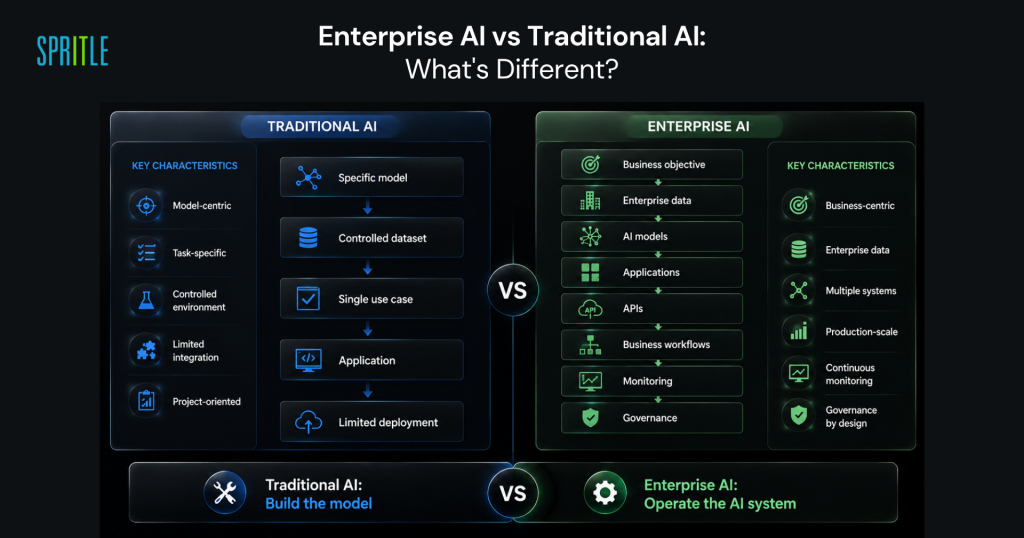
Enterprise AI vs Traditional AI: What’s Different?
Traditional AI projects often focus on building a model for a specific task.
Enterprise AI has a larger problem to solve: the model has to operate inside an organization.
| Traditional AI Project | Enterprise AI Implementation |
| Focuses primarily on a model or use case | Connects AI to business operations |
| Often uses controlled datasets | Works with enterprise-scale data environments |
| May operate independently | Must integrate with existing systems |
| Model accuracy is a major focus | Accuracy, security, reliability and business impact all matter |
| Limited number of users | Designed for enterprise users and workloads |
| Deployment may be the final step | Deployment begins continuous monitoring and optimization |
| Project-oriented | Lifecycle-oriented |
An enterprise implementation therefore needs more than data scientists and models.
It needs data engineering, software engineering, infrastructure, security, governance, monitoring and business ownership working together.
Why Enterprise AI Implementation Is Harder Than an AI Prototype
A prototype usually answers:
“Can this AI solution work?”
Enterprise implementation has to answer several harder questions:
- Can it work with our real data?
- Can it integrate with our existing applications?
- Can authorized users access it safely?
- Can we monitor its behaviour?
- What happens when the model produces a wrong answer?
- Who owns the system?
- How do we measure business value?
- Can the solution handle enterprise-scale workloads?
- What happens when the model or data changes?
This is why an AI proof of concept should not be treated as the final destination.
A recent enterprise implementation guide, for example, emphasizes data foundations, architecture, governance, operational ownership and ROI as key production concerns rather than simply demonstrating model capability.
The difficult part begins when AI has to become part of the business.
The Enterprise AI Implementation Lifecycle
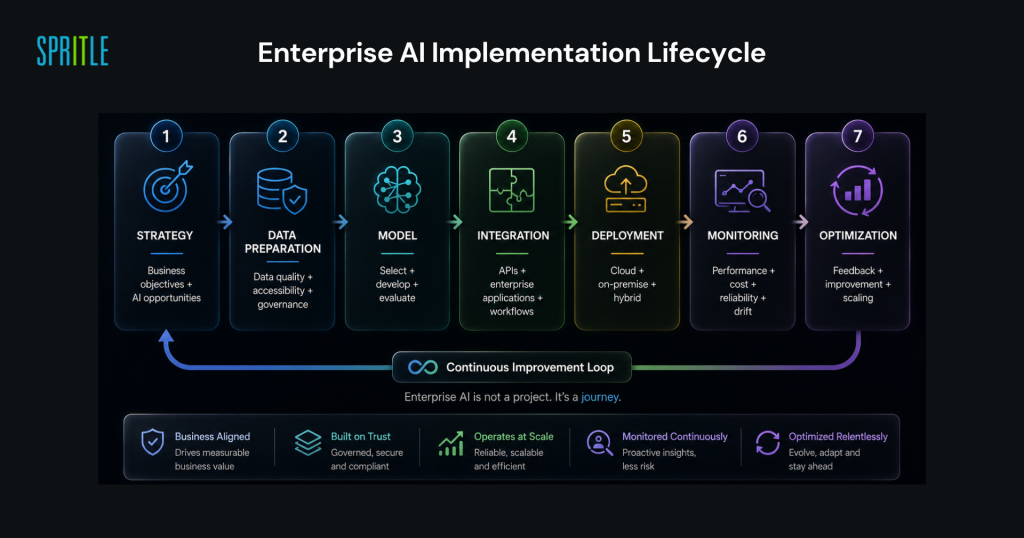
A practical Enterprise AI Implementation lifecycle can be organized into seven stages.
1. AI Strategy and Use-Case Identification
Implementation should start with the business problem, not the model.
Organizations first identify where AI could create measurable value.
Potential opportunities may include:
- Customer service automation
- Document intelligence
- Predictive maintenance
- Demand forecasting
- Fraud detection
- Knowledge assistants
- Software development
- Quality inspection
- Intelligent workflow automation
- AI agents
Each opportunity should be evaluated against business value, data availability, technical feasibility, risk, implementation effort and scalability.
The result is an AI implementation roadmap rather than a collection of disconnected experiments.
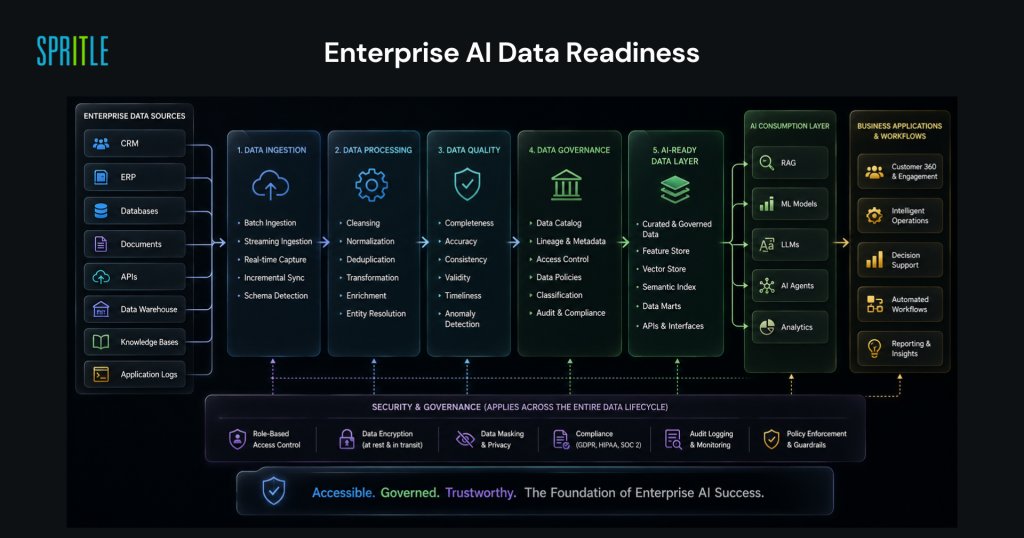
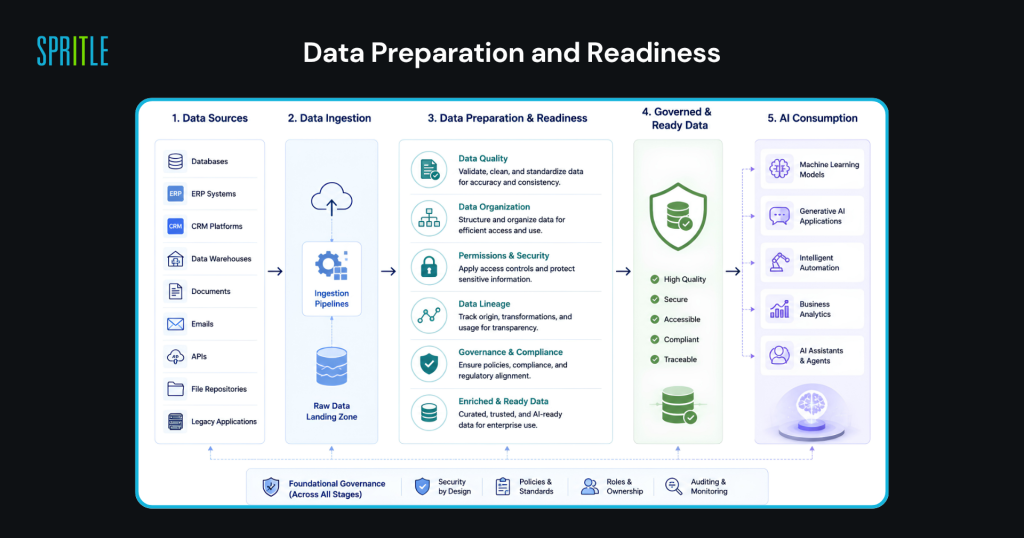
2. Data Preparation and Readiness
This is where many AI projects discover their real problem.
Enterprise data is often distributed across:
- Databases
- ERP systems
- CRM platforms
- Data warehouses
- Documents
- Emails
- APIs
- File repositories
- Legacy applications
Before AI can reliably use that information, organizations need to consider data quality, accessibility, structure, permissions, lineage and governance.
This is particularly important for generative AI and RAG systems, where retrieval quality directly affects the usefulness of the final output.
Recent enterprise AI analysis has highlighted data quality and readiness as major barriers to scaling AI from pilots into production.
3. Model Selection and Development
The best enterprise AI solution is not automatically the model with the highest benchmark score.
Depending on the use case, organizations may use:
- Large language models
- Small language models
- Machine learning models
- Computer vision models
- Speech models
- Predictive models
- Fine-tuned models
- Retrieval-augmented generation
- AI agents
- Hybrid model architectures
The decision should consider:
Accuracy + latency + cost + security + data requirements + scalability + maintainability.
For some workflows, a smaller model may be sufficient.
For others, a more capable model may justify the additional cost and complexity.
This is why model selection should be treated as an architecture decision, not simply a vendor comparison.
4. AI Integration With Enterprise Systems
An AI model sitting in isolation does not transform a business.
It needs to connect with the systems where work actually happens.
That could include:
- ERP
- CRM
- HR platforms
- Supply-chain systems
- Databases
- Internal applications
- APIs
- Knowledge repositories
- Data platforms
- Workflow engines
For example, an AI customer-service assistant becomes much more useful when it can securely retrieve customer information, check order status, access approved knowledge and initiate permitted workflows.
Integration is the bridge between AI capability and business action.
5. Deployment and MLOps
Once the solution has been validated, it needs a production environment.
This can involve:
- Cloud deployment
- On-premises infrastructure
- Hybrid architecture
- Containerization
- API management
- CI/CD
- Model versioning
- Model registries
- Automated testing
- Infrastructure monitoring
For machine learning systems, MLOps helps manage the operational lifecycle of models.
For generative AI systems, the operational layer may additionally involve prompt/version management, retrieval pipelines, evaluation, guardrails, model routing and inference monitoring.
The objective is not simply to deploy once.
It is to make the system repeatable, observable and maintainable.
AI Monitoring: What Happens After Deployment?
Deployment is not the finish line.
It is the point where the organization starts collecting evidence about how the AI system behaves in the real world.
Monitoring may cover:
- Accuracy
- Latency
- Availability
- Cost
- Data drift
- Model drift
- Hallucination or response quality
- Security events
- User feedback
- Usage patterns
- Business KPIs
For enterprise AI, governance also needs to continue across the lifecycle. ServiceNow’s current AI governance guidance, for example, describes governance as spanning demand and intake through deployment, monitoring and value realization.
That leads to an important principle:
An enterprise AI system should be managed as a lifecycle, not a one-time deployment.
AI Governance and Security Cannot Be Added Later
An AI system may interact with sensitive business information, make recommendations, generate content or trigger downstream actions.
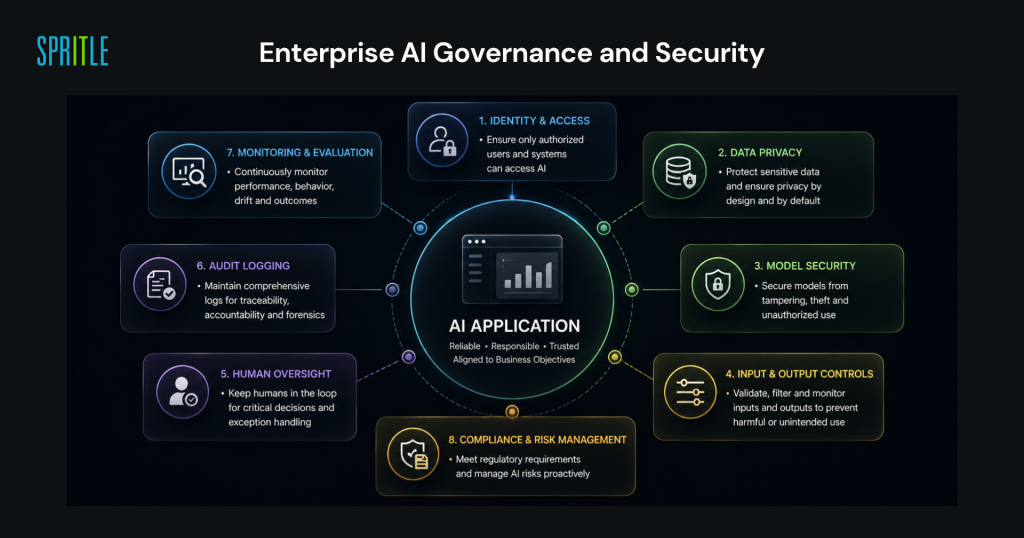
That makes governance part of the implementation architecture.
Important controls can include:
- Identity and access management
- Data privacy
- Encryption
- Audit logging
- Model access controls
- Prompt and input protection
- Output validation
- Human approval
- Policy enforcement
- Risk assessment
- Compliance controls
For agentic systems, governance becomes even more important because AI systems can interact with tools and execute actions rather than simply return text.
The safest approach is governance by design: define security, monitoring, accountability and risk controls while the system is being designed rather than after it reaches production. Current enterprise governance guidance increasingly emphasizes this lifecycle-based approach.
Enterprise AI Implementation Use Cases
Enterprise AI can be implemented across almost every major business function.
Customer Operations
AI assistants, intelligent routing, knowledge retrieval, conversation analysis and automated support.
Finance
Invoice processing, anomaly detection, forecasting, document extraction and financial analysis.
Manufacturing
Computer vision inspection, predictive maintenance, process optimization and production intelligence.
Supply Chain
Demand forecasting, inventory optimization, supplier analysis and exception management.
Software Engineering
Code generation, test automation, code review, documentation and developer assistants.
Enterprise Knowledge
AI-powered search, document intelligence, knowledge assistants and RAG-based internal systems.
The important question is not:
“Where can we put AI?”
It is:
“Which business processes become meaningfully better when AI is introduced?”
Benefits of Enterprise AI Implementation
A well-planned implementation can help organizations:
- Automate repetitive knowledge work
- Improve decision support
- Reduce manual processing
- Make enterprise information easier to access
- Improve operational efficiency
- Accelerate software and product development
- Personalize customer experiences
- Detect operational anomalies
- Build new AI-powered products and services
- Create reusable AI capabilities across business units
But these benefits depend on execution.
A poorly integrated AI system can create more operational complexity rather than less.
Common Enterprise AI Implementation Challenges
1. Poor Data Readiness
AI cannot compensate for inaccessible, inconsistent or poorly governed enterprise data.
2. Too Many Pilots
Organizations can accumulate prototypes without creating a path to production.
3. Choosing Technology Too Early
Starting with a model or platform instead of a business problem can produce unnecessary complexity.
4. Legacy Integration
Existing enterprise systems may not have been designed to support AI-driven workflows.
5. Security and Compliance
Sensitive data and AI-generated outputs require appropriate controls.
6. Lack of Ownership
Someone must remain accountable for the system after launch.
7. Measuring the Wrong Thing
Model accuracy alone does not prove business value.
The better question is:
Did the AI system improve the business metric it was introduced to change?
How to Build an Enterprise AI Implementation Strategy
A practical strategy can follow this sequence:
Business goal → Use case → Data readiness → Architecture → Model → Pilot → Integration → Production → Monitoring → Scale
At every stage, ask three questions:
Does it create business value?
Can we operate it reliably?
Can we scale it responsibly?
This prevents the implementation from becoming purely technology-driven.
It also creates a clearer path from an individual AI project to broader enterprise AI adoption.
Enterprise AI Implementation vs AI Tool Adoption
There is an important distinction between buying an AI product and implementing AI.
Installing an enterprise AI assistant may give employees access to a powerful tool.
But if an organization redesigns a customer-service workflow around AI, connects it to approved enterprise knowledge, establishes access controls, monitors response quality and measures resolution time, that is Enterprise AI Implementation.
The difference is operational.
Tool adoption gives people AI.
Implementation puts AI into the way the business works.
How to Know If Your Enterprise Is Ready for AI Implementation
Before starting, evaluate five areas:
| Area | Key Question |
| Business | Is there a measurable problem worth solving? |
| Data | Is the required data accessible and trustworthy? |
| Technology | Can AI integrate with the existing environment? |
| Governance | Can security, privacy and risk requirements be enforced? |
| Operations | Is there ownership for the system after deployment? |
If several answers are “no,” the next step may not be implementation.
It may be AI readiness.
That assessment can prevent an organization from spending months building a solution on foundations that are not ready.
The Real Goal of Enterprise AI Implementation
The objective is not to deploy the largest model.
It is not to launch the most impressive AI demo.
And it is not to say that every department is “using AI.”
The real goal is to create AI systems that work reliably within the business and produce measurable outcomes.
That requires a connected approach across strategy, data, models, software, infrastructure, integration, security, governance and people.
In other words:
Enterprise AI implementation is where AI stops being an experiment and starts becoming part of the operating model.
For organizations moving from isolated AI pilots toward production systems, an implementation assessment can help identify the right use cases, technical foundations, integration requirements and deployment path before significant resources are committed.
Frequently Asked Questions
What is Enterprise AI Implementation?
Enterprise AI implementation is the end-to-end process of deploying AI within an organization’s real business environment, covering strategy, data, model development or selection, integration, deployment, security, governance, monitoring and ongoing optimization.
How is enterprise AI different from traditional AI?
Traditional AI projects often focus on developing a model for a specific task. Enterprise AI must also address integration, security, governance, scalability, monitoring, user adoption and business outcomes.
What are the main stages of Enterprise AI Implementation?
The typical lifecycle includes strategy and use-case selection, data preparation, model development or selection, integration, deployment, monitoring, governance and continuous optimization.
How long does enterprise AI implementation take?
There is no universal timeline. A focused AI use case can move faster than a multi-system enterprise rollout. Complexity, data readiness, integration requirements, governance and deployment environment all affect implementation time.
What are the biggest challenges in implementing AI in enterprises?
Common challenges include poor data readiness, unclear use cases, legacy integration, security and governance requirements, lack of operational ownership, and difficulty moving successful pilots into production.
Does enterprise AI require custom AI models?
Not necessarily. Enterprises can use foundation models, APIs, open-source models, fine-tuned models, traditional machine learning or combinations of these approaches. The appropriate choice depends on the use case and business requirements.
How can enterprises measure AI implementation success?
Measure business outcomes alongside technical metrics. Depending on the use case, this could include processing time, cost reduction, productivity, accuracy, customer satisfaction, revenue impact, adoption or decision quality.


