

You’ve played around with Lovable AI or Bolt.new . Dragged, dropped, typed prompts, and suddenly…your MVP is “working.” Users can click, scroll, maybe even buy something. Feels good, right? Until the first real user hits the login button and it breaks. Or a payment fails. Or your database quietly throws an error that you didn’t even see.
If that sounds familiar, welcome to the club. You’re not failing—you’re just at the stage where AI app builders get you 70–80% there, but the last 20% is all human engineering. This guide will explain what “production-ready” actually means, why AI MVPs stall, and how to get across the finish line without losing your mind—or your users.
Where AI App Builders Shine and Where They Trip
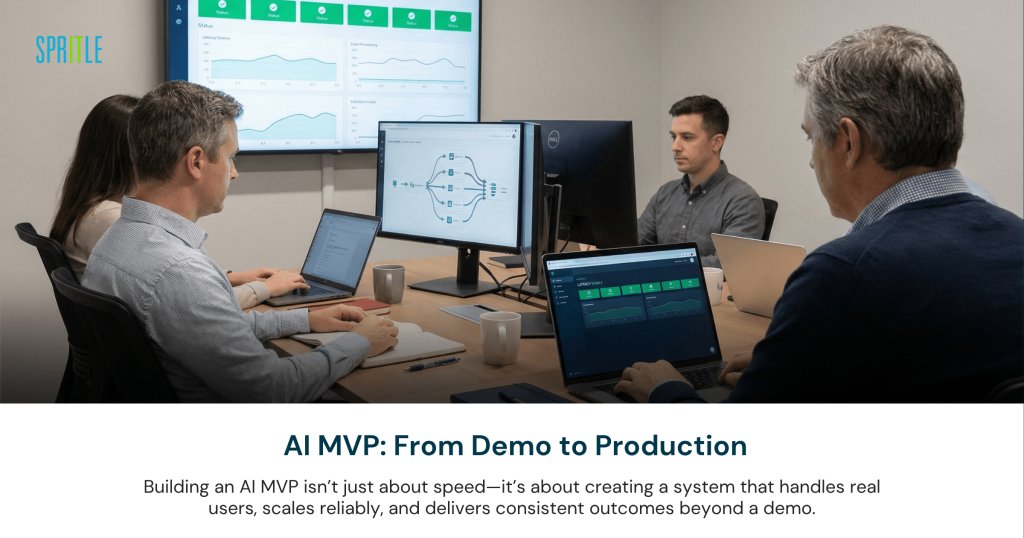
Let’s be honest: tools like Manus AI, Cursor AI, and Framer AI are amazing. You can:
- Whip up UI in minutes
- Generate React or Next.js components
- Store data in a simple table
…but here’s the rub: they don’t handle the messy stuff.
Here’s where founders usually hit the wall:
- Authentication – Users can sign up, but tokens expire randomly, sessions fail, multi-device login is impossible.
- Payments – Sandbox works. Real money? Not so much. Failed webhooks, race conditions, and currency issues lurk here.
- APIs – AI can generate snippets, but it won’t automatically handle retries, rate-limits, or secure key storage.
- Database logic – Flat tables or JSON only get you so far. Triggers, relationships, and validations? Nope.
- Performance & responsiveness – AI prototypes look great on desktop but lag on mobile or choke under load.
Think of AI builders as the skeleton. The muscles, tendons, and nerves? That’s the human dev work.
What “Production-Ready” Actually Means
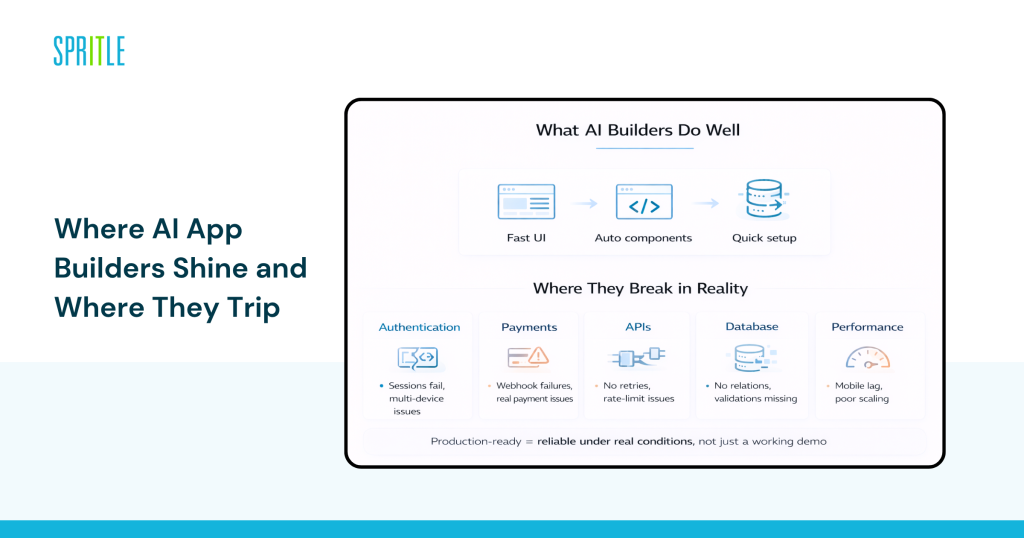
Stop thinking in terms of “looks done” or “sort-of works.” Production-ready has specific checkboxes:
- Authentication & security – Multi-device login, OAuth, JWT tokens, encrypted storage.
- Payments – Proper error handling, real-time webhook verification, multi-currency support.
- Database & backend logic – Relational schema, triggers, validations, indexing, optimized queries.
- APIs & integrations – Retries, rate-limiting, secure key storage, alerting for failures.
- Performance & responsiveness – Smooth across devices, lazy loading, caching strategies.
- Deployment & monitoring – CI/CD pipelines, cloud hosting, error tracking, rollback capabilities.
Here’s the truth: if any of these are missing, your MVP isn’t production-ready. No amount of prompt engineering fixes it.
Where Founders Usually Get Stuck
Here’s the “you know it when you see it” list:
1. Authentication Glitches
Users sign up fine. But try logging in on mobile or another device? Sessions vanish. Forgotten passwords break flow. Security holes pop up.
2. Payments That Fail Silently
Sandbox may work, but real transactions fail without proper error handling. Refunds? Multi-currency? AI builders don’t cover that.
3. Broken APIs
API snippets generate beautifully in your code, but one missed retry or rate-limit and suddenly your analytics, shipping, or notifications stop working.
4. Database Logic Gaps
Prototype tables are flat. Relationships, triggers, data validation, transactions—these are all missing. Without them, scaling is a headache.
5. Performance Issues
AI builders focus on “looks.” Users on iPhones or slow connections experience lag, crashes, or blank screens. First impressions are brutal.
How Technical Completion Fixes These Issues
Here’s what a skilled technical partner does:
- Authentication & Security – Implements OAuth, session persistence, encrypted data storage, JWT tokens.
- Payments – Moves from sandbox to production with webhook verification, retries, multi-currency support.
- Database & Backend Logic – Normalizes tables, creates triggers, validations, and optimized queries.
- APIs & Integrations – Adds retries, rate-limiting, monitoring, and secure key handling.
- Performance & Front-End – Lazy loading, caching, responsive layouts across all devices.
- Deployment & Monitoring – CI/CD setup, cloud hosting, error logging, alerting, rollback capability.
Think of it like turning a fast sketch into a fully engineered machine.
Real-Life Scenarios
Scenario 1: E-commerce MVP on Bolt.new
- Prototype: product pages and cart flows.
- Stuck: Checkout fails for multiple simultaneous users.
- Completion: Added transactional handling, webhook verification, monitoring.
- Result: Users check out reliably, first revenue flows smoothly.
Scenario 2: Content Platform on Framer AI
- Prototype: Course content loads.
- Stuck: Mobile login crashes, notifications don’t trigger.
- Completion: OAuth implemented, token refresh handled, UI optimized.
- Result: Mobile users finally enjoy a smooth experience.
Scenario 3: Analytics Dashboard on Manus AI
- Prototype: Single dataset charts.
- Stuck: Real-time API calls break under multiple users.
- Completion: Added retry logic, rate-limiting, cloud deployment.
- Result: Dashboard scales without downtime.
When to Bring in a Technical Partner
You’ve already done the creative heavy lifting. Know when to call in a pro:
- Critical flows like login, payments, or API calls fail under normal use.
- You need stability for real users, not just beta testers.
- Deployment, monitoring, or scaling introduces unfamiliar challenges.
The fastest teams don’t prompt harder—they know what requires expert hands.
FAQ
Q: What does “production-ready” mean for AI-built apps?
A: Authentication, payments, database, API, performance, and deployment must work reliably in real-world conditions—not just in sandbox.
Q: Can AI builders like Lovable AI or Bolt.new produce production-ready apps?
A: They create working prototypes. Production-ready apps need human engineering for backend, security, integrations, and performance.
Q: Is technical completion only about coding?
A: No. It’s architecture, deployment, monitoring, and making the app reliable for users.
Q: How do I know if my MVP needs completion?
A: Any critical flow—login, payment, API, database—fails in real usage. That’s your cue to bring in technical expertise.
Conclusion
You’ve already built something tangible with AI app builder .The missing step isn’t more prompts—it’s technical completion. Understanding what production-ready truly means helps you plan, avoid pitfalls, and launch confidently. The gap is smaller than you think. With the right partner, your prototype becomes a reliable, scalable, production-grade app.


