

Introduction
Manual QA is slowing your releases more than your code is. Engineering teams across the US are hitting a ceiling where testing cycles cannot keep up with deployment speed. According to the 2025 World Quality Report, nearly 40% of delays in software delivery are tied directly to testing inefficiencies.
Here’s the problem. You cannot scale testing the same way you scale development.
This is where AI test automation inside ADLC changes the equation. By embedding testing into the AI-driven software development lifecycle, teams are reducing QA bottlenecks, improving defect detection, and accelerating releases without expanding QA headcount. The shift is not incremental. It is structural, and it starts with understanding how testing actually evolves inside ADLC.
Where AI Test Automation Lives Inside the AI Software Development Lifecycle
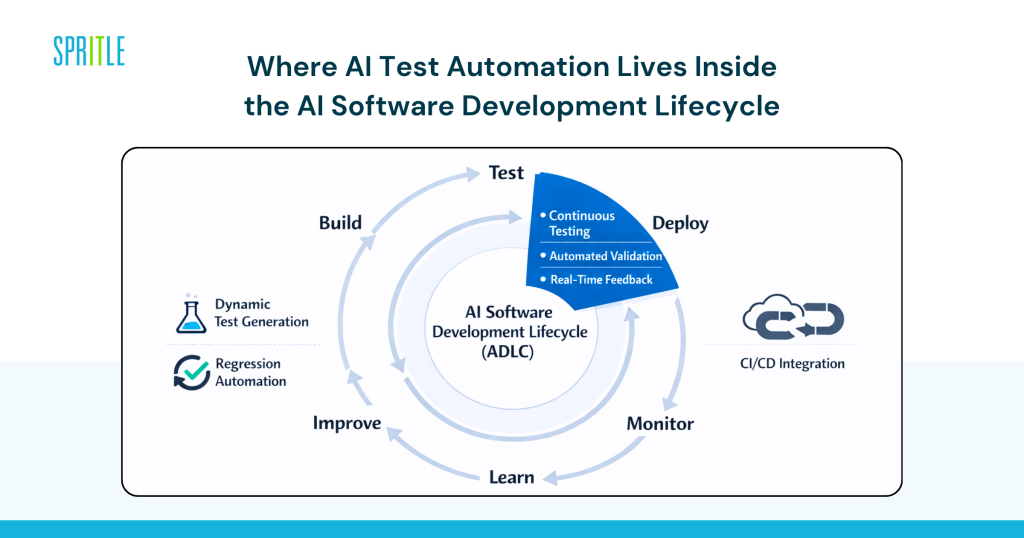
AI test automation is not a layer added after development. It is a core component of the AI software development lifecycle itself.
AI test automation in ADLC refers to the use of machine learning models and intelligent systems to automatically generate, execute, maintain, and optimize test cases across the development lifecycle.
This includes:
- Dynamic test generation based on user behavior
- Automated regression testing
- Real-time validation in CI/CD pipelines
Unlike traditional QA, testing is no longer a phase. It becomes a continuous system embedded in the AI-driven software development lifecycle.
Why This Changes Everything
Manual QA depends on scripts, human effort, and static scenarios.
AI-driven testing adapts.
It learns from:
- production data
- user flows
- historical defects
That shift is what transforms testing from a bottleneck into an accelerator.
Why QA Bottlenecks Are Forcing Teams to Rethink Testing
The cost of QA is rising, but the bigger issue is speed.
According to Capgemini’s 2025 report, enterprises using AI-driven testing reduced testing effort by up to 30% while improving release frequency.
What most teams miss is this. Manual QA was built for predictable systems. Modern applications are not predictable.
The Pressure Points You Are Already Feeling
- Regression cycles taking days instead of hours
- QA teams stretched thin across multiple releases
- High cost of hiring skilled QA engineers in the US
- Increasing complexity in microservices and APIs
At the same time, AI-native competitors are shipping updates daily. That gap compounds quickly.
How AI Test Automation Actually Replaces Manual QA Work
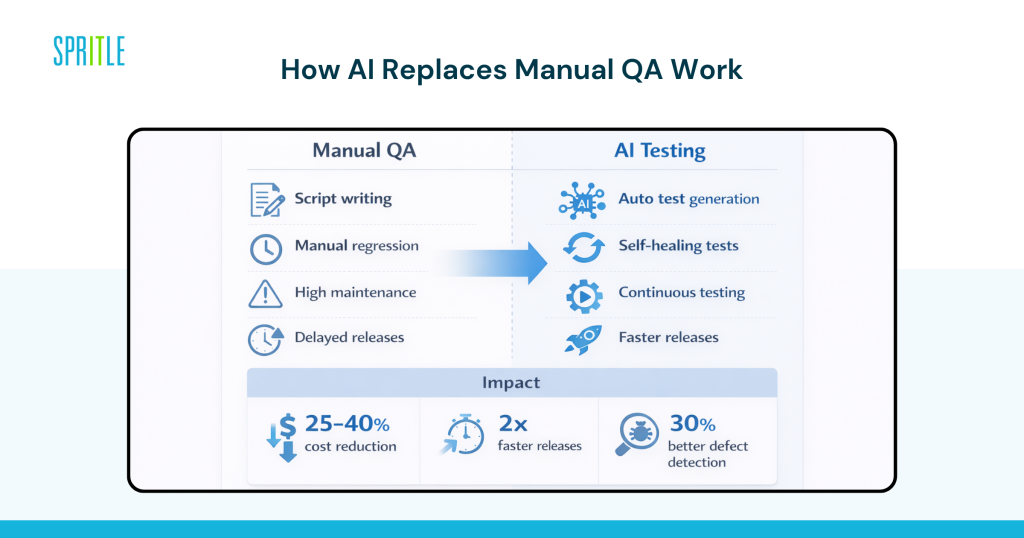
This is where it gets practical. AI is not replacing QA teams entirely. It is replacing specific types of work that do not scale.
Intelligent Test Creation Instead of Script Writing
Tools like Mabl, Testim, and Functionize generate test cases automatically by analyzing application behavior.
Instead of writing scripts, your team defines intent.
AI handles:
- UI test generation
- API validation scenarios
- edge case discovery
Gartner estimates that AI-driven test generation can reduce manual scripting effort by up to 50%.
Self-Healing Tests That Reduce Maintenance Overhead
One of the biggest hidden costs in QA is test maintenance.
AI tools solve this with self-healing capabilities:
- UI changes are detected automatically
- test scripts update without manual intervention
- false failures are reduced
This alone can cut maintenance time by 30 to 40 percent.
Continuous Testing Inside AI-Assisted CI/CD
Testing no longer waits for a release cycle.
Inside an AI-assisted CI/CD pipeline, tests run continuously:
- every commit triggers validation
- defects are caught earlier
- feedback loops improve future test coverage
This creates an intelligent testing and QA system that evolves with your application.
What This Means for Cost, Speed, and Engineering Efficiency
This is the section most CTOs care about. Does this actually move the needle?
The short answer is yes, but only when implemented inside ADLC.
Measurable Business Impact
Organizations adopting AI test automation report:
- 25 to 40% reduction in QA costs
- 2x faster release cycles
- up to 30% improvement in defect detection rates
Source: World Quality Report 2025
Why the ROI Is Real
You are not just saving time.
You are:
- reducing manual effort
- minimizing production defects
- accelerating feedback loops
This is how teams begin to reduce software development costs with AI without compromising quality.
Real-World Examples of AI Testing in Action
Netflix and Continuous Testing at Scale
Netflix uses automated and intelligent testing systems as part of its deployment pipeline.
Impact:
- thousands of tests executed per deployment
- minimal manual QA intervention
- high system reliability at scale
Their approach aligns closely with ADLC principles.
US Fintech Company Modernizing QA
A New York-based fintech firm adopted AI testing tools integrated with CI/CD.
Results:
- regression testing reduced from 48 hours to under 8 hours
- defect leakage dropped by 20%
- faster compliance validation
SaaS Platform in Chicago Scaling Without QA Hiring
A SaaS company replaced 60% of manual QA workflows with AI-based testing.
Outcomes:
- no additional QA hires despite product growth
- faster sprint cycles
- improved release confidence
The Risks You Need to Plan For Early
AI test automation is not plug-and-play. There are real risks if you approach it incorrectly.
Blind Trust in AI Outputs
AI-generated tests still need validation. Without oversight, false positives or missed edge cases can occur.
Poor Data Leads to Poor Testing
AI systems rely on historical and behavioral data. Weak datasets limit effectiveness.
Tool Fragmentation Across Teams
Using multiple disconnected testing tools creates inefficiencies instead of solving them.
Compliance and Security Concerns
In regulated industries, AI-generated tests must meet strict validation standards.
The honest answer is this. AI testing works best when it is part of a structured AI-driven software development lifecycle, not a standalone initiative.
What High-Maturity Teams Do Differently With AI Testing
This is where separation happens between teams experimenting with AI and those scaling it.
1. They Embed Testing Into Development, Not After
Testing is continuous, not a final step.
2. They Standardize Tools and Workflows
Consistency across teams ensures scalability.
3. They Invest in Feedback Loops
Every test result feeds back into improving future tests.
4. They Combine AI With Human Oversight
AI handles scale. Humans handle judgment.
5. They Partner Strategically When Needed
This is where many teams explore ADLC consulting services or work with an AI software development company to accelerate adoption.
If you are trying to build this from scratch, expect a learning curve.
How to Start Implementing AI Test Automation Without Disrupting Delivery
You do not need a full transformation on day one. You need a controlled rollout.
- Identify high-impact QA bottlenecks such as regression testing
- Introduce AI testing tools in a limited scope environment
- Integrate with existing CI/CD pipelines gradually
- Define governance for validation and security
- Expand based on measurable improvements
What separates teams that succeed is not the tool. It is how they integrate it into ADLC.
If you want to move faster, working with an experienced AI development lifecycle partner or provider of enterprise AI development solutions can shorten the path significantly.
Frequently Asked Questions
Q: How does AI test automation fit into the AI-driven software development lifecycle?
A: AI test automation is embedded directly into the AI-driven software development lifecycle as a continuous process. It automates test creation, execution, and optimization while integrating with CI/CD pipelines for real-time validation.
Q: Is AI test automation replacing QA engineers completely?
A: No. It replaces repetitive manual tasks like regression testing and script maintenance. QA engineers focus more on strategy, edge cases, and validation within the AI software development lifecycle.
Q: What kind of ROI can US companies expect from AI testing?
A: Most organizations see 25 to 40 percent reduction in QA costs and significantly faster release cycles. The ROI depends on how well AI testing is integrated into ADLC.
Q: Should we build AI testing capabilities internally or work with a partner?
A: If your team lacks experience with AI in SDLC, working with an AI software development company or ADLC consulting services provider can accelerate results and reduce implementation risks.
Conclusion
AI test automation is not just improving QA. It is redefining how testing works inside the AI-driven software development lifecycle. Teams that adopt it properly are removing bottlenecks, reducing costs, and delivering faster without compromising quality.
The gap between manual QA and AI-driven testing is widening quickly.
If your team is evaluating how to modernize testing, the right ADLC services or AI-driven development lifecycle services can help you move from experimentation to real impact.


