

Artificial intelligence is quietly undergoing one of its most important shifts yet. For years, AI agents were largely confined to text—answering questions, generating content, or automating simple, rule-based tasks. Useful, yes—but limited.
That limitation is now disappearing.
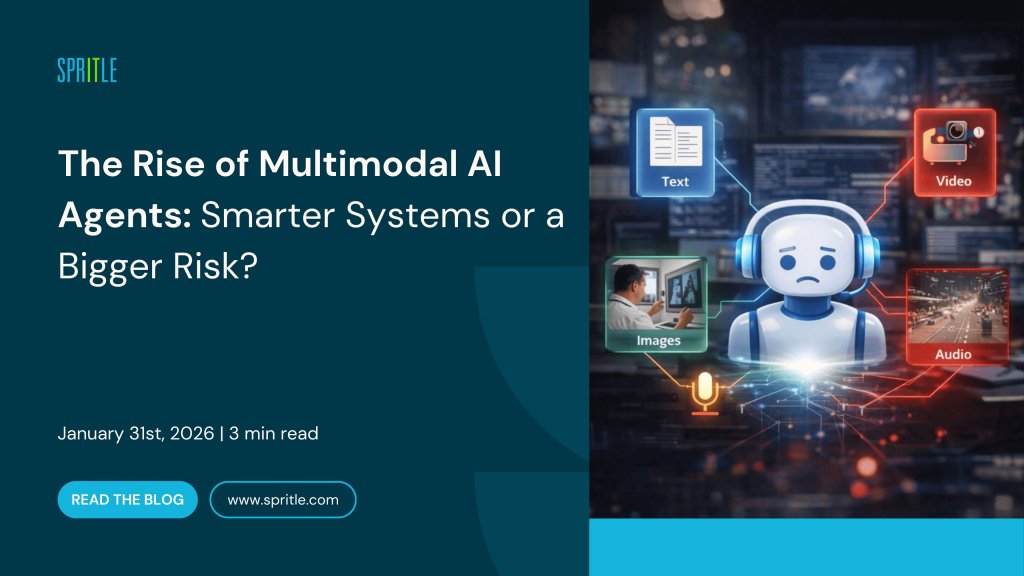
We’re entering the era of Multimodal AI Agents—systems that can see, hear, read, reason, and act across multiple types of data, much like humans do. These agents don’t just process text. They interpret images, analyze video, understand speech, read structured data, and connect everything into a single decision-making flow.
This shift is more than a technical upgrade. It’s fundamentally changing how digital products are built, how businesses operate, and how humans interact with intelligent systems.
But with this new power comes a critical question:
Are multimodal AI agents making systems smarter—or introducing new risks we’re not ready for?
What Are Multimodal AI Agents?
Multimodal AI agents are autonomous or semi-autonomous systems capable of processing and reasoning across multiple data formats at once. These formats typically include:
- 📝 Text
- 🖼 Images
- 🎥 Video
- 🔊 Audio
- 📊 Structured data (tables, logs, metrics)
Unlike traditional AI tools that react to a single input, multimodal agents combine signals from different sources, understand context, plan actions, and execute tasks across systems.
In simple terms:
- They don’t just respond to prompts
- They observe what’s happening
- They reason about what to do next
- They take action using tools and software
That’s what makes them agentic, not just intelligent.
Why Multimodal AI Matters (And Why Text-Only AI Isn’t Enough)
Real-world problems are rarely text-only.
Consider a few everyday scenarios:
- A doctor reviewing medical scans, written reports, lab results, and voice notes from a patient
- A customer support team analyzing screenshots, chat transcripts, payment history, and recorded calls
- An autonomous system navigating a physical environment using visual cues, instructions, and real-time feedback
Text-based AI agents struggle in these situations because critical information lives outside words.
Multimodal AI agents thrive because they can:
- Detect inconsistencies across different inputs
- Make better decisions using richer context
- Reduce manual handoffs between humans and systems
- Lower error rates in complex workflows
As digital environments become more visual, interactive, and data-rich, text-only AI simply isn’t enough.
How Multimodal AI Agents Actually Work
While the technology behind multimodal AI agents is complex, the core architecture follows a clear pattern.
At a high level, these systems combine:
1. Multimodal Foundation Models
These include large language models (LLMs) integrated with:
- Vision models (for images and video)
- Speech and audio models
- Structured data understanding
Together, they allow the agent to interpret different inputs in a unified way.
2. Reasoning and Planning Layers
This layer helps the agent decide:
- What the goal is
- What steps are required
- Which action to take next
It’s what turns perception into decision-making.
3. Tool Use and Execution
Multimodal agents don’t stop at understanding—they act. This involves:
- APIs
- Databases
- Browsers
- Business software
- Internal systems
Through these tools, agents can execute real-world workflows.
4. Memory Systems
Short-term memory helps maintain context during tasks.
Long-term memory enables learning over time.
Together, these components allow an agent to:
- Analyze a chart
- Read an email
- Listen to spoken instructions
- Update software systems
—all within a single workflow.
That’s the difference between an AI model and an AI agent.
Real-World Use Cases Gaining Momentum
Multimodal AI agents are no longer experimental. Adoption is already accelerating across industries.
Enterprise Operations
Organizations are using agents for:
- Automated report analysis
- Dashboard interpretation
- Decision support across departments
This reduces manual analysis and speeds up strategic decisions.
Healthcare
Multimodal AI is transforming diagnostics by combining:
- Medical imaging
- Clinical notes
- Patient conversations
When designed responsibly, this leads to faster insights and better outcomes.
Customer Experience
Modern support agents can now understand:
- Screenshots from users
- Voice complaints
- Chat history
- Transaction data
This creates more accurate, context-aware responses.
E-commerce and Retail
Multimodal systems enable:
- Visual product search
- Smarter recommendations
- Automated post-purchase workflows
Robotics and Autonomous Systems
Here, multimodal AI is essential. Agents must:
- Perceive their environment
- Plan actions
- Execute tasks in real time
Without multimodal intelligence, autonomy simply doesn’t work.
The Challenges Businesses Shouldn’t Ignore
Despite the excitement, multimodal AI agents introduce real and serious challenges.
Higher Computational Cost
Processing multiple data types requires significantly more compute, which increases infrastructure costs.
Data Quality and Bias
Each modality introduces its own bias and noise. When combined, these risks can multiply if not carefully managed.
Reliability in Real-World Conditions
Multimodal systems must perform consistently across unpredictable environments—not just in controlled demos.
Security and Governance Risks
More inputs mean more attack surfaces. Privacy, data leakage, and misuse become harder to control.
Accountability and Human Oversight
When an agent sees, hears, decides, and acts, responsibility becomes harder to trace.
That’s why the most successful deployments today are human-in-the-loop, not fully autonomous.
Smarter Systems—But Only With the Right Design
Multimodal AI agents are not about replacing humans. They’re about augmenting human decision-making at scale.
In practice, this means:
- Clear boundaries on what agents can and cannot do
- Transparent reasoning and observability
- Built-in human checkpoints for critical actions
- Ethical and safety-first design principles
Blind automation is risky. Thoughtful collaboration is powerful.
What’s Next for Multimodal AI Agents?
Looking ahead, multimodal agents will increasingly become:
- Digital coworkers supporting teams
- Operational copilots managing complex workflows
- Intelligent systems coordinating across tools and departments
The companies that succeed won’t be the ones chasing autonomy at all costs. They’ll be the ones designing for trust, collaboration, and accountability.
Final Takeaway
Multimodal AI agents aren’t a distant trend or a futuristic concept. They are the foundation of the next generation of intelligent systems.
They promise smarter decisions, richer context, and more capable automation. But they also demand careful design, strong governance, and human oversight.
The real question isn’t whether multimodal AI agents are coming.
It’s whether we’re building them responsibly.


