

Building AI systems in healthcare isn’t just a technical challenge. It’s a regulatory one.
In most industries, data pipelines focus on:
- Scalability
- Performance
- Cost
In US healthcare, everything revolves around:
- Compliance
- Privacy
- Traceability
If your AI pipeline mishandles patient data, it’s not just a bug, it’s a legal risk.
This is where ADLC (AI-driven software development lifecycle) becomes critical. It ensures that compliance, security, and auditability are built into the system, not added later.
Understanding the Basics: HIPAA and PHI
What is HIPAA?
The Health Insurance Portability and Accountability Act is the primary US law governing patient data protection.
It defines how healthcare data should be:
- Stored
- Processed
- Shared
HIPAA applies to:
- Healthcare providers
- Insurance companies
- Health tech platforms
What is Protected Health Information (PHI)?
PHI includes any data that can identify a patient, such as:
- Names
- Addresses
- Medical records
- Lab results
- Device identifiers
Even partial data can qualify as PHI if it can be linked back to an individual.
Why AI Data Pipelines Are High Risk in Healthcare
AI pipelines typically:
- Ingest large datasets
- Transform and enrich data
- Feed models for predictions
In healthcare, this creates risks like:
- Unauthorized access
- Data leakage
- Lack of traceability
Without proper design, AI systems can easily violate HIPAA.
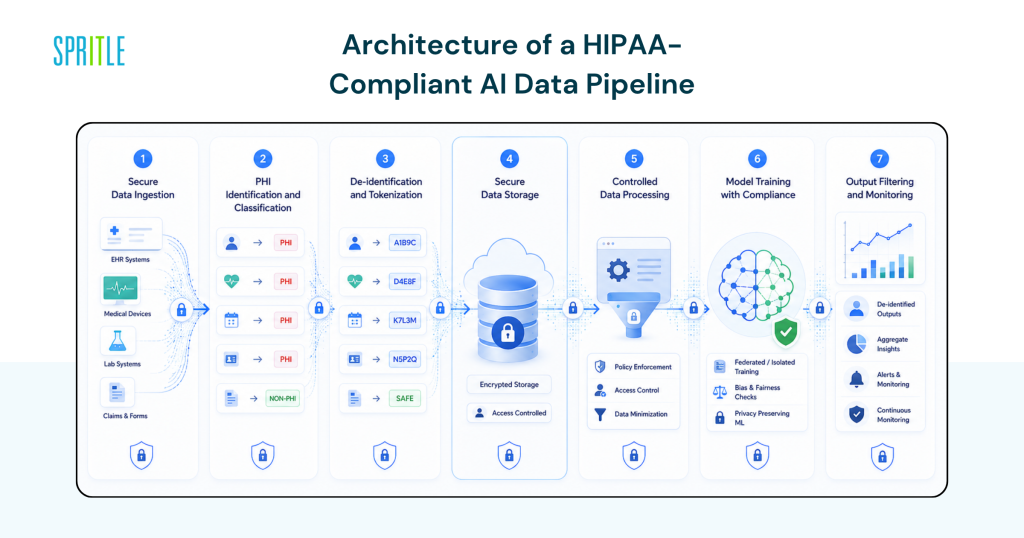
Architecture of a HIPAA-Compliant AI Data Pipeline
A compliant pipeline isn’t just about encryption—it’s about end-to-end control.
1. Secure Data Ingestion
Data enters the system from:
- EHR systems
- APIs
- Medical devices
Best practices:
- Use encrypted channels (TLS)
- Validate data sources
- Apply strict authentication
2. PHI Identification and Classification
Before processing:
- Detect PHI fields automatically
- Tag sensitive data
AI pipelines should include:
- Data classification layers
- Schema validation
3. De-identification and Tokenization
To safely use data for AI:
- Remove identifiers (de-identification)
- Replace with tokens (tokenization)
This ensures:
- Models don’t directly access PHI
- Data remains usable for training
4. Secure Data Storage
HIPAA requires:
- Encryption at rest
- Access control mechanisms
Use:
- Role-Based Access Control (RBAC)
- Attribute-Based Access Control (ABAC)
5. Controlled Data Processing
During transformations:
- Limit PHI exposure
- Use secure compute environments
Examples:
- Isolated processing containers
- Encrypted memory handling
6. Model Training with Compliance
AI models should:
- Avoid memorizing PHI
- Use anonymized datasets
Techniques:
- Differential privacy
- Federated learning
7. Output Filtering and Monitoring
Before exposing results:
- Ensure no PHI leaks in outputs
- Validate responses
This is especially critical for:
- AI assistants
- Clinical decision tools
Audit Logs: The Backbone of Compliance
What Are Audit Logs?
Audit logs track:
- Who accessed data
- When it was accessed
- What actions were performed
They are mandatory under HIPAA.
What Should Be Logged?
Every pipeline must record:
- Data access events
- Data modifications
- Authentication attempts
- System errors
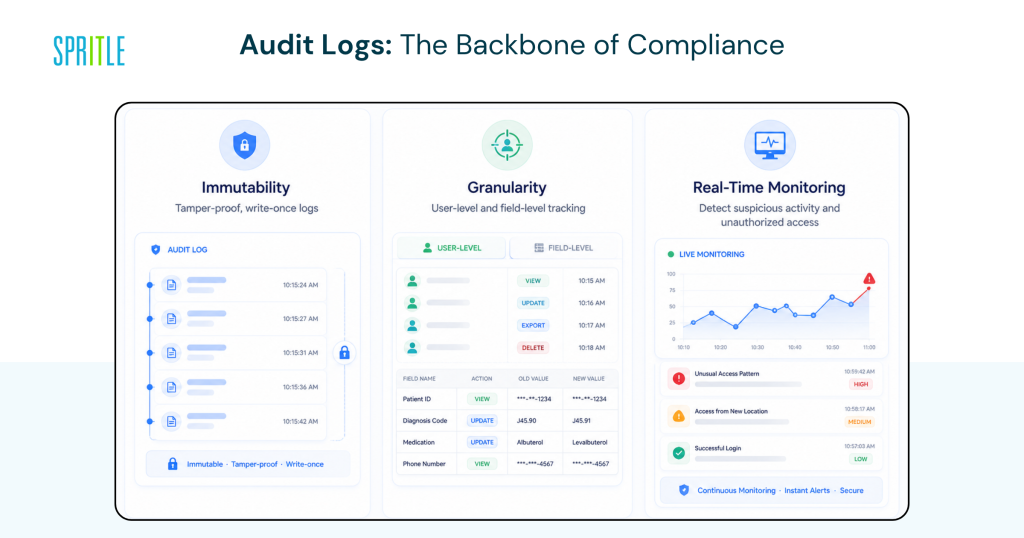
Key Features of Healthcare Audit Logs
1. Immutability
Logs must be:
- Tamper-proof
- Write-once
2. Granularity
Capture:
- User-level actions
- Field-level changes
3. Real-Time Monitoring
Detect:
- Suspicious activity
- Unauthorized access
Example Audit Flow
- Doctor accesses patient record
- System logs:
- User ID
- Timestamp
- Data accessed
- AI model processes anonymized data
- Output is logged and validated
This ensures full traceability.
How ADLC Ensures Compliance by Design
Traditional pipelines:
- Add compliance later
ADLC pipelines:
- Build compliance into every stage
Continuous Compliance Checks
- Automated policy validation
- Real-time alerts
AI Lifecycle Governance
- Track data lineage
- Monitor model behavior
Automated Documentation
- Generate compliance reports
- Simplify audits
Common Mistakes in Healthcare AI Pipelines
Storing Raw PHI in Training Data
Risk:
- Data leaks
- Legal violations
Weak Access Controls
Risk:
- Unauthorized access
Missing Audit Trails
Risk:
- Failed compliance audits
Overlooking Output Leakage
AI responses may:
- Accidentally expose PHI
Best Practices for Building Secure Pipelines
Minimize PHI Usage
Only collect:
- What is absolutely necessary
Encrypt Everything
- Data in transit
- Data at rest
Implement Zero Trust Architecture
- Verify every access request
- No implicit trust
Regular Audits and Testing
- Conduct compliance checks
- Simulate attack scenarios
Real-World Applications
Clinical Decision Support Systems
AI analyzes:
- Patient history
- Lab results
While ensuring:
- PHI protection
Remote Patient Monitoring
Devices send:
- Real-time health data
Pipeline ensures:
- Secure ingestion
- Continuous monitoring
Healthcare Chatbots
AI interacts with patients:
- Answers queries
- Provides guidance
Must ensure:
- No PHI leakage in responses
FAQ
Q: What is PHI in AI pipelines?
A: PHI is any patient-identifiable data that must be protected under HIPAA during collection, processing, and storage.
Q: How do audit logs help in compliance?
A: They provide traceability of all data access and actions, which is required for HIPAA audits and security monitoring.
Q: Can AI models be trained on PHI?
A: Yes, but only with strict safeguards like de-identification, consent, and secure environments.
Q: What is the role of ADLC in healthcare AI?
A: ADLC ensures compliance, security, and governance are integrated into every stage of the AI pipeline.
Conclusion
AI in healthcare is powerful—but also heavily regulated.
To build reliable systems, teams must go beyond performance and focus on:
- Compliance
- Data protection
- Auditability
By integrating these into the AI-driven software development lifecycle, organizations can create AI pipelines that are not only intelligent—but also secure, compliant, and trustworthy.
In healthcare, that’s not optional. It’s essential.


