

Introduction
Most organizations experimenting with AI in software development hit the same wall: promising prototypes, but no consistent impact in production. The reason isn’t lack of models—it’s lack of integration. Without embedding AI into delivery pipelines, insights stay isolated and never influence real releases.
CI/CD is where software becomes real. And if AI isn’t wired into that layer, ADLC remains theoretical.
The AI-driven software development lifecycle only delivers value when AI influences decisions at every commit, build, and deployment. That’s exactly where AI-powered CI/CD steps in—turning the AI software development lifecycle from concept into execution.
Let’s break down how AI transforms CI/CD into the operational backbone of ADLC—and why it’s becoming a priority for engineering leaders.
Why Traditional CI/CD Pipelines Fall Short
CI/CD pipelines were built for speed and automation—not intelligence.
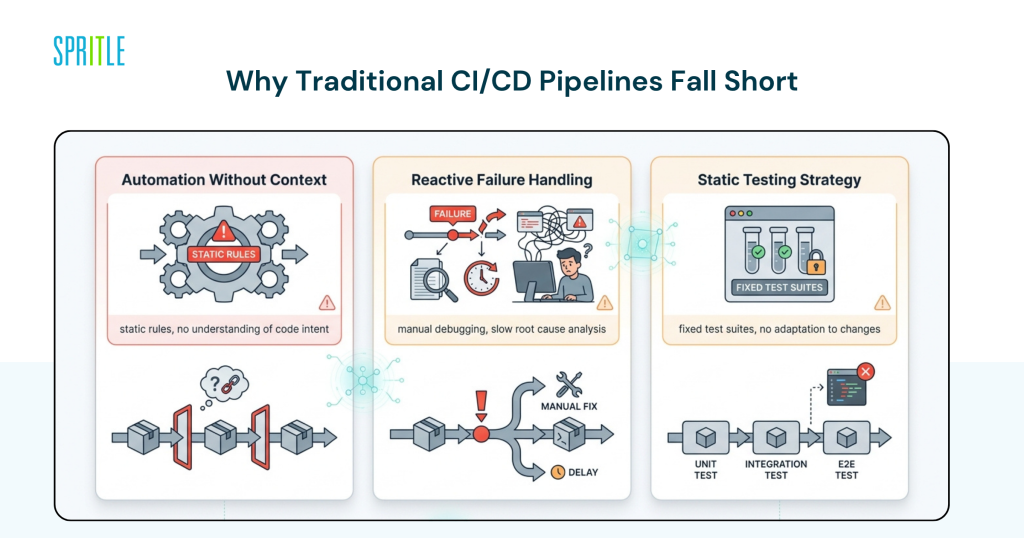
Automation Without Context
Traditional pipelines:
- Run predefined tests
- Trigger builds on commit
- Deploy based on static rules
They don’t:
- Understand code intent
- Predict risk
- Adapt dynamically
This creates a gap between automation and decision-making.
Reactive Failure Handling
When pipelines fail:
- Teams investigate manually
- Root cause analysis takes time
- Fixes are reactive
CircleCI (2023) reports that over 40% of pipeline failures require manual intervention, slowing delivery.
Static Testing Strategies
CI/CD pipelines rely on:
- Predefined test suites
- Fixed coverage strategies
They don’t evolve based on:
- Code changes
- User behavior
- Production feedback
This is where most quality gaps originate.
What AI in CI/CD Actually Means in ADLC
AI in CI/CD isn’t just adding tools—it’s embedding intelligence into every pipeline decision.
Intelligent Build and Test Orchestration
AI analyzes:
- Code changes
- Historical test results
- Risk patterns
Then dynamically decides:
- Which tests to run
- Which components to prioriti
- Production monitoring
- User analytics
- Incident reports
And feeds it back into:
- Testing strategies
- Deployment decisions
This is the core of the AI-driven software development lifecycle—closed-loop intelligence.
How AI Transforms Each Stage of the CI/CD Pipeline
This is where it gets practical.
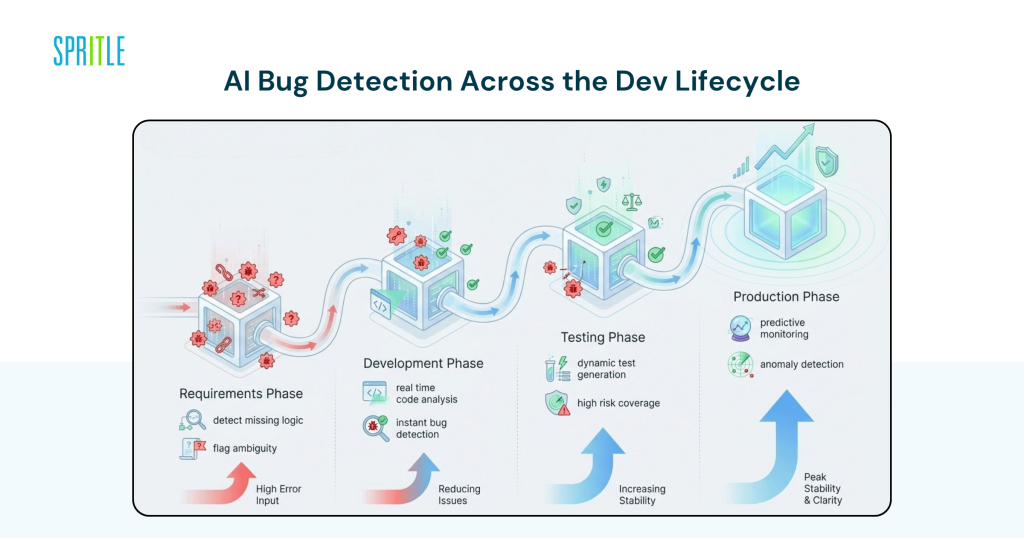
Code Commit Stage: Risk Detection at Source
AI evaluates:
- Code diffs
- Developer patterns
- Known vulnerabilities
Impact:
- Risky commits are flagged early
- Developers receive real-time feedback
Build Stage: Smarter Resource Allocation
AI optimizes:
- Build environments
- Resource usage
- Dependency management
Impact:
- Faster build times
- Reduced infrastructure cost
Testing Stage: Adaptive Test Execution
AI determines:
- Which tests are most relevant
- Where new tests are needed
- Which scenarios are high risk
Forrester (2023) found that AI-driven test optimization can reduce test execution time by up to 40%.
Deployment Stage: Predictive Release Management
AI evaluates:
- Deployment risk
- System dependencies
- Traffic patterns
Impact:
- Safer deployments
- Reduced rollback rates
Post-Deployment Stage: Continuous Learning
AI monitors:
- Application performance
- User behavior
- Error rates
Impact:
- Faster issue detection
- Continuous pipeline improvement
This lifecycle integration is what makes the AI software development lifecycle scalable.
Real-World Examples of AI in CI/CD
1. Netflix’s Automated Deployment Intelligence
Netflix uses AI-driven systems to:
- Analyze deployment risks
- Automate canary releases
Outcome:
- Safer, incremental rollouts
- Reduced production incidents
2. Google’s AI-Enhanced CI Systems
Google integrates AI into its CI pipelines to:
- Optimize test execution
- Detect flaky tests
Outcome:
- Faster builds
- Higher reliability
3. Shopify’s Intelligent Deployment Pipelines
Shopify uses machine learning to:
- Predict deployment outcomes
- Optimize release timing
Outcome:
- Improved release success rates
- Better system stability
These examples show how AI lifecycle management tools operationalize ADLC at scale.
The Business Impact: Why AI in CI/CD Matters
This isn’t just a pipeline upgrade—it’s a strategic shift.
Faster and More Reliable Releases
AI enables:
- Fewer failed builds
- Safer deployments
Resulting in faster time-to-market.
Lower Operational Costs
By optimizing:
- Build resources
- Test execution
- Debugging effort
AI reduces overall development costs.
Improved Developer Productivity
Engineers spend less time:
- Debugging pipeline failures
- Managing infrastructure
And more time building features.
This is why organizations are investing in:
- ADLC consulting services
- Strategies to hire AI development team capabilities
The Challenges of Implementing AI in CI/CD
The honest answer is: integration is complex.
Toolchain Complexity
Modern pipelines involve:
- Multiple CI/CD tools
- Cloud platforms
- Monitoring systems
Integrating AI across them requires expertise.
Data Silos
AI needs:
- Unified data from development, testing, and production
Siloed systems limit effectiveness.
Trust and Adoption
Teams may:
- Question AI decisions
- Resist automated changes
Building trust is critical for success.
How to Implement AI in CI/CD Without Disruption
You don’t need to rebuild your pipeline from scratch.
Step-by-Step Adoption
- Start with AI-assisted test optimization
Integrate AI tools to improve test selection - Introduce predictive analytics in pipelines
Use AI to identify high-risk builds - Adopt AI-driven observability tools
Tools like Datadog and Dynatrace provide insights - Integrate feedback loops across lifecycle
Connect production data back to CI/CD - Leverage expert partners when scaling
ADLC consulting services can accelerate implementation
What High-Performing Teams Do Differently
What separates teams that scale ADLC from those that struggle is execution discipline.
High-performing teams:
- Treat CI/CD as an intelligent system, not just automation
- Continuously refine pipelines using data
- Align engineering metrics with business outcomes
They don’t just deploy faster—they deploy smarter.
What to Look for in an AI-Driven CI/CD Strategy
If you’re evaluating your approach, focus on:
- End-to-end integration across the AI-driven software development lifecycle
- Scalable AI lifecycle management tools
- Real-time feedback loops
- Alignment with reliability and cost goals
The right strategy turns CI/CD into a competitive advantage.
FAQ
Q: How does AI improve CI/CD pipelines?
A: AI enhances CI/CD by predicting failures, optimizing test execution, and dynamically adjusting pipeline decisions based on data, improving speed and reliability.
Q: Is AI in CI/CD only for large enterprises?
A: No. Many AI-powered CI/CD tools are scalable and can be adopted incrementally by mid-sized teams as well.
Q: What tools support AI-driven CI/CD?
A: Tools like Harness CI, GitHub Actions with AI extensions, Datadog, Dynatrace, and Jenkins plugins are commonly used.
Q: How does AI in CI/CD support ADLC?
A: AI in CI/CD operationalizes ADLC by embedding intelligence into every stage of the pipeline, enabling continuous learning and improvement.
Conclusion
AI in CI/CD is not an enhancement—it’s the engineering layer that makes ADLC real. Without it, the AI-driven software development lifecycle remains disconnected from actual delivery.
By embedding intelligence into pipelines, the AI software development lifecycle ensures that every commit, build, and deployment benefits from data-driven decisions. The result is faster releases, lower costs, and higher reliability.
If your team is exploring ADLC, the question isn’t whether to integrate AI into CI/CD—it’s how quickly you can do it effectively. The teams that solve this are the ones turning AI into measurable outcomes, not just experiments.


