
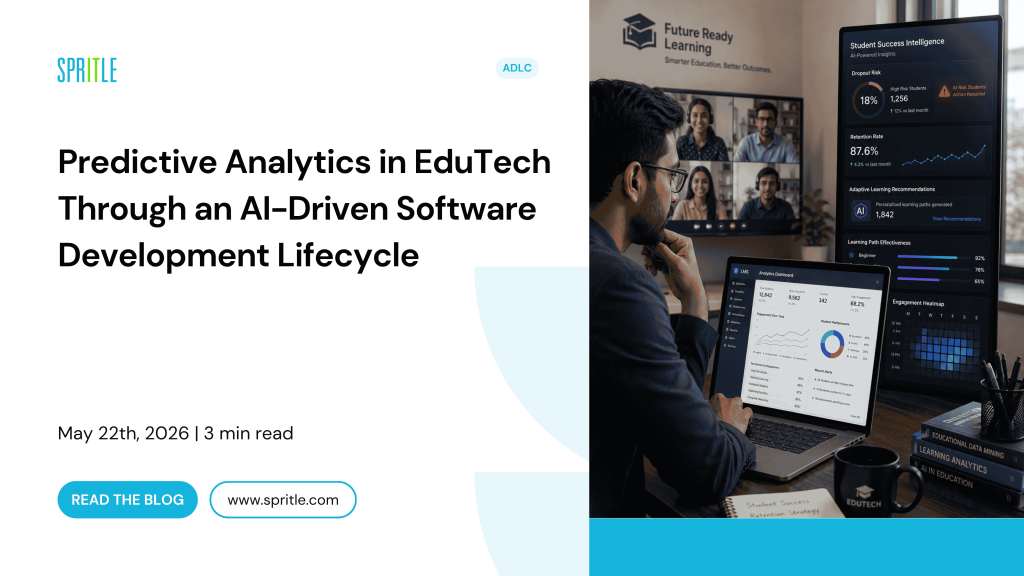
Student retention has become a board-level metric for universities, bootcamps, and enterprise learning platforms. Yet many EduTech companies still struggle with fragmented LMS data, unreliable adaptive models, and FERPA compliance issues that slow releases and increase risk.
This is where ADLC changes the conversation. An AI-driven software development lifecycle gives EduTech teams a structured framework for building predictive analytics systems that connect LMS platforms, personalize learning experiences, and maintain compliance throughout deployment.
The challenge is no longer whether predictive analytics works. The real question is whether your engineering lifecycle can support AI systems safely and at scale.
Why Predictive Analytics Is Becoming Essential in EduTech
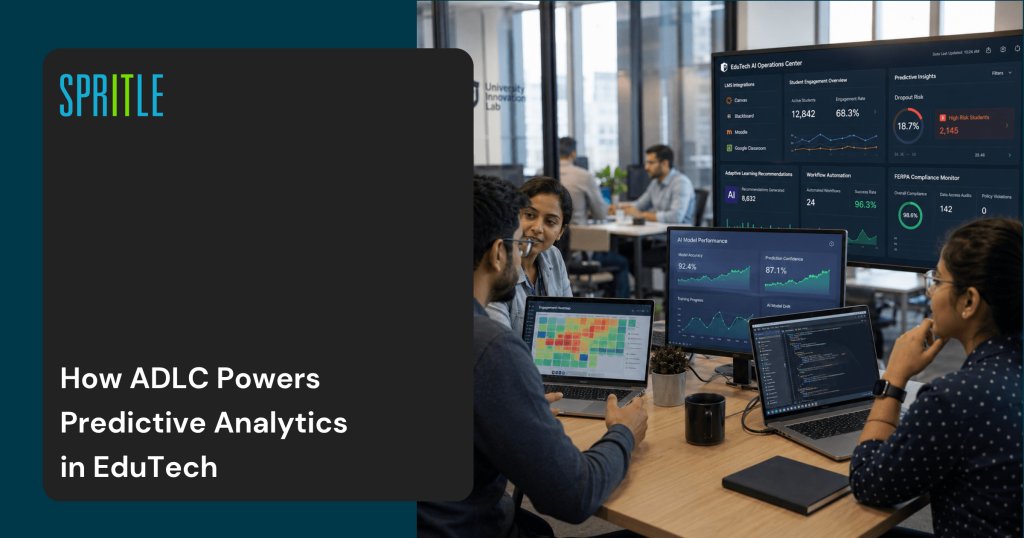
Predictive analytics in education is no longer limited to reporting dashboards. Modern platforms use machine learning to forecast student dropout risk, personalize learning paths, predict assessment outcomes, and automate intervention timing.
According to recent HolonIQ and Gartner education technology reports, AI-powered learning platforms continue to see strong enterprise adoption in 2026 because institutions want measurable retention, engagement, and completion outcomes.
Here’s the problem most CTOs face:
- LMS data exists in silos
- Student engagement signals are inconsistent
- Adaptive models lose accuracy over time
- Compliance reviews delay deployment
- Engineering teams lack AI governance workflows
An AI software development lifecycle solves these issues by integrating data governance, model monitoring, compliance validation, and deployment management directly into the product delivery process.
What Predictive Analytics Means Inside an LMS
In practical terms, predictive analytics combines:
- Historical student performance data
- Real-time LMS interaction tracking
- Behavioral engagement signals
- AI models that generate forecasts and recommendations
Platforms like Canvas LMS, Blackboard, and Moodle increasingly support API ecosystems that allow AI systems to process learner data continuously.
LMS Integrations Fail Without Strong Data Architecture
Most predictive learning initiatives fail before the machine learning layer becomes useful. The main reason is poor LMS integration planning.
Student information systems, learning management platforms, attendance software, and assessment tools generate different data structures. Without normalized pipelines, model accuracy drops quickly.
Recent Gartner research continues to show that poor data quality and fragmented integrations remain among the top reasons enterprise AI projects underperform in 2026.
This is where an AI-driven software development lifecycle becomes critical.
Instead of treating integrations as isolated API tasks, mature ADLC workflows standardize:
- Data ingestion rules
- Schema mapping
- Feature engineering pipelines
- Model retraining triggers
- Audit logging
- Data lineage tracking
What most teams miss is that predictive learning systems require constant coordination between engineering, analytics, and ML operations.
Real-World Example: Georgia State University
Georgia State University became widely recognized for using predictive analytics to improve student retention and graduation rates. Their initiative analyzed hundreds of academic risk indicators to identify intervention opportunities earlier.
The important lesson was not simply that AI improved retention. The university first centralized data coordination across academic systems before deploying predictive models.
That sequencing matters for modern EduTech platforms.
Adaptive Learning Models Require Continuous Governance
Adaptive learning systems are dynamic by nature. Student behavior changes across semesters, programs, and learning formats.
Static models fail quickly in educational environments.
An AI software development lifecycle helps teams operationalize continuous model governance instead of relying on occasional retraining.
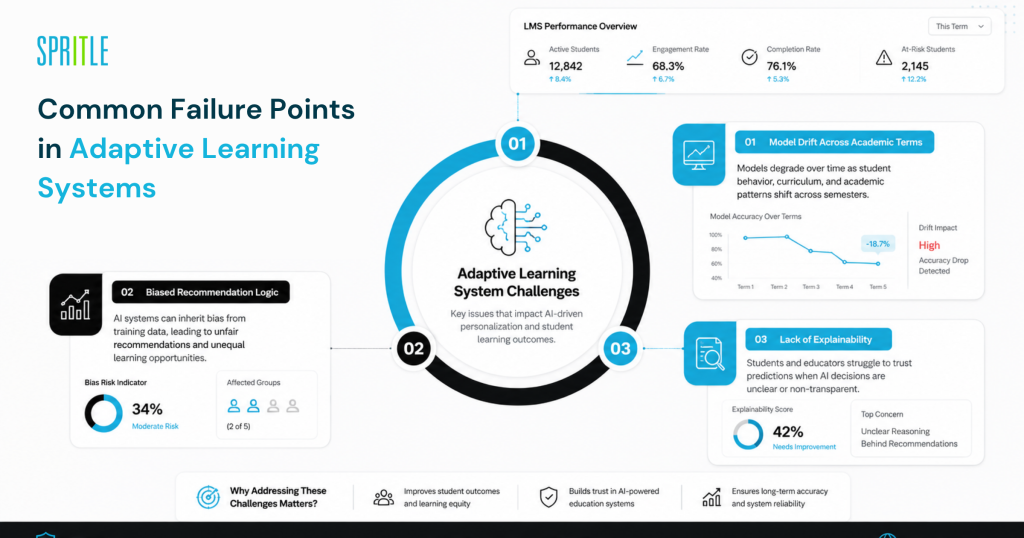
Common Failure Points in Adaptive Learning Systems
Model Drift Across Academic Terms
Changes in curriculum, grading patterns, or remote learning behavior can reduce model reliability within months.
Biased Recommendation Logic
Some adaptive systems prioritize already high-performing learners because training datasets contain uneven engagement signals.
Lack of Explainability
Faculty and administrators often cannot explain why recommendation engines prioritize certain interventions.
That creates trust and compliance concerns.
How ADLC Improves Adaptive Learning Operations
Effective ADLC consulting services introduce governance checkpoints throughout the AI lifecycle, including:
- Drift monitoring thresholds
- Human-in-the-loop approvals
- Model explainability reviews
- Fairness testing pipelines
- Version-controlled deployments
- Automated rollback protocols
Companies like Coursera and Duolingo continuously refine learner engagement algorithms through structured experimentation and monitoring systems.
The platforms succeeding at scale are not the ones with the most advanced AI models. They are the ones with disciplined AI lifecycle operations.
FERPA Compliance Must Be Built Into the Development Lifecycle
Many EduTech companies still treat FERPA compliance as a legal review at the end of development.
That approach creates risk.
Predictive analytics systems process sensitive educational records, behavioral data, and identity-linked engagement patterns. Compliance decisions directly affect architecture design.
According to the U.S. Department of Education, FERPA violations can create reputational damage, legal exposure, and institutional trust issues.
Three Compliance Risks Teams Often Miss
Excessive Data Collection
Many platforms collect unnecessary learner attributes without defining legitimate educational purpose.
Third-Party AI Vendor Exposure
External AI infrastructure providers sometimes retain unclear rights around training data and storage.
Limited Auditability
Institutions increasingly require visibility into how predictive decisions are generated.
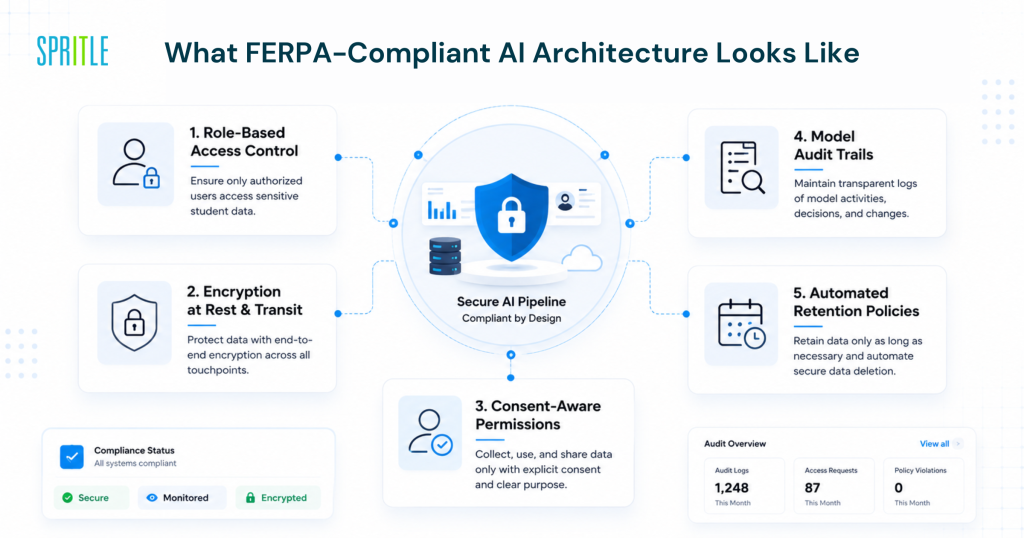
What FERPA-Compliant AI Architecture Looks Like
A FERPA-aware AI-driven software development lifecycle integrates compliance into engineering workflows from the beginning.
That includes:
- Role-based data access controls
- Encryption at rest and in transit
- Consent-aware permissions
- Automated retention policies
- Model audit trails
- Federated learning strategies where appropriate
Teams planning to hire AI development teams for EduTech initiatives should evaluate whether compliance engineering is embedded into delivery workflows or handled separately.
The Business Value of Predictive Analytics Depends on Operational Maturity
Many executives focus only on model accuracy.
That is incomplete.
The real ROI of predictive analytics depends on deployment reliability, adoption rates, and intervention timing.
Recent enterprise AI studies from McKinsey and Deloitte show that institutions with structured AI governance and operational AI workflows achieve better retention outcomes than organizations running disconnected analytics pilots.
Where EduTech Companies See Measurable Returns
Reduced Student Churn
Early-risk identification enables proactive intervention before disengagement escalates.
Improved Course Completion Rates
Adaptive learning recommendations improve progression and learner engagement.
Lower Operational Costs
Predictive alerts reduce manual monitoring workloads for instructors and advisors.
Faster Product Iteration
Structured ADLC workflows reduce delays in deploying AI-enhanced features.
Real-World Example: Civitas Learning
Civitas Learning built predictive student success systems used across higher education institutions. Their analytics frameworks helped schools identify at-risk learners earlier and prioritize interventions more efficiently.
The operational insight was clear: predictive systems only create value when integrated into institutional workflows.
What Separates Scalable EduTech AI Platforms From Experimental Projects
Most AI pilots in education never become durable products.
Not because the models fail, but because operational maturity never catches up.
Organizations succeeding with predictive analytics usually share four characteristics:
- Centralized learner data architecture
- Governance embedded into the AI software development lifecycle
- Continuous adaptive model monitoring
- Compliance integrated into engineering workflows
This is often where external ADLC consulting services become valuable.
Not for generic implementation support, but for building repeatable AI delivery systems that survive scaling pressures, compliance reviews, and evolving learner behavior.
If your roadmap includes adaptive learning systems, predictive engagement engines, or personalized education platforms, the real evaluation question is not whether to adopt AI.
It is whether your engineering lifecycle is mature enough to support it responsibly.
FAQs
Q: How does predictive analytics improve LMS platforms?
A: Predictive analytics improves LMS platforms by identifying at-risk students, personalizing learning paths, forecasting engagement trends, and automating intervention workflows. When combined with an AI-driven software development lifecycle, these systems become more scalable and operationally reliable.
Q: Why is FERPA compliance difficult in AI-powered EduTech systems?
A: FERPA compliance becomes difficult because predictive AI systems process sensitive educational records across multiple platforms and vendors. Engineering teams must manage consent controls, auditability, and secure data operations throughout the AI software development lifecycle.
Q: What role does ADLC play in adaptive learning model deployment?
A: ADLC provides structure for managing model retraining, governance, compliance testing, deployment monitoring, and data pipelines. Without a mature AI-driven software development lifecycle, adaptive learning systems often experience drift and inconsistent recommendations.
Q: What should CTOs evaluate before hiring an AI development team for EduTech analytics?
A: CTOs should evaluate LMS integration expertise, FERPA compliance capabilities, MLOps maturity, governance practices, and experience with adaptive learning systems. Teams offering ADLC consulting services should demonstrate repeatable workflows for secure AI deployment.
Conclusion
Predictive analytics is becoming core infrastructure for EduTech platforms competing on learner retention, personalization, and measurable outcomes. But model quality alone is not enough. LMS integrations, adaptive learning systems, and FERPA compliance all introduce operational complexity that traditional software delivery processes struggle to manage.
An AI-driven software development lifecycle gives engineering leaders a framework for building predictive systems that remain scalable, explainable, compliant, and production-ready in 2026 and beyond. If your organization is evaluating predictive learning initiatives, the right ADLC strategy can reduce risk while accelerating measurable educational outcomes.


