


Introduction
Development timelines are shrinking, but expectations are rising. US engineering teams are expected to ship faster, iterate more often, and still maintain production-grade quality. According to GitHub’s 2025 developer report, over 70% of teams now use some form of AI-assisted coding, yet many still struggle to translate that into real delivery speed.
Here’s the problem. AI tools alone do not fix slow development cycles.
Without a structured system like the AI-driven software development lifecycle (ADLC), AI code generation becomes another disconnected tool instead of a multiplier. When done right, it transforms how your team builds, tests, and ships software. Let’s break down how this actually works in practice.
Where AI Code Generation Actually Fits Inside ADLC
AI code generation is not just about writing code faster. It is about embedding intelligence into every stage of the AI software development lifecycle.
A Clear Definition
AI code generation inside ADLC is the use of large language models and machine learning systems to generate, review, and optimize code within a continuous, feedback-driven development lifecycle.
This is fundamentally different from traditional automation. Instead of isolated tools, you get a connected system where code creation, validation, and improvement happen in one loop.
What Most Teams Miss
Most teams plug tools like GitHub Copilot into their IDE and expect results.
What they miss is integration.
Inside ADLC, AI code generation connects with:
- AI-assisted CI/CD pipelines
- intelligent testing workflows
- automated software lifecycle monitoring
That is where the real gains come from.
Why Development Teams in the US Are Leaning Into This Now
Hiring is expensive. Retention is harder. And speed is now tied directly to revenue.
According to the US Bureau of Labor Statistics, senior developers command salaries well above $150,000. At the same time, McKinsey reports that AI-enabled development workflows can increase productivity by up to 40%.
This creates a clear shift.
The Pressure Points Driving Adoption
- Rising engineering costs
- Competition from AI-native startups
- Demand for faster release cycles
- Increasing complexity in modern software systems
[INTERNAL LINK: AI development lifecycle consulting]
The honest answer is simple. You cannot scale output just by hiring more engineers anymore. You need a smarter system.
How AI Code Generation Reduces Dev Time Without Breaking Quality
This is where it gets interesting. Speed gains are obvious. Maintaining quality is where most teams hesitate.
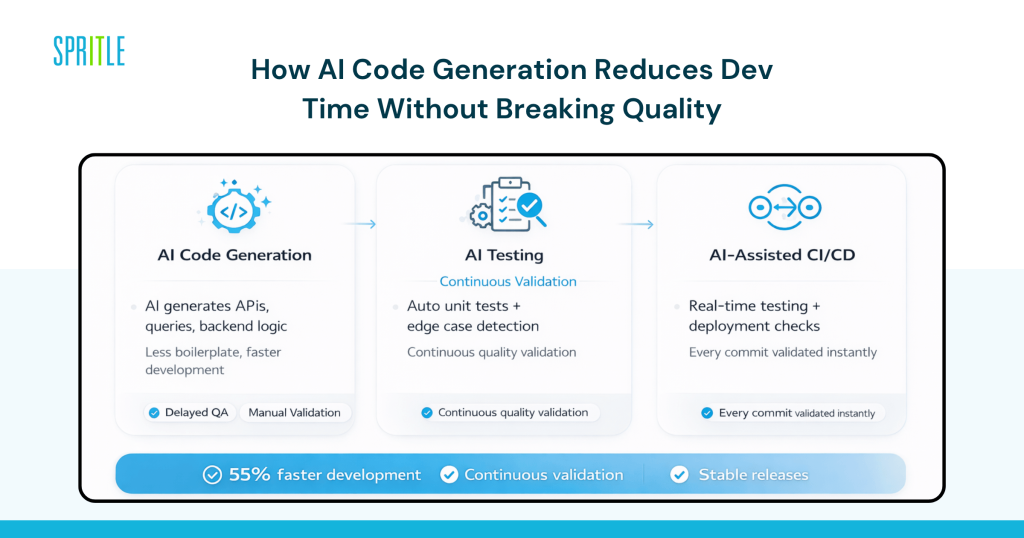
Faster Code Creation Without Manual Overhead
AI tools like GitHub Copilot and Amazon CodeWhisperer generate:
- API endpoints
- database queries
- repetitive backend logic
Developers spend less time writing boilerplate and more time solving real problems.
GitHub reports that developers complete tasks 55% faster when using AI coding assistants.
Built-In Feedback Loops Through AI Testing
AI code generation inside ADLC is tightly connected to intelligent testing systems.
Tools like Diffblue and Codium AI:
- generate unit tests automatically
- identify edge cases
- flag logical inconsistencies
This creates continuous validation instead of delayed QA cycles.
Continuous Validation Through AI-Assisted CI/CD
When AI code generation is integrated into CI/CD, every commit is evaluated in real time.
This includes:
- automated test execution
- performance checks
- anomaly detection
This is what turns a development process into an intelligent development pipeline.
Real-World Examples of AI Code Generation in Action
Microsoft and GitHub Copilot
Microsoft integrated GitHub Copilot across internal teams.
Reported outcomes:
- up to 50% faster code generation
- improved developer satisfaction
- reduced onboarding time for new engineers
This is a clear example of LLM in software engineering at scale.
Shopify’s Internal Developer Acceleration
Shopify has invested heavily in AI-assisted workflows.
Impact:
- faster feature rollouts
- reduced engineering bottlenecks
- improved consistency across codebases
They combined AI code generation with strong review systems, which is key.
US-Based SaaS Team Scaling Without Hiring
A mid-sized SaaS company in Denver implemented AI code generation within an ADLC framework.
Results in under 6 months:
- 35% reduction in development cycle time
- no increase in engineering headcount
- improved release stability
The Hidden Risks Most Teams Underestimate
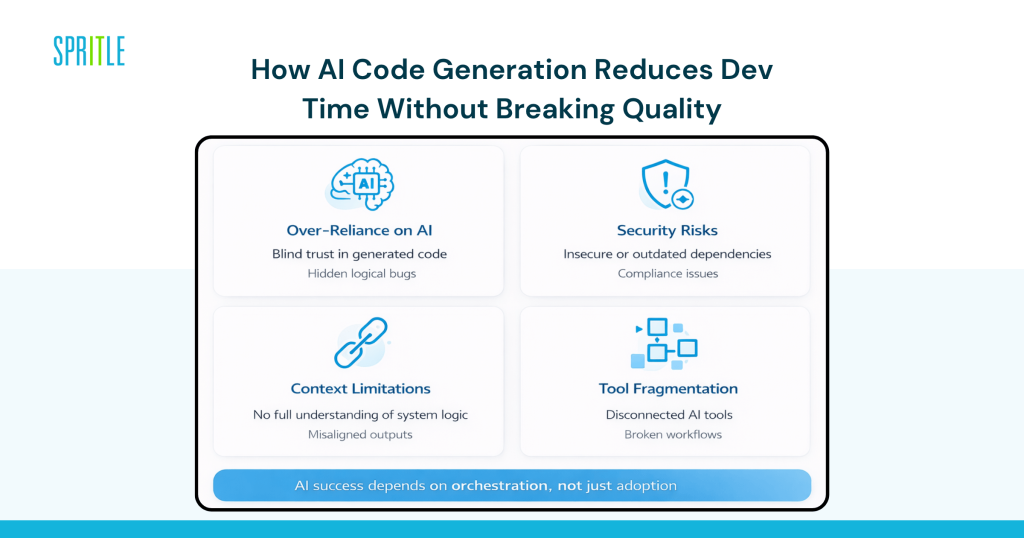
AI code generation is powerful, but it is not risk-free.
Over-Reliance on Generated Code
Developers may accept suggestions without fully validating logic. This can introduce subtle bugs.
Security and Compliance Gaps
AI-generated code can include outdated dependencies or insecure patterns. This is especially critical for fintech and healthcare teams.
Context Limitations
AI does not fully understand your business logic or system architecture. It works on patterns, not intent.
Tool Fragmentation
Using multiple disconnected AI tools can break workflows instead of improving them.
What most teams miss is that success depends on orchestration, not just adoption.
What High-Performing Teams Do Differently
The difference is not the tools. It is how they are used inside the AI-driven software development lifecycle.
1. Treat AI as a System, Not a Tool
They integrate AI across development, testing, and deployment.
2. Maintain Strong Human Oversight
AI accelerates. Engineers validate.
3. Build an Intelligent Feedback Loop
Every output is tested, monitored, and improved continuously.
4. Standardize Workflows Across Teams
Consistency ensures scalability.
5. Measure What Matters
They track:
- development velocity
- defect rates
- deployment frequency
This is where many companies start exploring AI development lifecycle consulting or working with an AI development lifecycle partner.
If you are trying to scale this internally without prior experience, the learning curve can slow you down.
How to Approach AI Code Generation Without Breaking Your Stack
If you are evaluating this for your team, avoid rushing into full adoption.
Start with a structured rollout.
- Identify repetitive coding tasks that consume developer time
- Introduce AI code generation tools in controlled environments
- Integrate with existing CI/CD and testing pipelines
- Establish governance for code validation and security
- Expand gradually based on measurable results
This approach reduces risk while proving ROI early.
If you want to accelerate this process, working with an experienced provider of ADLC services or an AI software development company can help you avoid common pitfalls.
Frequently Asked Questions
Q: How is AI code generation different inside ADLC compared to standalone tools?
A: Inside ADLC, AI code generation is part of a continuous system that includes testing, deployment, and monitoring. Standalone tools generate code, but ADLC ensures that code is validated and improved continuously.
Q: Can AI code generation really reduce development time for enterprise teams?
A: Yes. Most enterprise teams report 30% to 50% faster development cycles when AI code generation is integrated properly into the AI software development lifecycle with testing and CI/CD.
Q: Does AI-generated code compromise quality?
A: Not when implemented correctly. With intelligent testing and AI-assisted CI/CD, quality often improves because code is validated continuously rather than at the end of the cycle.
Q: Should we build this capability in-house or work with a partner?
A: If your team lacks experience with ADLC, working with an AI development lifecycle partner or enterprise AI development solutions provider can significantly reduce implementation time and risk.
Conclusion
AI code generation is not just about writing code faster. It is about redesigning how software is built within the AI-driven software development lifecycle. Teams that integrate it properly are not just saving time. They are improving quality, reducing costs, and scaling output without scaling headcount.
The gap between teams experimenting with AI and those operationalizing it is growing fast.
If your team is evaluating how to make this shift, the right ADLC services or AI-driven development lifecycle services can help you move from experimentation to real impact.


