

Introduction
Here’s the thing companies are generating more data than ever, yet a surprising amount of IT data never makes it into leadership conversations. Dashboards exist, reports are shared, and analytics tools are in place. Still, when decision-makers sit down, IT insights often take a backseat.
This isn’t just a communication gap. It’s a missed opportunity. When IT data in leadership meetings is overlooked, businesses risk making decisions without a full picture.

Let’s break down why this happens and what it really means for organizations trying to scale.
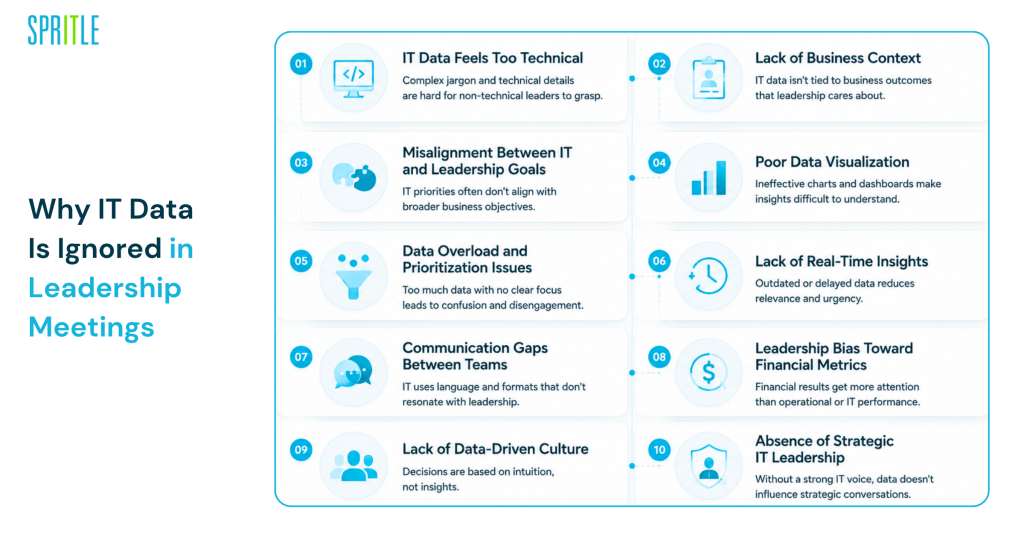
1. IT Data Feels Too Technical
One of the biggest reasons IT data is ignored is simple: it’s hard to understand.
Leadership teams are focused on growth, revenue, and strategy. When IT reports are filled with technical jargon—server uptime, latency metrics, API logs—it creates friction. If the data doesn’t translate directly into business impact, it gets side lined.
What this really means:
If IT teams don’t simplify the narrative, their data won’t influence decisions.
2. Lack of Business Context
Data without context is just noise. Many IT teams present metrics, but they fail to answer one critical question: Why does this matter to the business?
For example:
- Reporting “system downtime” is not enough
- Explaining “downtime caused a 15% drop in customer transactions” changes everything
Without connecting IT insights to business outcomes, leadership sees it as operational detail not strategic input.
3. Misalignment Between IT and Leadership Goals
There’s often a disconnect between what IT measures and what leadership cares about.
- IT focuses on performance, security, and infrastructure
- Leadership focuses on revenue, customer experience, and growth
When these priorities don’t align, IT data in decision-making becomes irrelevant in the eyes of executives.
The gap: IT speaks in systems, leadership thinks in outcomes.
4. Poor Data Visualization
Let’s be honest—no one wants to sit through cluttered spreadsheets or confusing dashboards.
If IT data isn’t presented clearly, it won’t get attention. Leadership meetings are fast-paced, and executives expect insights at a glance.
Common issues include:
- Overloaded dashboards
- Lack of clear KPIs
- No storytelling in data presentation
Good visualization turns complex data into quick insights. Without it, even valuable information gets ignored.
5. Data Overload and Prioritization Issues
Organizations today deal with massive volumes of data. The problem isn’t lack of data ,it’s too much of it.
When IT teams present everything, leadership ends up focusing on nothing.
Why this happens:
- No filtering of critical metrics
- No prioritization of actionable insights
- Too many reports with little clarity
To make IT data relevant, teams need to highlight what actually drives decisions.
6. Lack of Real-Time Insights
Leadership teams rely on timely data to make decisions. If IT reports are outdated or static, they lose relevance.
For example:
- Monthly reports don’t help in fast-moving environments
- Delayed insights reduce trust in data
Modern businesses need real-time IT analytics that support quick, informed decisions.
7. Communication Gaps Between Teams
Even when IT teams have valuable insights, they’re not always communicated effectively.
Common communication issues:
- No direct interaction between IT and leadership
- Data shared via reports without discussion
- Lack of storytelling or explanation
The result: IT becomes a support function instead of a strategic partner.
8. Leadership Bias Toward Financial Metrics
Let’s face it financial data dominates leadership meetings.
Revenue, profit margins, and ROI are always front and center. Compared to that, IT data can feel secondary unless it directly impacts financial performance.
But here’s the catch:
IT data often influences financial outcomes indirectly—through efficiency, security, and customer experience.
When this connection isn’t clear, IT insights are undervalued.
9. Lack of Data-Driven Culture
In some organizations, decisions are still driven by intuition rather than data.
Even with advanced tools, if leadership doesn’t prioritize data-driven decision-making, IT insights won’t matter.
Signs of this issue:
- Decisions made without referencing data
- Reports ignored or skimmed
- No accountability tied to metrics
Building a data-driven culture is essential for making IT data relevant.
10. Absence of Strategic IT Leadership
Finally, the role of IT leadership itself plays a big part.
If CIOs or IT heads are not actively involved in strategy discussions, their data won’t be either.
Strong IT leadership should:
- Translate technical insights into business value
- Advocate for data-driven decisions
- Align IT initiatives with company goals
Without this, IT remains operational—not strategic.
How to Make IT Data Matter in Leadership Meetings
Now the important part fixing the problem.
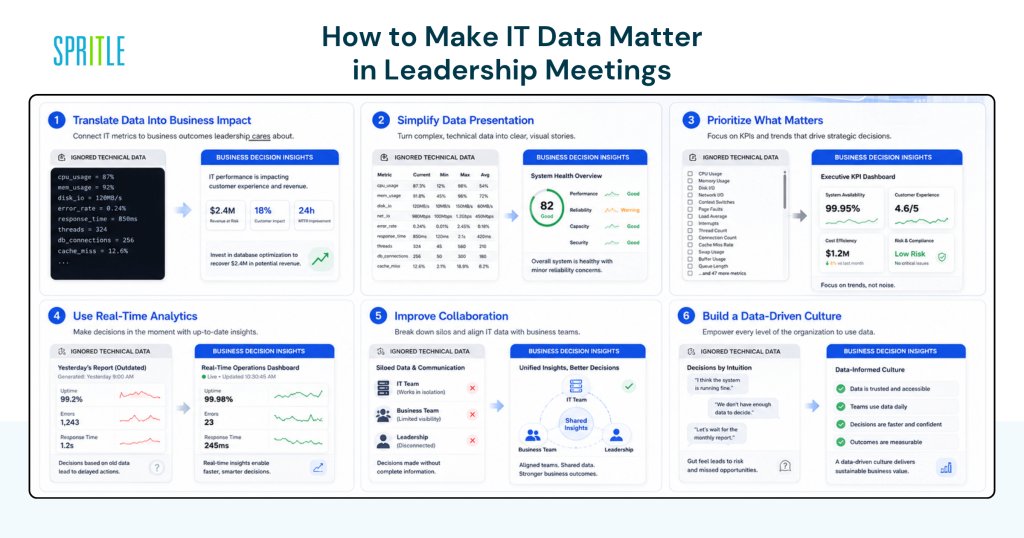
1. Translate Data Into Business Impact
Focus on outcomes, not just metrics. Tie every IT insight to revenue, cost, or customer experience.
2. Simplify Data Presentation
Use clean dashboards, clear visuals, and concise summaries. Make insights easy to grasp in seconds.
3. Prioritize What Matters
Highlight 3–5 key metrics that directly influence business decisions. Cut the noise.
4. Use Real-Time Analytics
Adopt tools that provide live data. Leadership needs insights they can act on immediately.
5. Improve Collaboration
Encourage regular interaction between IT and leadership teams. Data should be discussed, not just shared.
6. Build a Data-Driven Culture
Make data central to every decision. Leadership should expect and demand insights.
Conclusion
Ignoring IT data in leadership meetings isn’t just a minor oversight it’s a strategic risk.
When businesses fail to leverage IT data for decision-making , they miss out on insights that could improve efficiency, reduce risks, and drive growth.
The solution isn’t more data. It’s better communication, clearer context, and stronger alignment between IT and leadership.
Because when IT data is understood and valued, it stops being background noise—and starts becoming a competitive advantage.


