

What No One in ITSM Wants to Admit (But Everyone Is Thinking)
Let’s start with an uncomfortable truth.
Most IT leaders don’t actually choose their ITSM platform.
They inherit a decision culture.
For years, that culture sounded like this:
“If you’re serious about ITSM, you go with ServiceNow.”
No debate. No nuance. No context.
ServiceNow became the safe answer — the checkbox that satisfied boards, consultants, and analysts alike. It symbolized maturity, scale, and “enterprise-grade” credibility.
But something has changed.
Quietly. Gradually. Almost invisibly.
Across mid-market enterprises, global delivery centers, universities, healthcare organizations, and fast-scaling companies, IT teams are asking a dangerous question:
“What if ServiceNow is actually more than we need?”
That’s when ManageEngine ServiceDesk Plus (SDP) enters the conversation — not with hype, but with results.
The ITSM Industry’s Biggest Open Secret
Here’s the truth no vendor presentation will show you:
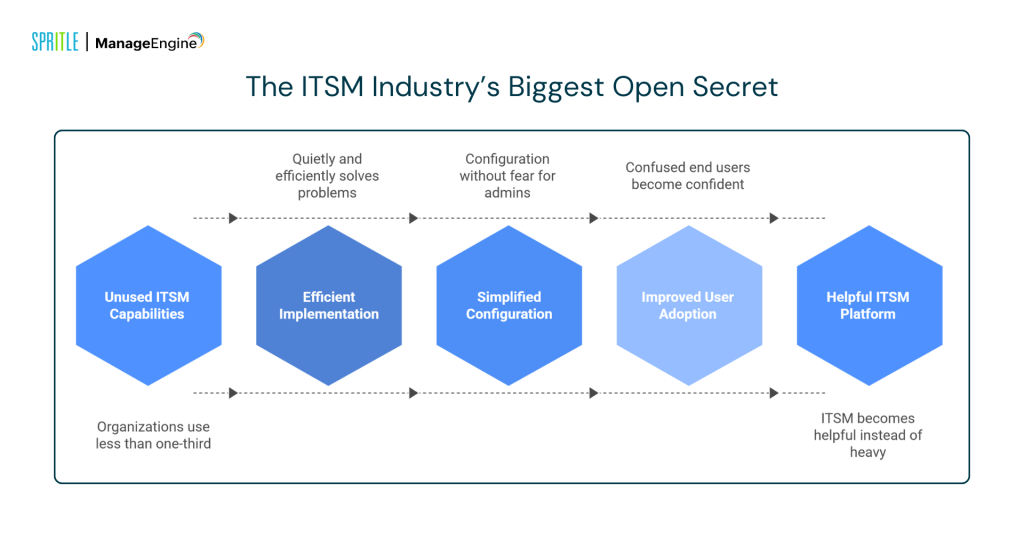
Most organizations use less than one-third of their ITSM platform’s capabilities.
Not because teams are incompetent.
Not because IT maturity is low.
But because complexity kills momentum.
What starts as an “enterprise-grade transformation” often turns into:
- Endless configuration cycles
- Long implementation timelines
- Dependency on external consultants
- Confused end users
- Admins afraid to touch workflows
In short, ITSM becomes heavy instead of helpful.
And that’s the exact problem ManageEngine SDP solves — quietly, efficiently, without drama.
ServiceNow Isn’t the Villain — But It Is Overkill (Sometimes)
Let’s be fair.
ServiceNow is a powerful platform.
It can do almost anything.
But here’s the real issue:
Just because a platform can do everything doesn’t mean your organization should.
Most ITSM teams don’t actually need:
- Deep custom app development
- Highly specialized CMDB modeling
- Enterprise-wide orchestration across dozens of departments
What they do need is simpler and more urgent:
- Faster ticket resolution
- Cleaner change workflows
- Better asset visibility
- Higher end-user adoption
- Clear SLA tracking
- Predictable costs
This gap — between what’s sold and what’s needed — is where ManageEngine SDP shines.
The ManageEngine Philosophy: Practical ITSM
ManageEngine doesn’t sell dreams.
It sells tools that work.
ServiceDesk Plus was built with a simple mindset:
“How do real IT teams operate under real deadlines with real constraints?”
That philosophy is visible across SDP.
1. ITSM That Works on Day One
One of SDP’s most underrated strengths is speed.
You don’t need months just to make it usable.
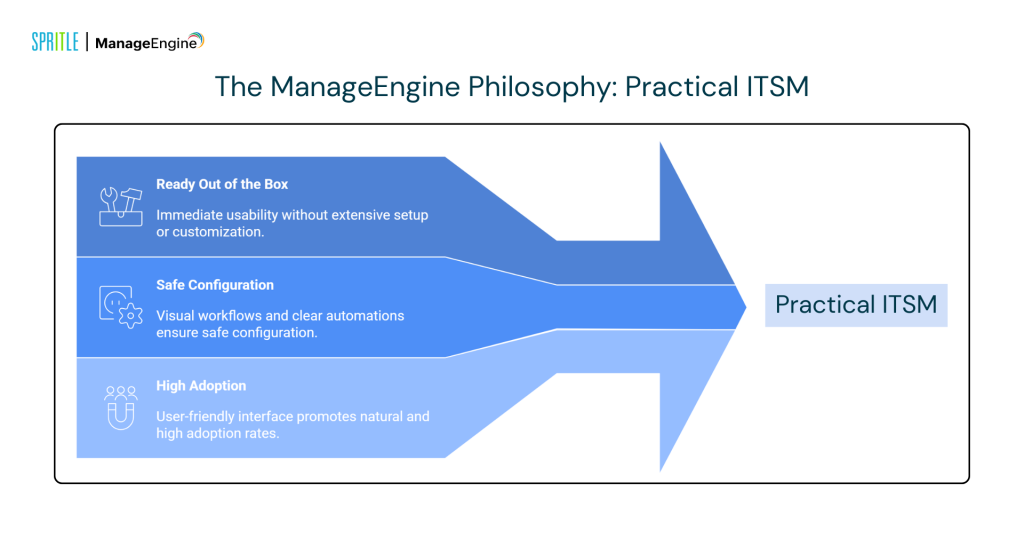
Incidents, problems, changes, service requests, approvals, assets — all come ready out of the box.
You configure what matters.
You don’t rebuild what already works.
For IT teams that don’t want a year-long ITSM project, this is a game-changer.
2. Configuration Without Fear
Let’s talk about admin anxiety — something rarely discussed.
In many enterprise ITSM tools, admins hesitate to change workflows because:
- One wrong update can break dependencies
- Rollbacks are painful
- Documentation is fragmented
- Knowledge lives with consultants
With ManageEngine SDP, configuration feels safer:
- Visual workflows
- Clear rule-based automations
- Understandable triggers and actions
This shifts control back to internal teams instead of external partners.
And empowerment — not features — is what truly accelerates ITSM maturity.
3. Adoption: The Most Ignored ITSM Metric
Here’s a brutal reality:
An ITSM tool users avoid is a failed ITSM tool — no matter how advanced it is.
SDP wins where it matters most:
- Clean interface
- Simple self-service portal
- Logical ticket flows
- Minimal training required
When employees don’t need instructions just to raise a request, adoption happens naturally.
And when adoption is high, everything else improves — SLA compliance, data quality, reporting, and trust in IT.
ManageEngine’s Ecosystem Advantage
Another reason SDP punches above its weight?
It doesn’t operate in isolation.
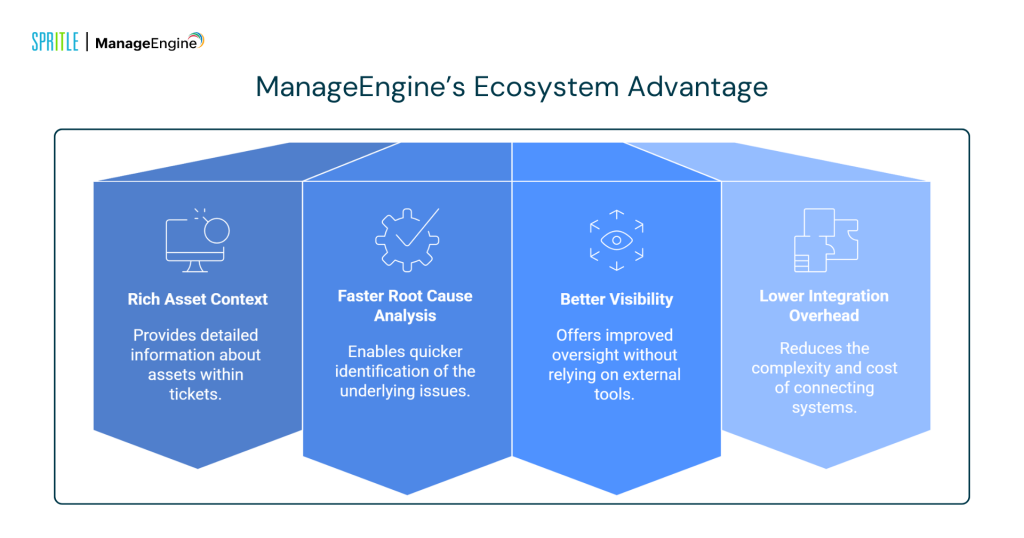
ManageEngine’s ecosystem — endpoint management, monitoring, identity, analytics — plugs directly into ServiceDesk Plus.
That means:
- Rich asset context inside tickets
- Faster root cause analysis
- Better visibility without third-party tools
- Lower integration overhead
ServiceNow can do this too — but often through additional modules, integrations, or cost layers.
SDP’s advantage is built-in, not bolted on.
The Feature Myth That’s Finally Dying in ITSM
For years, ITSM decisions were driven by feature checklists.
The result?
- Bloated platforms
- Underused capabilities
- Overengineered processes
By 2026, this mindset won’t survive.
The new ITSM question is simple:
“Does this platform make our IT team faster and our users happier?”
ManageEngine SDP answers “yes” more often than people expect.
Cost Is Not the Point — Control Is
SDP isn’t winning just because it’s cheaper.
It’s winning because it offers control:
- Control over budgets
- Control over timelines
- Control over configuration
- Control over growth
Lower total cost of ownership is a result, not the goal.
And in uncertain economic climates, control becomes a strategic advantage.
Is ManageEngine SDP a “ServiceNow Killer”?
Let’s be honest.
No — SDP won’t replace ServiceNow everywhere.
But yes — it makes ServiceNow unnecessary for a large percentage of organizations.
And that’s far more disruptive.
It challenges outdated assumptions:
- Bigger is better
- More features equal more value
- Higher cost equals higher maturity
Those beliefs are collapsing — slowly, but decisively.
Final Thought
This isn’t about killing a platform.
It’s about killing an outdated belief:
“If it’s enterprise-grade, it must be complicated.”
ManageEngine SDP proves the opposite.
And that’s why — quietly and consistently —
it keeps winning deals, without making noise.


