

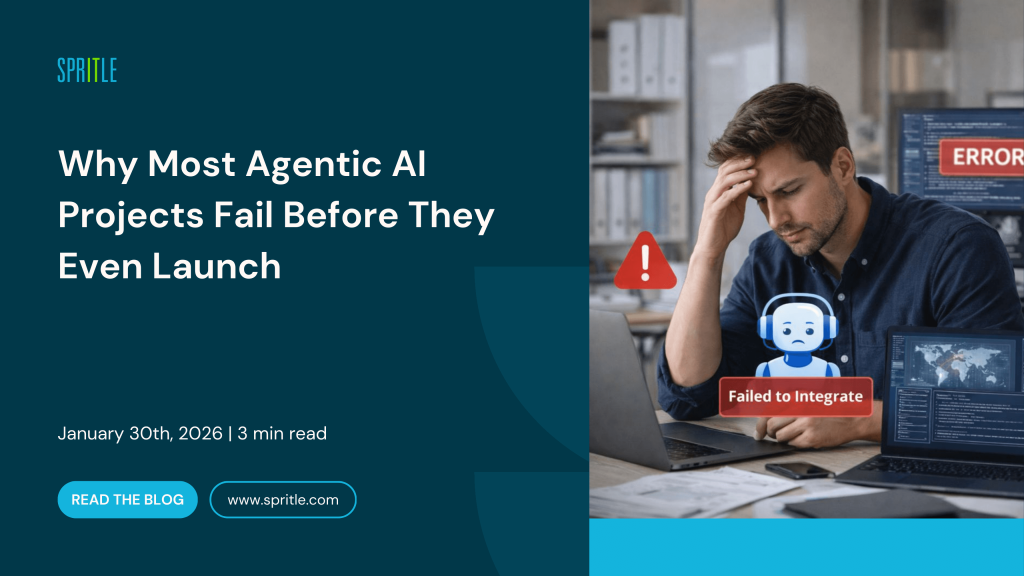
AI agents are rapidly becoming one of the most talked-about innovations in enterprise technology. From autonomous task execution to end-to-end workflow automation, Agentic AI promises to move beyond chatbots and copilots into systems that actually do work.
But here’s the uncomfortable truth:
👉 Most Agentic AI projects fail before they even launch.
Not because the models aren’t powerful enough.
Not because the ideas aren’t ambitious.
They fail because integration is treated as an afterthought.
In this article, we’ll break down why Agentic AI initiatives collapse early, what most teams get wrong, and why APIs and AI integration are the real foundation of successful AI agents.
What Is Agentic AI (And Why Everyone Is Talking About It)
Agentic AI refers to AI agents capable of planning, deciding, and executing actions autonomously across systems. Unlike traditional AI assistants that respond to prompts, AI agents are designed to:
- Execute multi-step tasks
- Interact with tools and platforms
- Monitor outcomes and adjust actions
- Operate with minimal human intervention
In theory, an AI agent could:
- Detect a drop in sales
- Analyze CRM and analytics data
- Create follow-up tasks
- Notify teams in Slack
- Schedule meetings automatically
Sounds powerful, right?
So why do most Agentic AI projects never make it to production?
The Core Reason Agentic AI Projects Fail Early
❌ Over-Reliance on LLMs Alone
Large Language Models (LLMs) like GPT, Claude, or Gemini are incredibly good at:
- Reasoning
- Summarization
- Planning
- Natural language understanding
But LLMs are not connected to your business systems by default.
They can:
- Draft a follow-up email — ❌ but can’t send it
- Suggest updating a CRM record — ❌ but can’t modify it
- Identify trends — ❌ but can’t pull live warehouse data
In short:
🧠 LLMs can think — but they can’t act.
And Agentic AI without action is just another smart assistant.
Why APIs Are the Backbone of Agentic AI
If an AI agent is expected to deliver real business value, it must be able to execute actions in real systems. That’s only possible through APIs.
APIs Enable AI Agents to:
- Pull real-time data
- Trigger workflows
- Update records
- Communicate across tools
- Complete tasks end-to-end
Without APIs:
- No system access
- No automation
- No execution
- No ROI
👉 No APIs = No Agentic AI
What AI Agents Actually Need to Do Their Job
A production-ready AI agent must be able to:
- Query CRMs like Salesforce or HubSpot
- Schedule meetings via Google Calendar
- Create tasks in Jira, Asana, or Notion
- Post updates in Slack or Teams
- Fetch analytics from data warehouses
- Trigger backend workflows
All of this requires secure, reliable API integration.
This is where most AI projects stall — they look impressive in demos but fail in real-world environments.
From Prompt Chains to Real AI Process Automation
Many GenAI tools today rely heavily on prompt chaining — passing text outputs from one step to another.
While this works for experimentation, it breaks down quickly in enterprise use cases.
Why Prompt-Only Systems Fail:
- No guaranteed execution
- No system state awareness
- No error handling
- No observability
- No security controls
Agentic AI requires structured tool usage, not just clever prompts.
That means:
- Defined APIs
- Clear permissions
- Deterministic actions
- Auditable workflows
Without this, AI agents remain theoretical — not operational.
Integration Is the Real Competitive Advantage in Agentic AI
In the Agentic AI era, success won’t come from having the largest model.
It will come from having:
✅ Clean, well-documented APIs
✅ Secure authentication and permissions
✅ Standardized workflows
✅ Observability and monitoring
✅ Safe agent execution environments
Organizations that treat AI integration as a first-class priority will outperform those chasing model upgrades alone.
Because their AI agents will:
- Act, not just advise
- Execute, not just suggest
- Deliver outcomes, not demos
Why Enterprise Agentic AI Needs More Than Intelligence
Let’s be clear:
Agentic AI is not a plug-and-play solution.
It sits at the intersection of:
- AI models
- APIs
- Backend systems
- Security
- DevOps
- Workflow orchestration
Ignoring integration complexity leads to:
- Broken workflows
- Security risks
- Inconsistent results
- Poor adoption
This is why most Agentic AI projects fail before launch — not due to lack of intelligence, but due to lack of execution infrastructure.
How to Build Agentic AI That Actually Works
If you’re building or evaluating AI agents, ask these critical questions early:
- What systems does the agent need to access?
- Are APIs available and reliable?
- Is permission management clearly defined?
- Can actions be audited and monitored?
- Is failure handling built into workflows?
Agentic AI success is less about prompts — and more about engineering discipline.
🚀 Final Thought: Integrate or Stagnate
The future of AI is not passive.
It’s active.
AI agents that integrate seamlessly across your tech stack will redefine how work gets done — from sales operations and marketing automation to finance, HR, and customer support.
But AI agents that can’t act are just glorified assistants.
So if you’re investing in Agentic AI, ask yourself:
👉 Are your AI agents truly connected — or just really smart bystanders?
Because in the world of Agentic AI, the choice is clear:
Integrate — or stagnate.
👋 Let’s Continue the Conversation
Are you exploring AI agents, automation workflows, or enterprise AI integration in your business?
What’s been your biggest integration challenge so far — APIs, permissions, or workflow complexity?
Share your thoughts below or connect with us. We’d love to hear your experience.


