

Introduction
Bug fixing is one of the most expensive and underestimated drains in modern software delivery. A defect caught in production can cost up to 100x more to fix than one caught during development (IBM Systems Science Institute). Yet most teams still rely on reactive debugging instead of proactive detection.
This is where the ADLC (AI driven software development lifecycle) changes the equation. By embedding AI bug detection across every phase, teams reduce rework, accelerate releases, and prevent cascading failures before they happen.
If you’re managing large codebases, distributed teams, or high-velocity releases, the real question isn’t whether to adopt AI-driven bug detection it’s how fast you can scale it effectively.
What AI Bug Detection at Scale Actually Means in ADLC
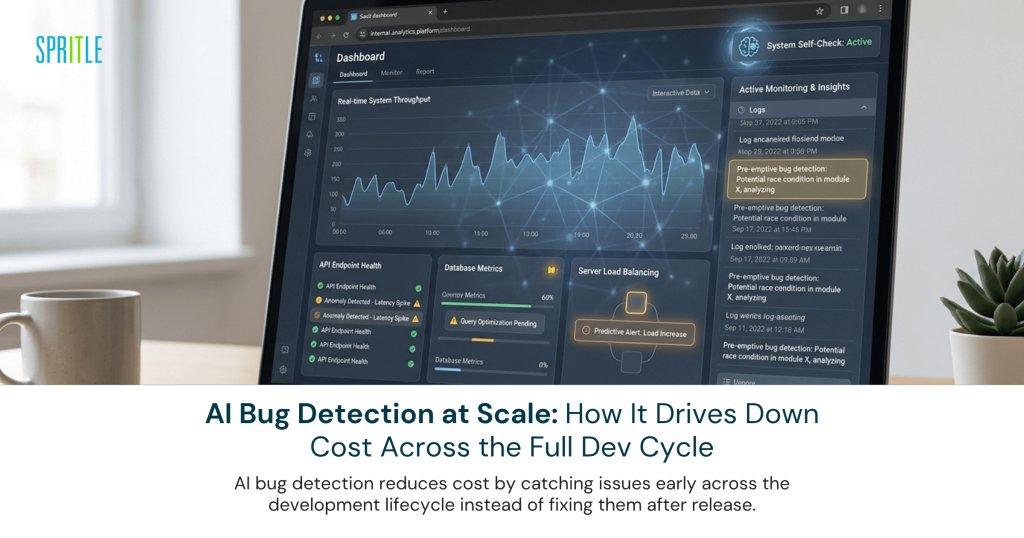
AI bug detection at scale is not just smarter testing it’s continuous, automated defect identification embedded across the AI software development lifecycle.
Unlike traditional QA, which happens late in the cycle, AI driven detection operates in real time:
- During code commits (static analysis + ML models)
- During CI/CD pipelines (automated anomaly detection)
- During runtime (observability + predictive alerts)
This creates a feedback loop where issues are identified, classified, and even suggested for resolution instantly.
How It Differs from Traditional QA Models
Traditional testing:
- Manual-heavy
- Reactive
- Limited coverage
AI-driven testing in ADLC:
- Predictive and proactive
- Learns from historical bugs
- Scales across millions of lines of code
According to Gartner (2024), organizations adopting AI in testing reduce defect leakage by up to 35%.
Where Costs Actually Come From in the Dev Cycle
Most engineering leaders underestimate where bug-related costs accumulate. It’s not just debugging ,it’s everything around it.
Hidden Cost Drivers You’re Already Paying For
- Rework cycles – Fixing bugs across multiple environments
- Delayed releases – QA bottlenecks slow time-to-market
- Production failures – Downtime, SLA penalties, lost trust
- Developer productivity loss – Context switching kills efficiency
- Security vulnerabilities – Late-stage fixes are costly and risky
The National Institute of Standards and Technology (NIST) estimates software bugs cost the US economy over $2.08 trillion annually.
This is exactly where AI-driven detection shifts the cost curve left catching issues before they escalate.
How AI Bug Detection Reduces Cost at Every Stage
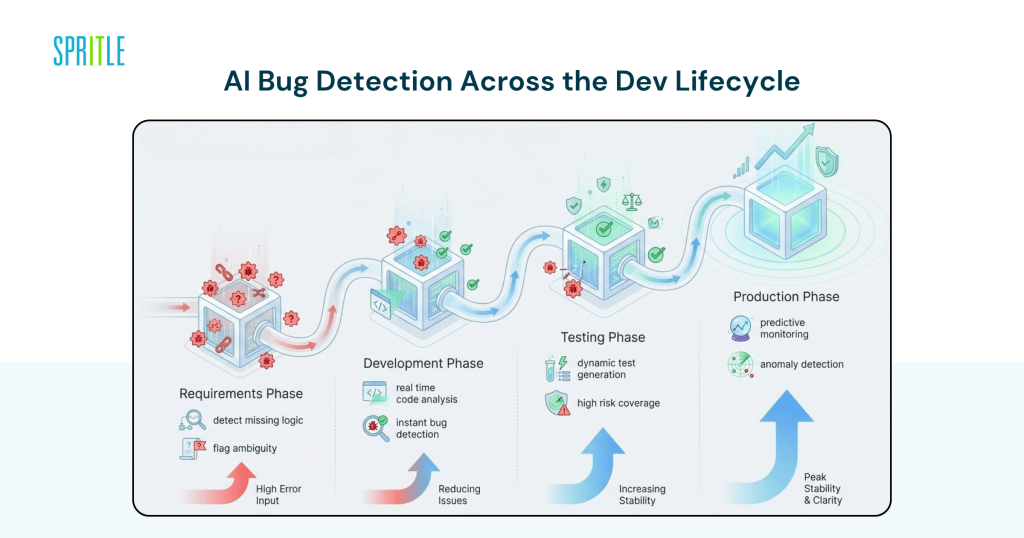
1. Requirements & Design Phase: Preventing Logical Defects Early
AI models analyze historical requirements and identify inconsistencies or missing conditions.
- Detect ambiguous user stories
- Flag conflicting requirements
- Suggest edge cases early
This reduces downstream design flaws ,a major source of expensive rework.
2. Development Phase: Real-Time Code-Level Detection
AI-powered tools like DeepCode (now part of Snyk) and GitHub Copilot analyze code as it’s written.
- Identify syntax and logical errors instantly
- Recommend secure coding practices
- Learn from open-source vulnerability databases
A 2023 GitHub study found AI-assisted coding reduces bug introduction rates by ~30%.
3. Testing Phase: Intelligent Test Coverage Expansion
AI testing tools (e.g., Testim, Functionize) generate and prioritize test cases dynamically.
- Focus on high-risk code areas
- Automatically update tests when code changes
- Reduce redundant test cases
This improves coverage without increasing QA effort—a direct cost win.
4. Deployment & Production: Predictive Bug Detection
AI observability platforms like Dynatrace and New Relic detect anomalies in real time.
- Predict system failures before they occur
- Correlate logs, metrics, and traces
- Trigger automated remediation workflows
Forrester (2024) reports that predictive monitoring reduces downtime by up to 40%.
The ROI Equation: Why CTOs Are Prioritizing AI in ADLC
Here’s the part most teams care about numbers.
AI bug detection doesn’t just improve quality; it fundamentally changes cost structure.
Quantifiable Business Impact
- 30–50% reduction in QA effort (Capgemini, 2023)
- 25–40% faster release cycles
- Up to 60% fewer production defects
- Lower cloud and infrastructure waste due to fewer failures
But the biggest gain? Developer velocity.
When engineers spend less time fixing bugs, they spend more time building features that drive revenue.
Real World Examples: AI Bug Detection in Action
1. Microsoft: AI Driven Static Analysis at Scale
Microsoft integrates AI into its development workflows using tools like IntelliCode.
- Reduced code review time significantly
- Improved consistency across large engineering teams
- Enabled faster iteration cycles
This aligns directly with ADLC principles continuous intelligence embedded in development.
2. Netflix: Predictive Failure Detection
Netflix uses AI-driven observability to detect anomalies in streaming services.
- Prevents outages before users notice
- Reduces incident response time
- Maintains high service reliability
The cost savings from avoided downtime alone justify the investment.
3. PayPal: Automated Testing with AI
PayPal implemented AI-based testing to scale across microservices.
- Reduced manual testing effort
- Increased test coverage across APIs
- Accelerated release timelines
These outcomes mirror what mature ADLC consulting services aim to deliver.
What Most Teams Get Wrong About Scaling AI Bug Detection
Here’s the problem: many teams adopt AI tools but fail to see results.
Why? Because they treat AI as a tool, not a lifecycle strategy.
Common Pitfalls
- Implementing AI only in testing, not across the lifecycle
- Lack of training data for ML models
- Poor integration with CI/CD pipelines
- Ignoring developer adoption and workflow fit
The honest answer is AI bug detection only works when it’s embedded into the AI software development lifecycle, not bolted on at the end.
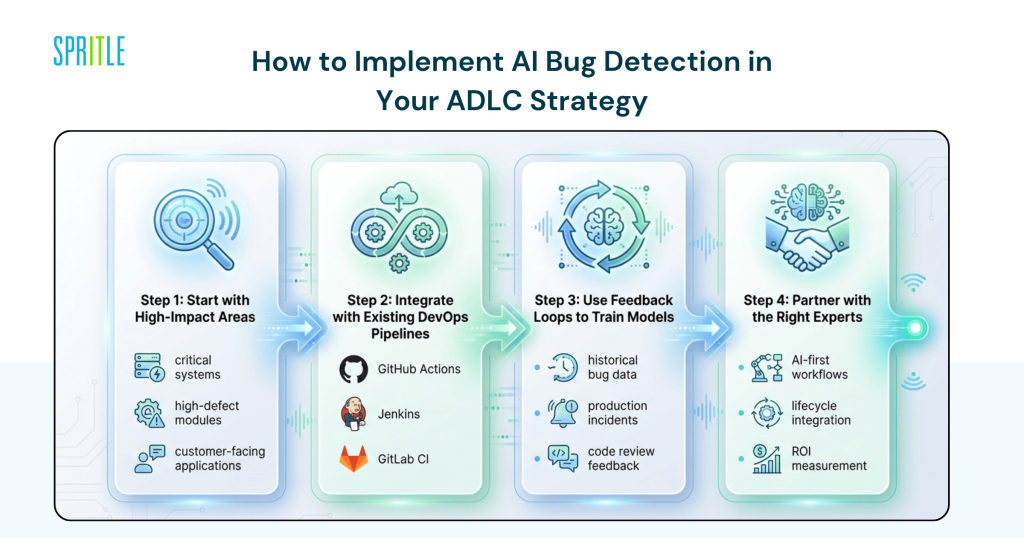
How to Implement AI Bug Detection in Your ADLC Strategy
Step 1: Start with High-Impact Areas
Focus on:
- Critical systems
- High-defect modules
- Customer-facing applications
This ensures immediate ROI.
Step 2: Integrate with Existing DevOps Pipelines
AI tools must work within your CI/CD workflows not outside them.
- GitHub Actions
- Jenkins
- GitLab CI
Seamless integration drives adoption.
Step 3: Use Feedback Loops to Train Models
AI improves over time. Feed it:
- Historical bug data
- Production incidents
- Code review feedback
This makes detection smarter and more accurate.
Step 4: Partner with the Right Experts
Scaling AI across the lifecycle requires more than tools.
This is where hire AI development team or ADLC consulting services becomes relevant. The right partner helps:
- Design AI-first workflows
- Integrate tools across the lifecycle
- Measure ROI effectively
What Separates Teams That Succeed with AI Bug Detection
The difference isn’t budget it’s strategy.
High-performing teams:
- Treat AI as part of engineering culture
- Align AI initiatives with business KPIs
- Continuously refine models and workflows
Teams that fail:
- Deploy isolated tools
- Expect instant results
- Ignore change management
This is where a structured AI-driven software development lifecycle becomes critical it ensures AI is not just implemented, but sustained.
FAQ Section
Q: How does AI bug detection differ from traditional automated testing?
A: Traditional automated testing follows predefined scripts, while AI bug detection uses machine learning to identify patterns, predict defects, and adapt over time. This makes it more scalable and effective in complex systems.
Q: Can AI bug detection fully replace manual QA teams?
A: No. AI augments QA teams by handling repetitive and large-scale detection tasks, but human expertise is still required for exploratory testing, edge cases, and strategic validation.
Q: What is the cost of implementing AI bug detection in ADLC?
A: Costs vary based on tools and scale, but most organizations see ROI within 6–12 months due to reduced defects, faster releases, and lower maintenance overhead.
Q: Which industries benefit most from AI-driven bug detection?
A: Industries with complex, high-scale systems such as fintech, healthcare, SaaS, and e-commerce see the highest impact due to the cost of failures and need for reliability.
Conclusion
Bug detection is no longer just a QA concern it’s a lifecycle wide cost driver. Teams that rely on late-stage testing will continue to pay for rework, delays, and production failures.
AI changes that dynamic. When embedded into the ADLC, bug detection becomes continuous, predictive, and cost-efficient. The result is not just better software, but faster delivery and stronger business outcomes.
If your team is evaluating how to scale development without scaling cost, the right AI software development lifecycle approach and the right partner can make that transition measurable and sustainable.


