
Introduction
Most software failures don’t happen during deployment—they begin with poor requirements.
Recent industry insights show that only around 30–40% of software projects fully succeed, while the majority face delays, cost overruns, or scope issues. Unclear, incomplete, or constantly evolving requirements remain one of the leading causes behind these failures.
If you’re a CTO or product leader, this is familiar territory: shifting stakeholder expectations, repeated revisions, and documentation that becomes outdated before development even begins.
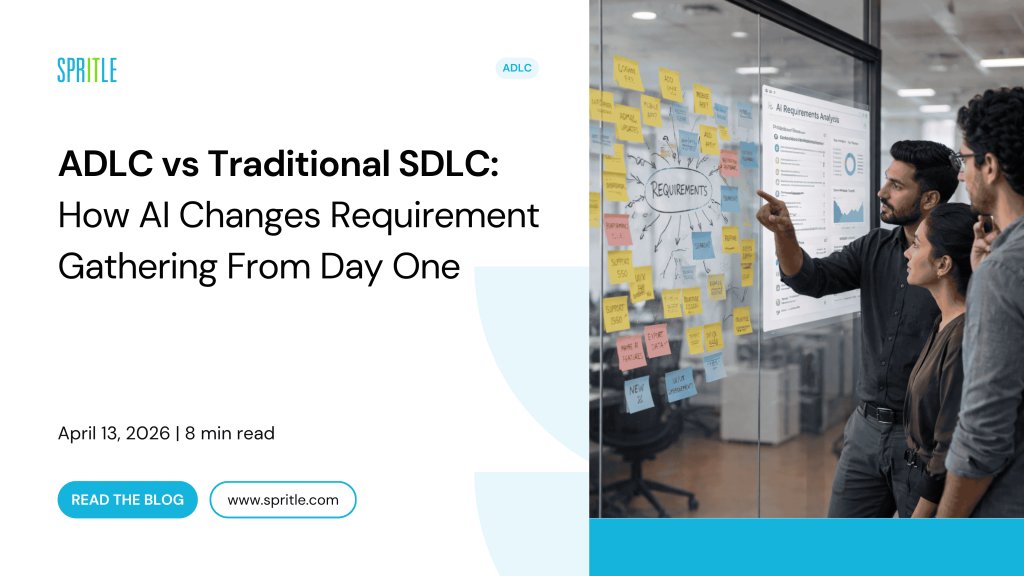
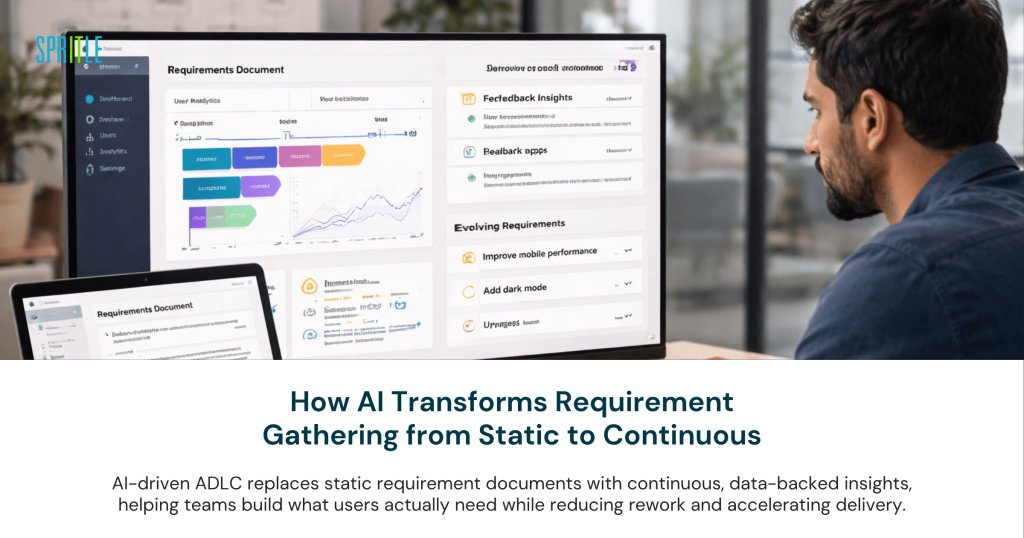
This is where ADLC (AI-Driven Software Development Lifecycle) fundamentally changes the equation. Unlike traditional SDLC, where requirement gathering is static and manual, ADLC introduces continuous, data-driven requirement discovery from day one.
Here’s what that shift really means—and why it’s becoming essential for modern engineering teams.
What is ADLC? (AI-Driven Software Development Lifecycle)
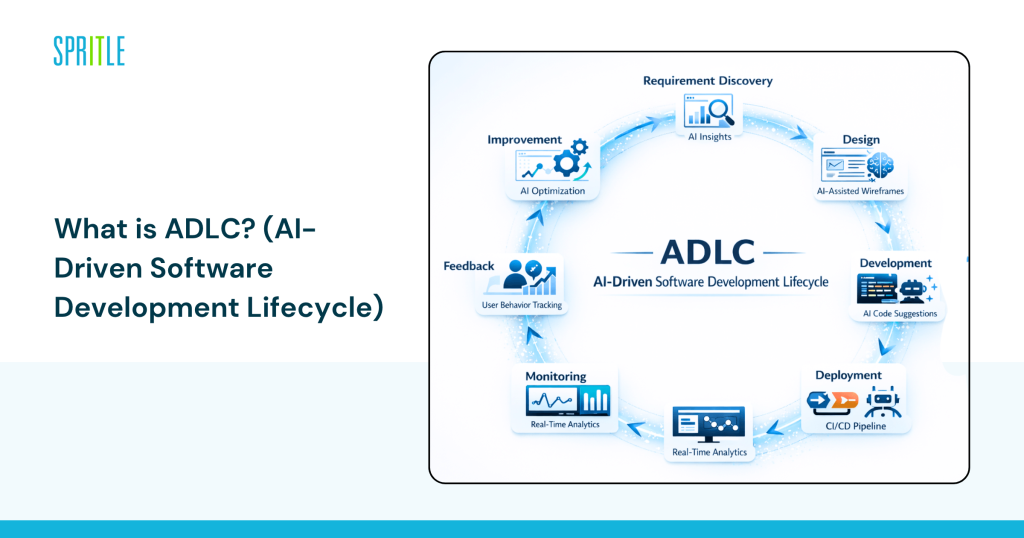
ADLC is a modern approach where artificial intelligence is embedded across every stage of the software lifecycle—from requirement gathering to deployment and optimization.
Instead of relying on static inputs, ADLC continuously learns from:
- Real-time user behavior
- Product analytics
- Customer feedback
- Historical development data
This enables continuous requirement discovery, validation, and improvement.
Key Characteristics of ADLC
- AI-driven requirement discovery
- Predictive feature recommendations
- Automated documentation
- Real-time validation
- Continuous feedback loops
👉 In short, ADLC transforms development from static and reactive → dynamic and predictive.
What is SDLC? (Software Development Lifecycle)
SDLC (Software Development Lifecycle) is the traditional framework used to design, build, test, and deploy software in structured phases.
Typical stages include:
- Requirement gathering
- System design
- Development
- Testing
- Deployment
- Maintenance
It emphasizes upfront planning and documentation, with validation typically happening later in the cycle.
Key Characteristics of SDLC
- Fixed requirement phase
- Documentation-heavy process
- Sequential or iterative models (Waterfall, Agile)
- Late-stage validation
👉 In short, SDLC is structured—but often rigid and slower to adapt.
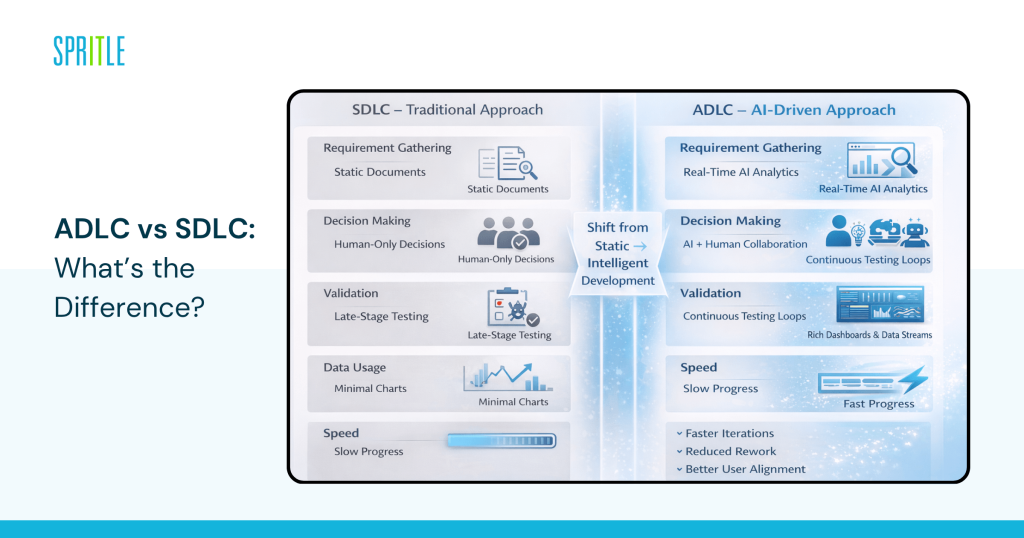
ADLC vs SDLC: What’s the Difference?
| Aspect | SDLC | ADLC |
|---|---|---|
| Requirement Gathering | Static, upfront | Continuous, AI-driven |
| Decision Making | Human-led | AI-assisted + human validation |
| Flexibility | Limited | Highly adaptive |
| Validation | Late-stage | Real-time |
| Data Usage | Minimal | Core to process |
| Speed | Slower | Faster iterations |
Why Traditional SDLC Breaks at the Requirement Stage
Traditional SDLC treats requirement gathering as a front-loaded phase. You document everything upfront, lock it in, and move forward. On paper, it sounds disciplined. In reality, it’s fragile.
The Static Requirement Problem
Requirements in SDLC are often based on:
- Stakeholder assumptions
- Limited user feedback
- Outdated historical data
By the time development begins, user expectations and market conditions may have already changed.
Modern industry research shows that poor requirement clarity can increase rework costs by 25–30%, making it one of the most expensive inefficiencies in software development.
Communication Bottlenecks
Requirement gathering depends heavily on:
- Product managers translating business needs
- Analysts interpreting those needs
- Engineers implementing interpretations
Each handoff increases the risk of misalignment, leading to gaps between what was intended and what gets built.
Late Validation Cycles
In SDLC, validation typically happens during:
- User Acceptance Testing (UAT)
- Beta releases
By this stage, fixing issues is significantly more expensive—both in time and cost.
What ADLC Actually Changes in Requirement Gathering
The shift to ADLC is not just automation—it’s a structural transformation.
Continuous Requirement Discovery with AI
Instead of one-time documentation, ADLC continuously updates requirements using:
- Real-time user behavior
- Product analytics platforms (like Mixpanel and Amplitude)
- AI-powered feedback analysis
This ensures requirements evolve alongside actual user needs—not assumptions.
Natural Language Processing (NLP) for Requirement Clarity
AI-powered tools such as OpenAI APIs, Microsoft Copilot, and Atlassian Intelligence can:
- Convert conversations into structured requirements
- Detect ambiguity
- Suggest missing edge cases
This significantly reduces manual effort and misinterpretation.
Predictive Requirement Modeling
AI doesn’t just document requirements—it predicts them.
Using:
- Historical project data
- Industry patterns
- Behavioral insights
AI can recommend features and improvements before stakeholders even request them.
Industry forecasts suggest that more than half of requirement documentation will be AI-assisted by 2026–2027, marking a major shift in how software is planned.
From Reactive to Predictive: The Business Impact of ADLC
Faster Time-to-Market
With ADLC:
- Validation happens early and continuously
- Fewer development iterations are needed
- Teams can significantly accelerate release cycles when supported by strong data and workflows
Reduced Rework Costs
Because requirements are validated in real time:
- Fewer features need rebuilding
- Engineering effort is optimized
This is especially critical for fast-growing SaaS and digital product teams.
Better Alignment with User Needs
ADLC integrates:
- Customer feedback
- Usage analytics
- Behavioral insights
So teams build what users actually need—not what stakeholders assume.
Real-World Examples of AI-Driven Requirement Transformation
1. Microsoft
Microsoft integrates AI into development workflows using tools like GitHub Copilot and Azure AI.
Outcome:
- Faster requirement-to-code translation
- Reduced ambiguity
- Improved developer productivity
2. Airbnb
Airbnb uses machine learning to analyze:
- Search behavior
- Booking patterns
- User drop-offs
Outcome:
- Data-driven feature prioritization
- Continuously evolving requirements
3. Spotify
Spotify relies on:
- A/B testing
- Real-time analytics
Outcome:
- Requirements validated before full rollout
- Strong data-driven product decisions
The Hidden Challenges of Moving to ADLC
Data Dependency
ADLC depends on:
- High-quality datasets
- Clean analytics pipelines
Without reliable data, AI-driven insights can be misleading.
Tool Fragmentation
Teams often struggle with:
- Integrating AI tools into existing workflows
- Managing multiple platforms
Choosing the right ecosystem is critical.
Organizational Resistance
Transitioning to ADLC requires:
- Cultural change
- New skill sets
- Trust in AI-assisted processes
Resistance can slow adoption.
What High-Performing Teams Do Differently
They Treat Requirements as Living Assets
Requirements are:
- Continuously updated
- Version-controlled
- Data-backed
They Combine Human Judgment with AI
AI suggests. Humans decide.
This ensures:
- Strategic alignment
- Context-aware decisions
They Invest in Expertise
Organizations often:
- Build dedicated AI teams
- Partner with specialized development providers
Because implementing ADLC effectively requires both technical and strategic expertise.
How to Transition from SDLC to ADLC Without Disruption
Step-by-Step Approach
- Start with AI-assisted documentation
- Integrate product analytics tools
- Introduce predictive modeling gradually
- Shift to data-driven decision-making
- Leverage expert guidance where needed
What to Look for in an ADLC Partner
Choose partners with:
- Proven AI-driven development experience
- Strong data engineering capabilities
- Integration expertise (Jira, GitHub, cloud platforms)
- Clear validation frameworks
The right partner doesn’t just implement tools—they transform your workflow.
FAQ
Q: How is requirement gathering different in ADLC vs SDLC?
A: SDLC relies on static, upfront requirements, while ADLC continuously updates requirements using AI insights from real-time data.
Q: Do you need large datasets for ADLC?
A: Not initially. You can start small and scale as your data maturity improves.
Q: What tools are commonly used in ADLC?
A: OpenAI APIs, Microsoft Copilot, Atlassian Intelligence, Mixpanel, and Amplitude.
Q: Is ADLC suitable for all projects?
A: It works best for dynamic, evolving products like SaaS platforms. For stable systems, a hybrid approach is often more practical.
Conclusion
The biggest challenge in software development hasn’t changed:
👉 The gap between what teams build and what users actually need
Traditional SDLC tries to solve this with planning and documentation.
ADLC solves it with data, continuous feedback, and intelligent iteration.
This shift isn’t just about speed—it’s about building the right product from the start.
Teams adopting AI-driven development approaches are already seeing:
- Faster releases
- Reduced costs
- Stronger product-market fit
If your organization is rethinking how requirements are defined and validated, adopting ADLC—or working with the right partner—can turn that process into a long-term competitive advantage.


