

The way we test software is changing — and it’s changing fast. Over the past couple of years, AI has moved from a buzzword in QA discussions to something teams are actively building into their workflows. If you’re working in software quality or engineering, understanding these shifts isn’t optional anymore. It’s part of staying effective.
Here’s a practical breakdown of the 10 AI innovations driving real results in QA today — what each one does, and why it matters.
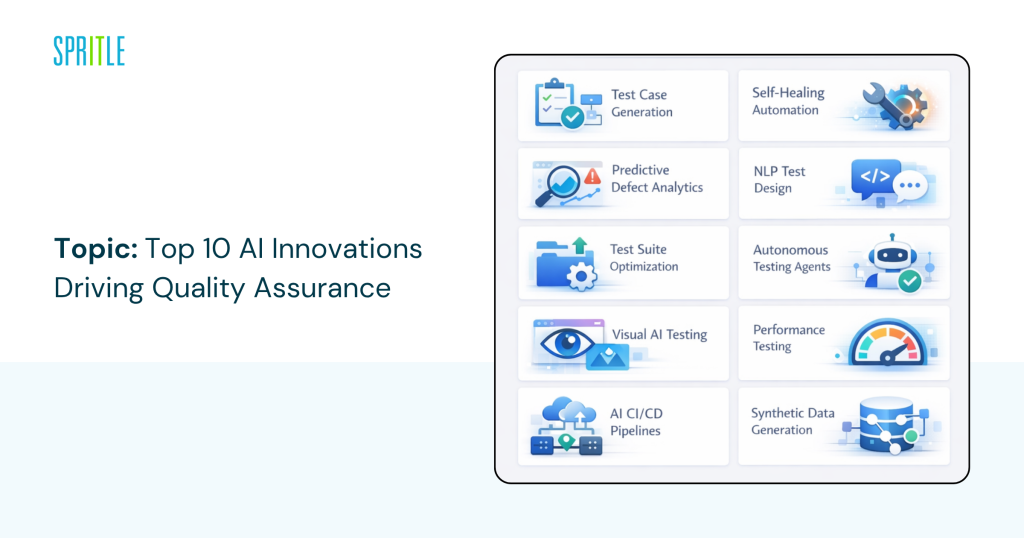
1.AI-driven test case generation
Traditionally, QA teams spend a significant amount of time writing and maintaining test cases. With AI-driven test case generation, this process becomes faster and smarter.
AI can analyze user stories, past defects, and even production logs to automatically generate high-coverage test scenarios. This not only reduces manual effort but also ensures better coverage in shorter release cycles.
As a result, teams can scale testing without increasing team size — making it both efficient and cost-effective.
2.Self-healing test automation
Problem:
Automation scripts often break due to minor UI changes, leading to high maintenance effort.
Solution:
Self-healing automation uses AI to detect changes in elements like selectors, labels, and workflows, and automatically updates scripts.
Outcome:
- Reduces maintenance effort by up to 70%
- Keeps pipelines stable
- Minimizes false failures
3.Predictive defect analytics
Use Case:
A fintech application wants to reduce production defects.
How AI Helps:
AI analyzes historical defects, code changes, and risk areas to prioritize testing.
Outcome:
- Focus shifts to high-risk modules
- Regression becomes smarter
Production defects reduce significantly
4.NLP-based automated test design
- NLP converts plain-language requirements into executable test cases
- Speeds up test creation by up to 80× compared to manual effort
- Bridges the gap between business requirements and QA validation
- Reduces requirement mismatches early in the process
Improves alignment between stakeholders and QA teams
5.Intelligent test suite optimization
- AI removes outdated, redundant, and low-value test cases
- Continuously audits and optimizes test suites
- Reprioritizes tests based on current usage and release priorities
- Speeds up overall testing and execution cycles
- Reduces release cycle time by up to 40%
6.Fully autonomous testing agents
- Agentic AI can select, execute, and manage test scenarios autonomously
- Handles self-recovery from routine test failures
- Provides automated test reporting with minimal human input
- Can manage up to 60% of testing independently
- Frees QA teams to focus on strategy, exploratory testing, and edge cases
7.Visual AI testing for UI quality
| Before AI | After AI |
| Manual UI checks | Automated visual validation |
| Missed UI inconsistencies | Detects layout & rendering issues |
| Time-consuming | Fast & scalable |
| Device-specific bugs missed | Cross-device consistency |
8.AI-powered performance & load testing
AI-driven performance testing simulates real-world user behavior instead of relying on static scripts. This helps teams uncover hidden bottlenecks and performance issues before production.
Key Benefits:
- Detects critical failures faster
- Simulates real traffic patterns
- Provides actionable insights
9.AI-integrated CI/CD pipelines
What if your CI/CD pipeline could decide which tests to run automatically?
That’s exactly what AI does. Instead of running all tests every time, AI selects only the most relevant ones based on code changes and risk. This means faster feedback, fewer delays, and a much more efficient pipeline.
10.Generative AI for synthetic data & test scripts
- Generates high-quality synthetic test data
- Creates tests for rare and complex edge cases
- Expands test coverage up to 4×
- Identifies scenarios typically missed in traditional testing
- Reduces post-release incidents significantly
A practical note on adoption
The most effective teams aren’t adopting all ten of these at once. They’re identifying their biggest friction point, whether that’s script maintenance, test coverage gaps, or slow feedback loops and piloting one or two tools against that specific problem. They measure the outcome, build internal confidence, and scale from there.


